
Livraison le jour même ou le lendemain

Qualité garantie

Débloquez vos offres de bienvenue: Livraison GRATUITE | Jusqu'à -80 % | 30 jours d'essai gratuits à JoyPlus
Téléchargez l'application
An uneven paint line, adhesive marks on a wall or plaster pulled away when the tape is removed can turn a simple renovation into a major repair job. Choosing masking tape for painting is therefore not just about the colour or the price of the roll. Above all, you need to consider the surface, how long the tape will be left in place and its level of adhesion.
Whether you are repainting a room, an exterior wall or a piece of furniture, or adding decorative finishing touches, here are the criteria to check before buying your masking tape.
A very sticky tape is not necessarily the most suitable. On a painted wall, varnished wood or vinyl wallpaper, excessive adhesion can pull away the finish when the tape is removed. Conversely, tape with too little adhesion may allow paint to seep underneath, particularly on an uneven surface.
The level of adhesion should match the surface: low for delicate surfaces, medium for walls and common materials, and higher for brick, concrete or untreated wood.
The claim ‘no residue’ should always be considered alongside the recommended usage time and application conditions. A masking tape described as leaving no residue may be designed to stay in place for a few days indoors, but for much less time outdoors. Sunlight, humidity and temperature changes can affect how the adhesive performs.
Removing the tape within the period recommended by the manufacturer reduces the risk of adhesive residue or paint being pulled away.
A width of 19 or 24 mm is suitable for edges and precision work. To protect a skirting board, joinery or a wider area, a 36 or 48 mm format means fewer strips are needed. However, bear in mind that wide tape does not replace additional protection when paint is sprayed or applied with a roller near a sensitive area.
Before choosing painter’s tape, place your surface in one of the following categories:
The surface must be clean, dry, dust-free and degreased. On a damp or powdery surface, even professional masking tape may lose its effectiveness.
For outdoor use, check for information about UV resistance, as well as the recommended removal time. Exterior masking tape intended to remain in sunlight must offer resistance suited to this exposure. This does not mean it can be left in place indefinitely.
The ScotchBlue Multi-Surface products featured in this selection state that they can be removed cleanly for up to 14 days, including in direct sunlight. ScotchBlue PRO Perfect Finish specifies UV resistance and clean removal for up to 21 days, according to the information provided for the product. These time periods naturally depend on the actual application conditions and the type of surface.
Compare the ratio between length and width, rather than the displayed price of the roll. The formats available in this selection range mainly from 19 to 48 mm in width, with lengths of 41 or 50 m. A narrow roll helps limit overspill around mouldings, while wider tape speeds up the protection of surrounding areas.
For a large project, a multi-roll pack can help prevent interruptions. For a simple touch-up, a 24 or 36 mm roll is usually sufficient.
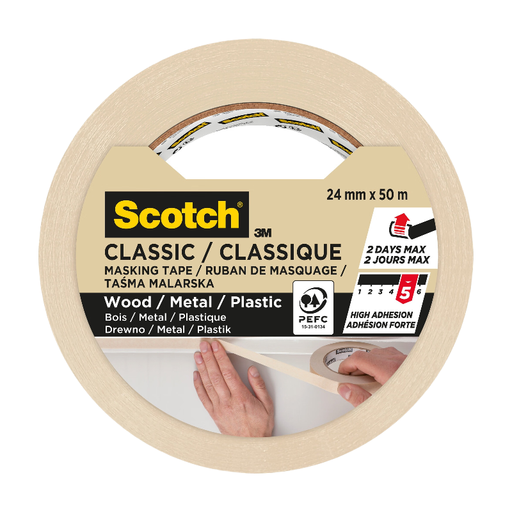
Why this choice suits this profile : With its 24 mm width and 50 m length, this tape is suitable for touch-ups, smooth walls and small decorating jobs where clean lines are essential.
It is designed for smooth surfaces and short applications. According to the product details, residue-free removal is possible for up to 2 days, encouraging you not to delay removing it.
A versatile 24 mm width, a 50 m length and removal designed for undamaged surfaces.
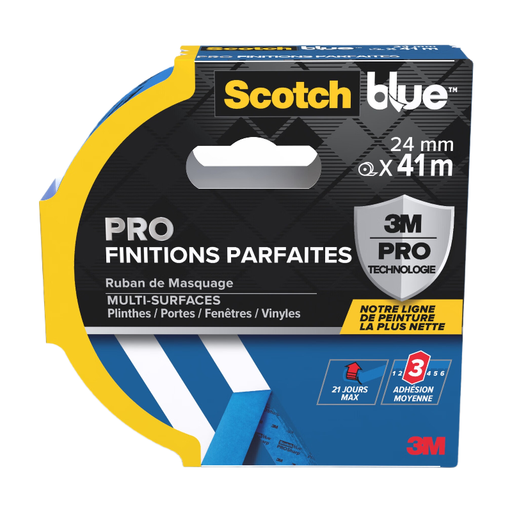
Why this choice suits this profile : This product is aimed at projects where perfectly clean edges are essential, on metal, glass, wood or painted walls, both indoors and outdoors.
The product details mention PRO Edge-Lock+ technology and clean removal for up to 21 days, with adhesion stated as twice as strong as the original Edge-Lock technology.
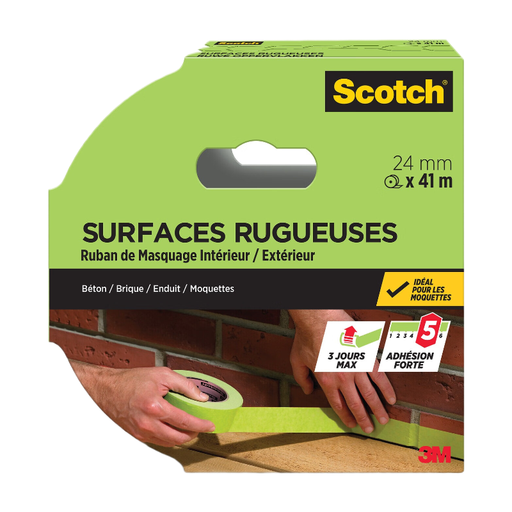
Why this choice suits this profile : Its reinforced adhesive is designed for brick, concrete, roughcast, concrete blocks and untreated wood – common surfaces in renovation projects and on building sites.
It does not claim to be suitable for every application with a universal adhesive: its product details specifically recommend it for rough surfaces and advise removal within 3 days.
24 mm × 41 m format, hand-tearable, suitable for indoor and outdoor use, with strong adhesion stated for rough surfaces.
For particularly fragile surfaces, the purple Scotch Delicate Surfaces tape offers low adhesion and is available in 24 or 36 mm widths, depending on the product. The product details state that clean removal is possible for up to 60 days, but testing it first is still recommended, particularly on wallpaper or a recently applied finish.
We have put together a complete, real-time updated list of products that fully meet these strict selection criteria, as well as European safety regulations.
Choose masking tape for delicate surfaces, with low adhesion, and make sure the paint is sufficiently dry. Always test it first in an inconspicuous area. Remove the tape slowly at a 45° angle, without pulling it perpendicular to the wall.
It depends on the product, the exposure and the surface. The products featured state periods ranging from a few days to several weeks. Standard tape may need to be removed within 24 hours outdoors, while some UV-resistant products state that they can remain in place for up to 14 or 21 days. Always check the packaging before applying the tape.
For edges, mouldings and details, a width of 19 or 24 mm makes positioning easier. The 36 or 48 mm formats are better suited to protecting neighbouring surfaces. However, precision also depends on how well the surface is prepared and the pressure applied to the edges.