
Same-day & Next-day Delivery

Quality Guaranteed

Unlock Your Welcome Offers: FREE Delivery | Up to 80% OFF | Free 30-day JoyPlus trial
Download the APP
Painting masking tape can save you valuable time. But choosing the wrong product can damage the surface, leave adhesive residue or create uneven edges. Whether you are repainting a bedroom, façade or piece of furniture, or creating a decorative finish, the colour of the roll alone is not enough to help you choose the right product.
Here are the main pitfalls to avoid and the criteria to check before you buy.
Masking tape that sticks firmly is not necessarily the most suitable choice. On a freshly painted wall, wooden flooring or vinyl wallpaper, excessive adhesion can pull away the finish. Conversely, tape designed for delicate surfaces may come loose on porous concrete or textured render.
The best approach is to match the level of adhesion to the surface, rather than simply to the type of paint used.
The term residue-free masking tape generally refers to a specific usage period. This may be limited to a few days, vary depending on exposure to sunlight or apply only to indoor use.
Tape left in place for too long may leave an adhesive film, even if its technical specifications promise clean removal under the stated conditions. Make a note of the application date and remove it as soon as the paint is dry to the touch.
Tape suitable for wood, metal and glass is not necessarily suitable for a porous wall or a recently painted surface. Delicate, rough, smooth or UV-exposed surfaces require different properties.
ScotchBlue multi-surface tape is described as offering medium adhesion for indoor and outdoor use. Professional masking tape designed for rough surfaces uses a stronger adhesive to follow uneven areas more effectively.
A width of 19 mm is suitable for details, narrow mouldings and precise patterns. The 24 mm formats are versatile for skirting boards, frames and colour separation. Widths of 36 to 48 mm cover a larger area and help limit splashes during major projects.
To estimate the quantity required, measure each edge to be protected, add the lengths together, then allow an additional 10 to 15%. A 41- or 50-metre roll may be enough for one room. For a complete renovation, a pack containing several rolls will generally be more practical.
For use near a window or outdoors, look for UV-resistant adhesive tape. The ScotchBlue specifications indicate residue-free removal for up to 14 days under certain conditions of direct sunlight exposure. Other low-adhesion products claim up to 60 days, while some Japanese paper masking tapes state UV resistance limited to 7 days.
These time limits do not replace the manufacturer’s instructions. The surface must be clean, dry and dust-free. After applying the tape, press down the edges carefully, generally wait 30 to 60 minutes before painting, then remove the tape slowly at around 45° when the paint is dry to the touch.
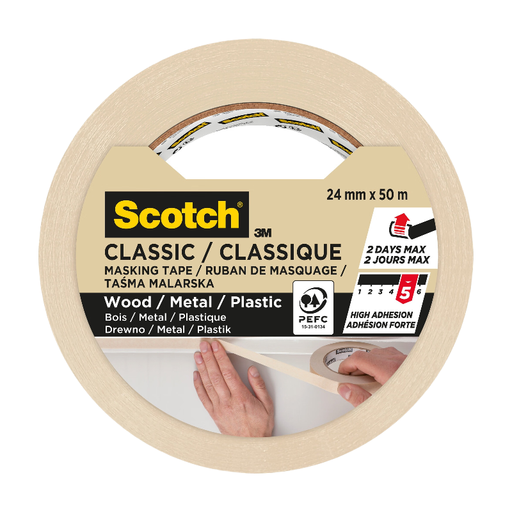
Why this choice suits this profile: Its 50m x 24mm format is suitable for everyday jobs on smooth, well-maintained surfaces, without needing to buy several different products.
The specifications promise clean, residue-free removal if the tape is removed within two days, limiting the risks associated with leaving it in place for too long.
50m length, versatile 24mm width and a design created for perfectly straight lines.
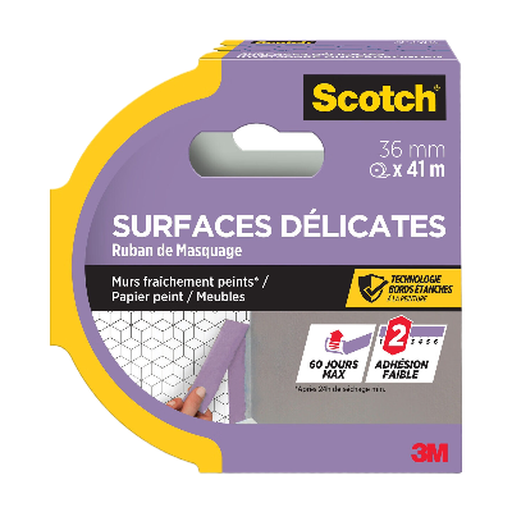
Why this choice suits this profile: Its low-adhesion adhesive is suitable for decorative finishes requiring careful application on parquet flooring, furniture or vinyl wallpaper.
It avoids excessive adhesion on sensitive surfaces and promises residue-free removal for up to 60 days, depending on the stated conditions.
36mm width, stated UV resistance and hand-tear design for clean paint lines.
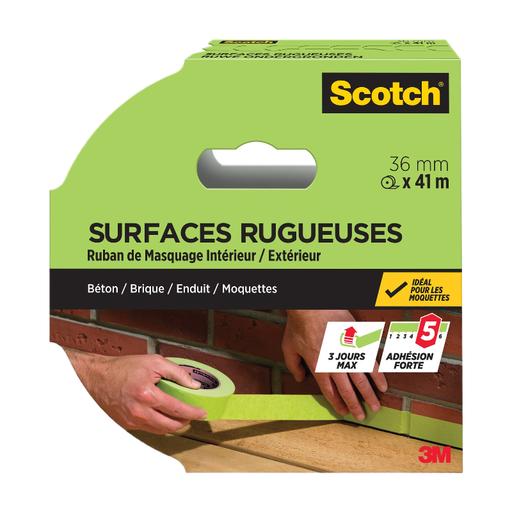
Why this choice suits this profile: It is designed for work on brick, concrete, textured render, breeze blocks and unfinished wood, both indoors and outdoors.
Its reinforced adhesion is suitable for rough surfaces, unlike tape designed only for smooth walls.
41m x 36mm, hand-tear design and clean removal promised for up to three days after application.
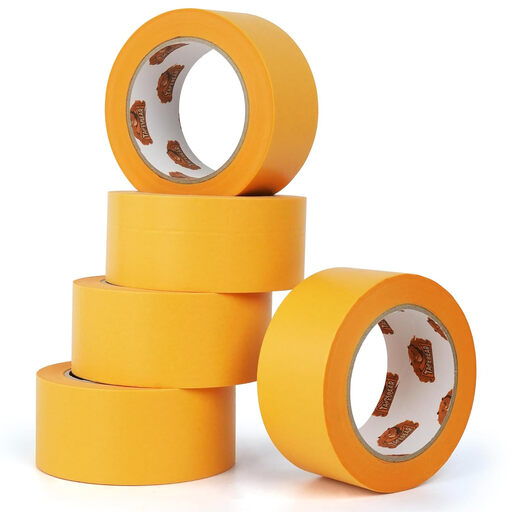
Why this choice suits this profile: This pack of five 50mm rolls is suitable for renovations, multi-colour designs and projects requiring a substantial supply.
The low-adhesion adhesive helps limit the risks on certain delicate surfaces. However, the specifications recommend testing it first and removing it within seven days.
Five rolls, 50m per roll, 50mm width and a washi paper backing with stated UV resistance for up to seven days.
We have put together a comprehensive, real-time updated list of products that meet these strict selection criteria and European safety regulations.
For repairs, choose repair tape or invisible adhesive tape. Scotch Extremium invisible, for example, is presented as suitable for glass and transparent plastic, while Scotch Magic is suitable for repairing paper, envelopes and photographs. These products are not a substitute for masking tape designed for painting.
Choose a low-adhesion product and wait until the paint is sufficiently dry, often at least 24 hours according to the product instructions. Test it in an inconspicuous area before covering the entire surface.
The length of time depends on the product, surface and exposure. Technical specifications may recommend removing standard tape after two days, or specialised products after several days or even several weeks. Remove it as soon as possible once the paint is dry.
The 24mm format is suitable for most jobs. A width of 36 to 48mm provides greater protection for edges and adjacent surfaces. For fine patterns, mouldings and details, the 19mm format makes precise positioning easier.