
Livraison le jour même ou le lendemain

Qualité garantie

Débloquez vos offres de bienvenue: Livraison GRATUITE | Jusqu'à -80 % | 30 jours d'essai gratuits à JoyPlus
Téléchargez l'application
The right painting masking tape can save you valuable time. Choose poorly, however, and it could pull off fresh paint, leave adhesive residue or create uneven edges. Whether you’re working on a wall, skirting board, window or piece of furniture, the result depends less on the colour of the roll than on its adhesion level, the surface you need to protect and how long you leave it in place.
Colour is often used to distinguish different ranges, but it is no substitute for the technical specifications. Purple tape may be intended for delicate surfaces, while a green model is more likely to be designed for brick, concrete or unfinished wood. Before ordering, always check the compatible surface, adhesion level and recommended removal time.
Multi-surface masking tape is practical for painted walls, wood, glass and metal. However, it may be too aggressive for delicate wallpaper, fresh paint or a powdery surface. The term « multi-surface » does not mean « suitable for every surface without precautions ».
Even tape designed for clean removal has a recommended usage period. Depending on the product reference and conditions of use, this can range from a few days to several weeks. Direct sunlight, heat, humidity and the quality of the paint can also affect the result. The longer you wait, the greater the risk of leaving residue or pulling off the paint film.
For interior renovation work, choose your painter’s tape according to the surface you need to protect, not just the price of the roll.
A width of 24 to 36 mm is generally suitable for edges, skirting boards and frames. At 48 to 50 mm, you can protect a wider area from splashes, particularly around window frames or during renovation work.
For details, decorative patterns and small areas, 19 mm clean-line tape is easier to handle. Also consider coverage: a 41 m roll is enough for many household projects, while a five-roll pack of 50 m rolls is better suited to several rooms or a larger job.
The claims « clean removal for up to 3, 7, 14 or 60 days » apply to each product reference and its conditions of use. They do not guarantee the same result on every surface.
For outdoor use or areas near a window, look for clearly stated UV resistance. According to its product specifications, ScotchBlue Multi-Surface Masking Tape can be removed without leaving residue for up to 14 days of direct sunlight exposure. TAPEBEAR Gold claims UV resistance for up to 7 days. In both cases, carrying out a preliminary test is strongly recommended.
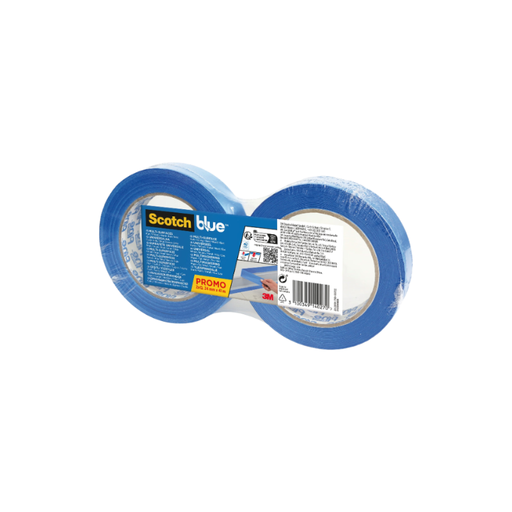
Why this choice suits this profile : With two 41 m x 24 mm rolls, this pack is suitable for small painting jobs on walls, wood, glass and metal.
The specifications identify the compatible surfaces, medium adhesion and a stated removal time of up to 14 days in certain conditions.
A pack of two 24 mm-wide rolls, suitable for indoor and outdoor use.
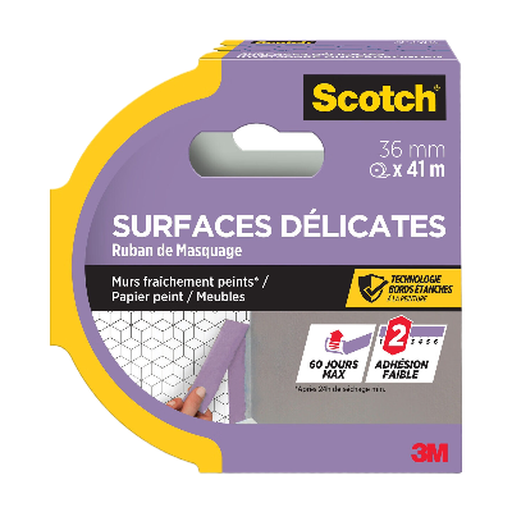
Why this choice suits this profile : Its low-adhesion adhesive is designed for furniture, parquet flooring and vinyl wallpaper, with a width of 36 mm.
Its moderate adhesion helps limit the risk to delicate surfaces, but testing it on an inconspicuous area is still necessary.
41 m roll, stated removal time of up to 60 days and easy hand-tear design.
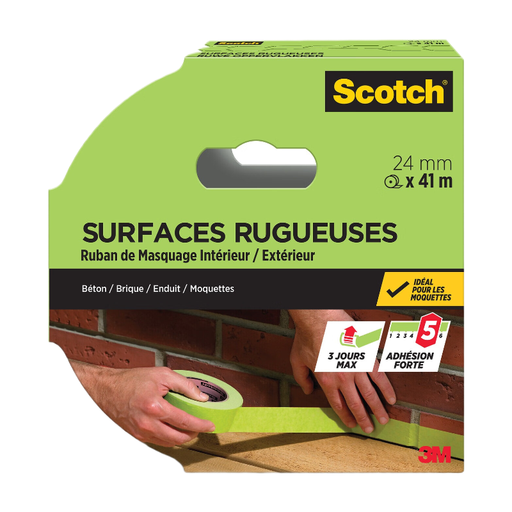
Why this choice suits this profile : Its high adhesion is designed for brick, concrete, textured render, breeze block, unfinished wood and certain carpets.
It does not claim to be suitable for every surface: its intended use is clearly rough surfaces, with removal required within 3 days.
41 m x 24 mm, easy hand-tear design and suitable for indoor and outdoor use.
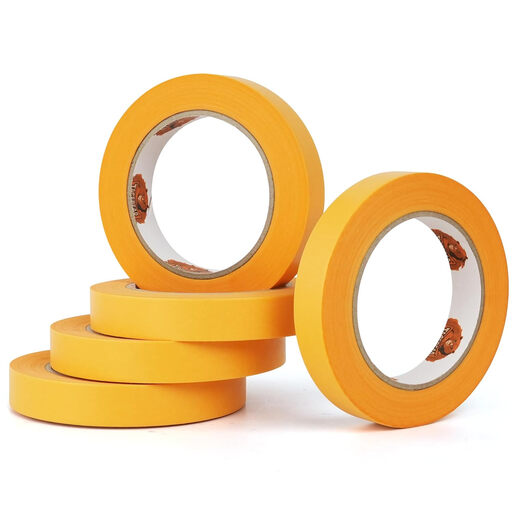
Why this choice suits this profile : Its narrow width makes it easier to work on details, furniture, multicoloured patterns and finishes.
The specifications mention a low-adhesion adhesive and UV resistance for up to 7 days, while recommending a test on sensitive surfaces.
Five-roll pack of 50 m rolls, washi paper and a width of 19 mm.
We have put together a complete, real-time-updated selection of products that meet these exacting selection criteria and European safety standards.
Masking tape for walls cannot replace proper surface preparation. For electrical work, use only a product specifically designed for that purpose: standard masking tape is not an electrical insulator.
Wait until the paint has dried completely, in accordance with the manufacturer’s instructions, then choose low-adhesion tape. Test it beforehand, particularly on matt paint, wallpaper or a recently renovated surface.
It depends entirely on the product reference. Some specifications allow 2 or 3 days, while others allow up to 7, 14 or 60 days under specific conditions. Remove the tape as soon as the paint is touch-dry and never exceed the stated duration.
The most common causes are a dusty surface, an edge that has not been pressed down properly, a layer that is too thick or an uneven surface. On a textured wall, choose tape designed for rough surfaces and press firmly along its entire length.