
Livraison le jour même ou le lendemain

Qualité garantie

Débloquez vos offres de bienvenue: Livraison GRATUITE | Jusqu'à -80 % | 30 jours d'essai gratuits à JoyPlus
Téléchargez l'application
Choosing a hydraulic bottle jack is about more than simply looking at its tonnage capacity, handle or lifting height. Several technical features determine whether it is compatible with your vehicle and how long it will last. Whether you own an SUV, run a garage, transport goods or work in industry, the wrong choice can make the jack unusable, unstable or simply unsuitable for the job.
Here are the key criteria to consider before buying, along with a selection of models suited to different uses.
A 6-tonne hydraulic jack is not automatically suitable for every vehicle weighing 6,000 kg. During lifting, the actual load supported depends on the lifting point used and the distribution of the weight. Always consult the vehicle’s manual and follow the manufacturer’s instructions.
For an SUV or pick-up, a 6-tonne capacity already covers many common requirements. For a lorry, bus or construction vehicle, a 10-tonne hydraulic jack provides a more comfortable margin, provided the lifting point is compatible.
A jack capable of lifting very high can still be unusable if its minimum height is excessive. Measure the distance between the ground and the lifting point when the vehicle is resting normally on its wheels. This is particularly important for SUVs fitted with underbody protection, commercial vehicles and vehicles whose suspension may sag.
The available stroke must also allow you to reach the height needed to position suitable axle stands. A jack must never be used on its own to support a raised vehicle.
Marketing claims are no substitute for a detailed technical specification. Instead, check for features such as a forged steel base, a corrosion-protected piston and a safety valve. The stability of the base, the quality of the welds, the grip of the saddle and the precision of the adjustment should also be assessed.
For an SUV, pick-up or small lorry, the 6-tonne TCE model shown below has a rated capacity of 6,000 kg. For a heavy goods vehicle, bus, construction vehicle or certain industrial machines, a 10-tonne model, equivalent to 10,000 kg, will generally be the more suitable choice.
A heavy-duty bottle jack should nevertheless be selected based on the vehicle’s total weight, the load carried by the axles, the chassis structure and the intended lifting point. Maximum capacity alone does not guarantee compatibility.
A jack’s stroke is generally specified as “minimum height – maximum height”. An adjustable lifting height, provided by an adjustment screw, makes it easier to position the jack before pumping.
The 6-tonne TCE model offers a stated range of 207 to 402 mm. The 10-tonne model covers a range of 222 to 448 mm. These figures must be compared with the vehicle’s actual ground clearance and the height of the lifting point.
A forged steel base provides a rigid platform, while a treated non-slip saddle improves grip at the lifting point. The chrome-plated piston specified on these models is designed to provide better resistance to surface oxidation. It must nevertheless be kept clean and protected from moisture.
The adjustable overload safety valve, also described as an adjustable relief valve, limits hydraulic pressure when the load risks exceeding the rated capacity. Under no circumstances does it allow you to lift a heavier load than the one specified, and it does not remove the need to follow the manufacturer’s instructions.
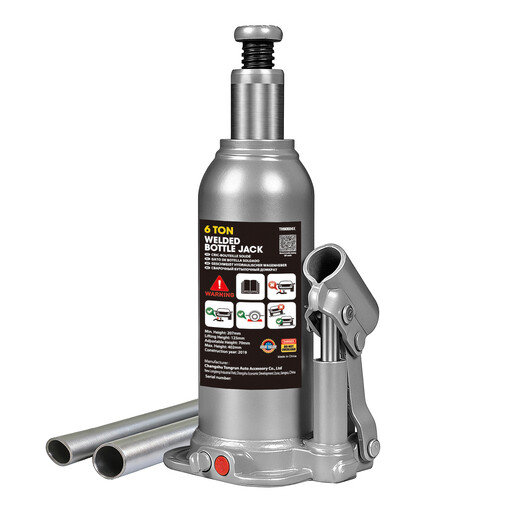
Why this choice suits this profile: With its 6-tonne capacity and 207 to 402 mm range, this model is suitable for motorists looking for a jack for an SUV or small lorry without moving straight to a higher capacity.
The lifting capacity and dimensions are clearly stated, so you are not choosing this jack based solely on a vague marketing description.
Forged steel base, chrome-plated piston, treated non-slip saddle and height-adjustment screw.
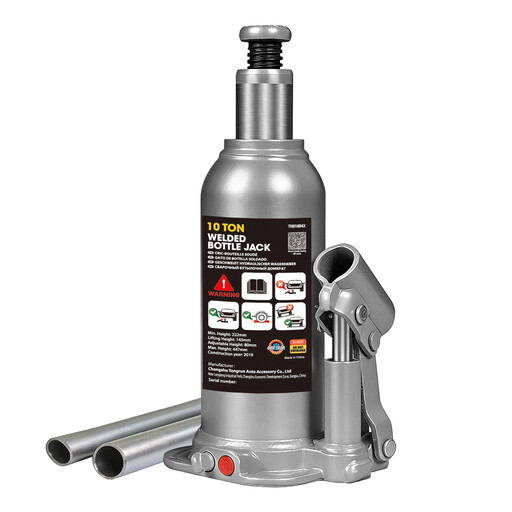
Why this choice suits this profile: Its 10-tonne capacity and stated maximum height of 448 mm provide valuable extra capacity for users working on heavy vehicles.
The specification details the lifting range, capacity and safety features instead of relying solely on the term “industrial”.
10,000 kg capacity, forged steel base, chrome-plated piston and adjustable overload safety valve.
Why this choice suits this profile: Workshops, construction sites and professionals looking for a jack for a lorry or bus can opt for this model, designed for heavy vehicles and certain industrial machines.
Its 222 to 448 mm range lets you check the available height, while the valve and reinforced base address the points to consider for regular use.
Treated non-slip saddle, extended handle, precise screw adjustment and stated 10-tonne capacity.
Before every lifting operation, inspect the piston, welds, saddle and base. Position the vehicle on a flat, sufficiently strong surface, apply the handbrake and use only the lifting points specified by the manufacturer.
A few simple precautions can help reduce the risk of wear and accidents:
Service life depends on how often the jack is used, the load lifted, storage conditions and maintenance. A leak, pitted piston or deformed base should prompt you to stop using the equipment immediately, then have it repaired or replaced in accordance with the manufacturer’s recommendations.
A 6-tonne hydraulic jack may be suitable if its capacity, minimum height and contact point match the vehicle’s specifications. Always check the actual load supported by the axle or the area being lifted.
A 10-tonne jack for lorries and buses may be considered for a heavy vehicle if its lifting height and saddle are compatible. The jack’s maximum capacity does not replace the manufacturer’s lifting procedures or the use of suitable supports.
A manual hydraulic jack does not consume energy during lifting, but it does require regular checks. Cleaning the piston, storing the equipment in a dry place and respecting the rated capacity all help to prevent premature replacement.