
Same-day & Next-day Delivery

Quality Guaranteed

Unlock Your Welcome Offers: FREE Delivery | Up to 80% OFF | Free 30-day JoyPlus trial
Download the APP
A hydraulic car jack can make changing a wheel or carrying out work in the garage much easier. However, you need to choose the right model: insufficient capacity, an excessive minimum height or an impractical design can quickly turn a tool intended to help you into a pointless purchase.
Before placing your order, it is therefore worth looking beyond the marketing claims and focusing on a few practical specifications. A hydraulic trolley jack designed for a small city car will not have the same requirements as a model intended for an SUV, lorry or workshop used every day.
A jack advertised for 3 tonnes does not mean that it can safely lift any 3-tonne vehicle without precautions. You must take account of the vehicle’s total weight, how it is distributed between the axles and the exact location of the lifting point.
For everyday use, the jack’s capacity must remain higher than the load actually supported at the lifting point. Consult the vehicle manual and never exceed the maximum load specified by the manufacturer.
A conventional jack may simply not fit underneath a low vehicle. Conversely, a model with too short a lifting range may not reach the chassis of an SUV or van.
An ultra-low-profile jack with a minimum height of 85 mm will be better suited to low vehicles. For raised vehicles, a maximum height exceeding 450 mm provides more clearance.
Aluminium makes a jack easier to transport, while steel generally provides greater weight and rigidity. The best choice therefore depends on how you intend to use it: storing it in the boot, occasional repairs, frequent transport or intensive workshop use.
Also examine the castors, lifting saddle, handle, lowering valve and whether the jack has overload protection.
Do not simply look at the maximum capacity: the lifting range is just as important. A model ranging from 85 to 380 mm will not meet the same needs as an adjustable jack ranging from 150 to 530 mm. When changing a wheel, focus particularly on the height needed to lift it clear of the ground, taking the position of the lifting point into account.
A wide saddle can improve stability, provided it is positioned exactly on the point specified by the manufacturer. A rubber base or saddle can help prevent marks on the vehicle, but it can never replace correct positioning.
The ground must be hard, level and stable. Avoid gravel, slopes and soft surfaces. Whenever you work underneath the vehicle, fit suitable axle stands: a hydraulic jack must never be used on its own as a support during repairs.
Some models in this selection mention EN 1494 certification as well as CE marking. Check this information on the product page and in the documentation. It does not remove the need to follow the manufacturer’s instructions, observe the rated capacity and comply with safety rules.
For a professional hydraulic jack, also check the availability of spare parts, the length of the warranty, servicing requirements and whether the model is suitable for how frequently you intend to use it.
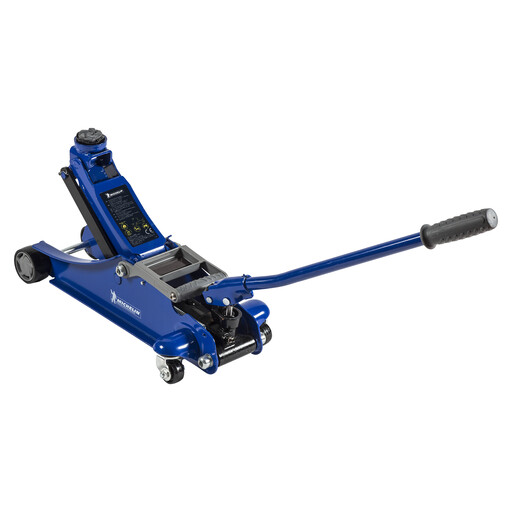
Why this choice suits this user: With a capacity of 1 800 kg and a lifting range of 105 to 350 mm, this model is suitable for many passenger cars. It is up to the job of changing a wheel or carrying out routine maintenance, provided you work on a suitable surface.
The minimum and maximum heights are clearly stated, helping you avoid choosing a model that is too tall or unable to reach the lifting point of a passenger car.
360° swivelling handle, swivel castors, rubber saddle and a magnetic tray for wheel nuts and small parts.
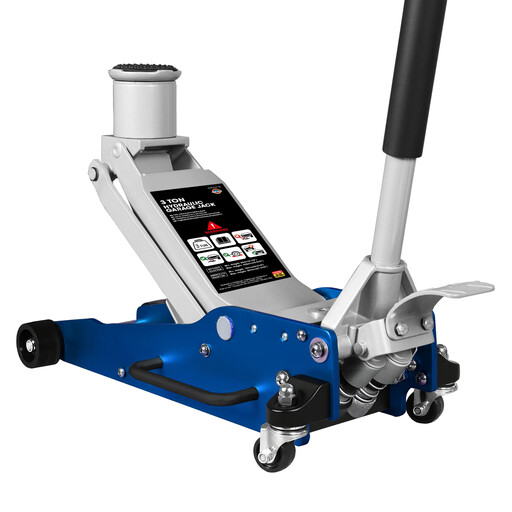
Why this choice suits this user: Its minimum height of 85 mm makes it suitable for low cars, while its extension allows it to reach an advertised height of 541 mm. It therefore combines portability with a wide lifting range.
Its two height ranges reduce the risk of choosing an ultra-low-profile jack that would be unable to reach a taller vehicle.
Advertised 3-tonne capacity, dual pump, aluminium alloy body, and EN 1494 and CE information on the product page.
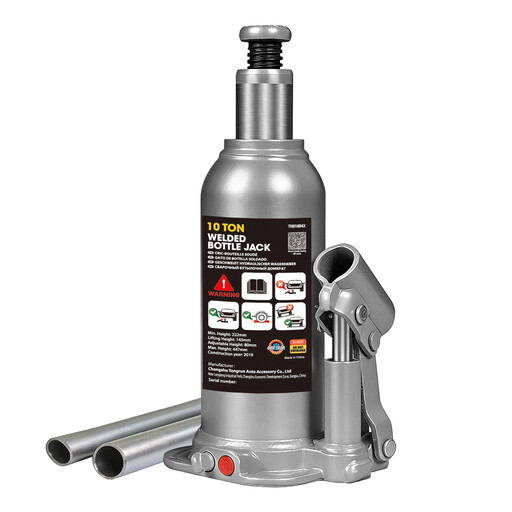
Why this choice suits this user: This hydraulic bottle jack is advertised for lorries, buses, construction vehicles and industrial equipment, with a rated capacity of 10 tonnes.
Its capacity and lifting range of 222 to 448 mm are stated separately, making it easier to compare them with the vehicle’s dimensions.
Forged steel base, chrome-plated piston, overload safety valve and height-adjustment screw.
We have put together a comprehensive, real-time updated list of products that meet these demanding selection criteria and European safety requirements.
Regularly inspect the castors, saddle, hose, welds and any signs of oil leakage. A loss of pressure, uneven lowering or jerky operation should prompt you to stop using the jack immediately and consult the instructions.
Check the SUV’s weight, the height of its lifting points and the jack’s maximum height. A 3-tonne model may be suitable for some SUVs, but its capacity should never be chosen solely based on the body type. For a heavier vehicle, a 6-tonne jack may provide extra capacity, provided its minimum and maximum heights are compatible.
No. A jack is designed to lift the vehicle, not to support it during extended work. Use axle stands with a suitable capacity, positioned on the designated support points. This precaution applies equally to a workshop jack and a compact hydraulic trolley jack.
Routine maintenance is generally limited to cleaning, checking the castors and looking for possible leaks. Replacing a part, hydraulic fluid or a seal depends on the model and the availability of components. Before buying, consult the instructions and servicing terms so that you can anticipate any potential costs.