
Livraison le jour même ou le lendemain

Qualité garantie

Débloquez vos offres de bienvenue: Livraison GRATUITE | Jusqu'à -80 % | 30 jours d'essai gratuits à JoyPlus
Téléchargez l'application
A hydraulic car jack can make life easier when changing a wheel or carrying out minor maintenance — provided you choose a model that is compatible with your vehicle’s weight and ground clearance. However, product specifications deserve careful attention, particularly the stated capacity, lifting height and compliance information.
Before placing your order, here are the most common mistakes to avoid and the criteria to check when choosing the right hydraulic trolley jack, hydraulic bottle jack or equipment suitable for motorcycles, quad bikes and commercial vehicles.
A capacity of 2.5 tonnes, 3 tonnes or more refers to the maximum load stated by the manufacturer. It does not automatically mean that the jack is suitable for every vehicle. Start by checking the vehicle’s maximum authorised mass — the PTAC — and remember that the jack will generally lift only part of the vehicle’s total weight.
For a saloon or city car, a 2.5-tonne hydraulic jack may be sufficient, depending on the vehicle’s specifications. For an SUV, MPV or commercial vehicle, it is better to allow a comfortable safety margin and choose a stable base.
A jack with a high capacity may prove unusable beneath a low car. Its minimum height must be lower than the distance between the ground and the lifting point specified by the manufacturer.
An ultra-low-profile jack with an entry height of 85 mm is not suitable for the same applications as a hydraulic bottle jack whose minimum height exceeds 200 mm. Measure the ground clearance and, above all, the height of the lifting point before comparing models.
The CE marking indicates that the manufacturer declares the product compliant with the European requirements applicable to it. It does not replace reading the instructions or checking the load limits and usage guidance. Standard EN 1494 covers mobile or movable lifting equipment: its presence on the product page is a useful detail to check.
In all cases, a jack is not designed to support a vehicle at height for extended periods. When working beneath a car, use suitable axle stands and follow the lifting points specified by the manufacturer.
Before buying, compare these three essential specifications:
A 3-tonne hydraulic jack offering a range of 135 to 460 mm may be suitable for a variety of passenger vehicles. For an SUV or commercial vehicle, however, check the actual dimensions of the lifting point. For a lorry, bus or industrial equipment, a high-capacity bottle jack will generally be more suitable than a compact trolley jack.
A steel frame, a sufficiently wide base, suitable wheels and a non-slip saddle all help to make lifting more stable and controlled. Swivel castors make it easier to position a garage jack, while a hydraulic bottle jack, with its more vertical design, is generally easier to store.
Also check whether the jack has a safety overload valve, height adjustment screw or rubber pad. These features do not replace basic precautions: the jack must be placed on a hard, level and unobstructed surface.
For changing a wheel occasionally, a model with an ergonomic handle that is easy to store may be perfectly adequate. In a workshop or for regular maintenance, manoeuvrability, lifting range and access to the lowering valve become considerably more important.
Owners of two-wheelers should choose a motorcycle and quad bike jack with a platform designed to hold the vehicle securely. Equipment intended solely for a car may not have the shape or stability required for this type of use.
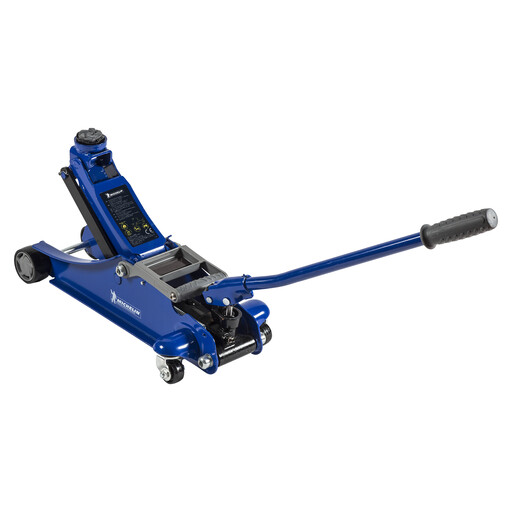
Why this choice suits this profile : With a stated capacity of 1,800 kg and a lifting height between 105 and 350 mm, this hydraulic trolley jack is suitable for owners of cars and light vehicles looking for a manoeuvrable tool for routine maintenance.
The lifting heights are clearly stated, allowing you to compare them with the vehicle’s lifting point before buying.
360° pivoting handle, swivel castors, magnetic storage space for small nuts and universal rubber saddle.
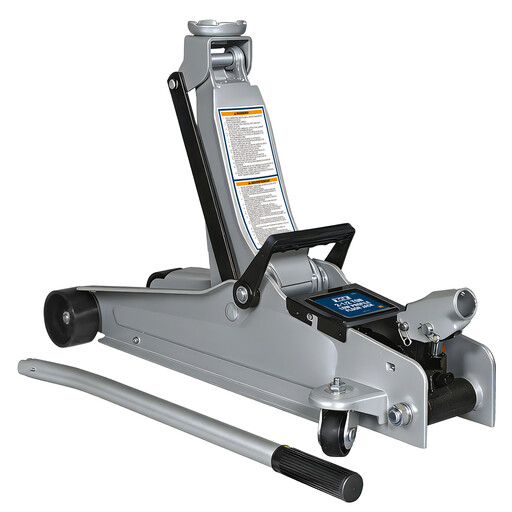
Why this choice suits this profile : Its stated minimum height of 85 mm makes it suitable for low cars and certain sports models. Its 2.5-tonne capacity also covers many passenger vehicles, SUVs and MPVs, provided their weight is taken into account.
The 85 mm entry height is stated clearly, rather than being replaced by a vague promise of compatibility with low cars.
Steel construction, lifting range of 85 to 380 mm, and stated CE and EN 1494 compliance. Check the contents of the package, particularly the handle, which is listed as non-standard for this batch.
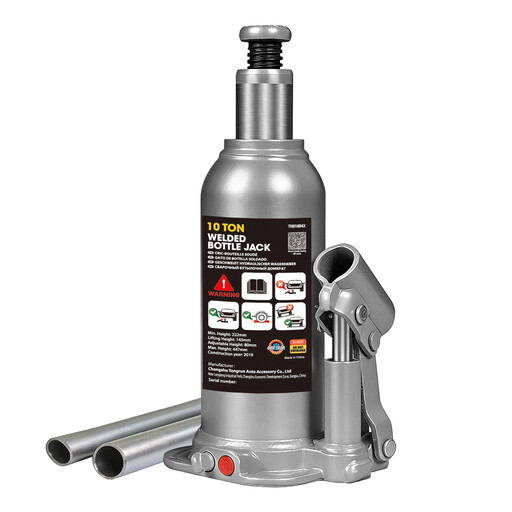
Why this choice suits this profile : With a stated capacity of 10 tonnes and a lifting height between 222 and 448 mm, this jack is designed for lorries, buses, construction vehicles and industrial equipment. It meets heavy lifting needs where a vertical format is required.
The capacity, lifting range and safety overload valve are detailed separately, making technical checks easier.
Forged steel base, chrome-plated piston rod, treated non-slip saddle and adjustment screw for setting the height.
We have put together a complete, real-time updated selection of products that meet these demanding criteria and European safety requirements.
For a motorcycle or quad bike, choose a platform specifically designed for this purpose, such as lifting equipment rated for 544 kg, rather than a car jack. Depending on the job, lateral stability and the presence of securing straps can make all the difference.
Start by checking the vehicle’s weight, then choose a capacity greater than the load that will actually be lifted. A 1.8-tonne model may be suitable for some light vehicles, while a 2.5- or 3-tonne hydraulic jack will provide a different safety margin. For an SUV or commercial vehicle, also check the maximum height and the shape of the lifting point.
A hydraulic trolley jack is generally bulkier than a hydraulic bottle jack. Measure the boot and check the weight of the equipment before buying it for roadside repairs. If you plan to keep a jack permanently in the car, its size, handle and supplied accessories are almost as important as its lifting capacity.
This depends on how often it is used, storage conditions and maintenance. Store the jack away from damp, regularly inspect the wheels and saddle, and look for any leaks. Follow the instructions when checking the hydraulic oil level. Equipment that leaks, lowers unevenly or shows signs of deformation must not be used again until it has been inspected or replaced.