
Livraison le jour même ou le lendemain

Qualité garantie

Débloquez vos offres de bienvenue: Livraison GRATUITE | Jusqu'à -80 % | 30 jours d'essai gratuits à JoyPlus
Téléchargez l'application
A hydraulic car jack makes changing a wheel, rotating tyres or carrying out maintenance work easier. However, the stated tonnage alone is not enough to make the right choice. Minimum height, lifting range, stability and compatibility with your vehicle’s lifting points must also be taken into account.
A jack rated at 3 tonnes is not automatically suitable for every vehicle. Its capacity must be compared with the vehicle’s weight, while retaining a sufficient safety margin. For a passenger car, a 1.8-tonne jack already covers many everyday needs. An SUV, van or light commercial vehicle may nevertheless require a higher capacity.
The stated capacity corresponds to the maximum load. It must never be exceeded, even for a short operation.
A jack that is too tall when retracted may not fit under a low-slung car. Conversely, an insufficient maximum height may prevent you from lifting an SUV’s wheel clear of the ground properly. Measure the distance between the ground and the lifting point before choosing your car lifting jack.
A sturdy steel jack can be perfectly suitable for regular use, but stability also depends on the base, wheels, saddle and quality of the hydraulic system. A heavy, bulky model is not necessarily the most practical option in a cramped garage or when storing it in the boot.
For a city car or saloon, a capacity of 1.5 to 2 tonnes may be sufficient for occasional use, subject to the manufacturer’s recommendations. For an SUV or more regular use, a 3-tonne hydraulic trolley jack provides a greater safety margin, but it will generally be more bulky.
The hydraulic SUV jack should be chosen according to the vehicle’s weight, ground clearance and the location of its lifting points. Take care not to confuse payload, kerb weight and gross vehicle weight.
Check the following three values:
For example, the MICHELIN model shown below extends from 105 to 350 mm, while the 3-tonne model reaches 460 mm. This difference can be decisive for an SUV or a vehicle with substantial ground clearance.
For a jack intended for wheel changes, swivel castors make positioning easier, particularly when the vehicle moves slightly as it is raised. A saddle fitted with a rubber pad can also protect the lifting point, provided it is suited to the shape specified by the manufacturer.
Before each use, position the jack on hard, level and stable ground. Apply the handbrake, select a gear or activate the mode recommended by the manufacturer, then place wheel chocks if necessary. Once the vehicle has been raised, always position axle stands before working underneath it. A jack alone must never be used as a permanent support.
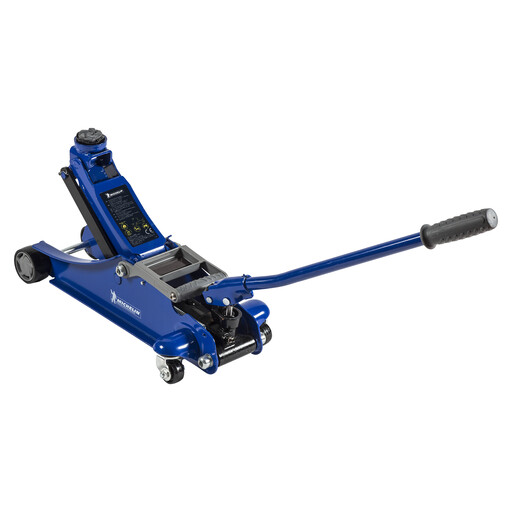
Why this choice suits this profile : its 1,800 kg capacity and 105 mm minimum height make it suitable for many motorists looking for a jack to change tyres and carry out routine jobs.
The lifting range is clearly stated, making it easy to check compatibility with the vehicle’s ground clearance before buying.
Height from 105 to 350 mm, swivel castors, 360° rotating handle and universal rubber saddle.
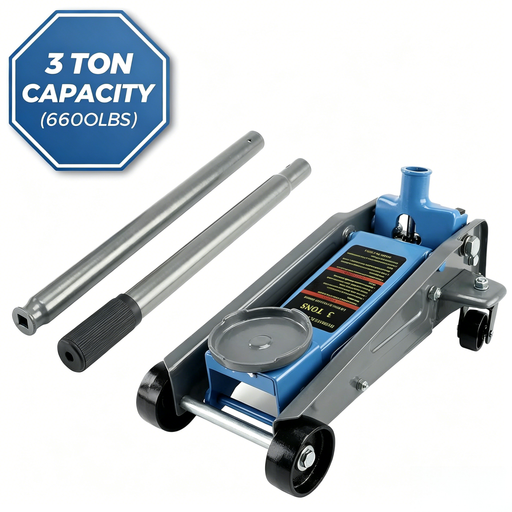
Why this choice suits this profile : this 3-tonne hydraulic trolley jack is suitable for car and SUV owners looking for a wide lifting range for their garage.
Its stated lifting range of 135 to 460 mm reduces the risk of choosing a model that is too low for a raised vehicle.
3,000 kg capacity, steel construction, two large wheels and two 360° swivel castors.
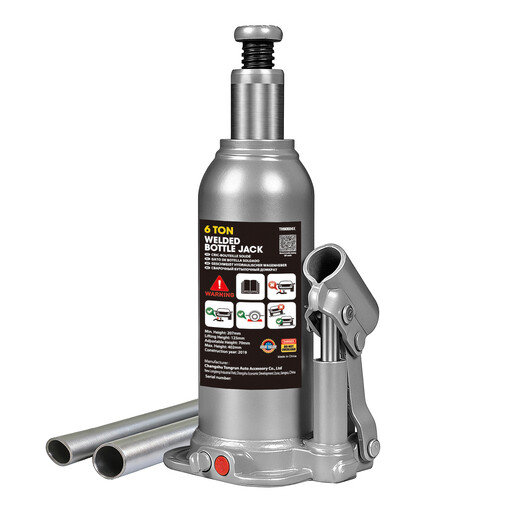
Why this choice suits this profile : this 6-tonne bottle jack is aimed at workshops and users who lift compatible SUVs, pick-ups or light commercial vehicles.
Its capacity and lifting range of 207 to 402 mm are clearly specified, making it easier to compare them with the vehicle’s dimensions.
Forged steel base, chrome-plated piston rod, non-slip saddle and overload safety valve.
Consult the vehicle manual to identify the authorised lifting points. Then position the jack beneath the designated point, close the lowering valve and operate the handle gradually. Avoid sloping surfaces, soft ground and makeshift supports.
To extend the service life of a garage jack:
Service life depends on how often the jack is used, storage conditions, the load applied and compliance with the instructions. If the jack stops reaching its usual height or lowers unevenly, stop using it and consult the manual.
Start by checking the vehicle’s weight and the available clearance beneath the chassis. A 1.8-tonne model may be suitable for many cars, while a 3-tonne model provides greater capacity for certain SUVs and garage work. In all cases, the maximum permitted load must never be exceeded.
No. It is used to raise the vehicle, but must never be relied on to support it alone during repairs. Use suitable axle stands, positioned at the support points specified by the manufacturer. Never get underneath a vehicle supported solely by a jack.
A hydraulic trolley jack is generally easier to move around. It is particularly suitable for changing wheels and carrying out regular work in a garage. A bottle jack is more upright and compact and can offer high capacities, such as 6 tonnes, but its minimum height and positioning must be fully compatible with the vehicle.