
Livraison le jour même ou le lendemain

Qualité garantie

Débloquez vos offres de bienvenue: Livraison GRATUITE | Jusqu'à -80 % | 30 jours d'essai gratuits à JoyPlus
Téléchargez l'application
At a time when healthy cooking and material transparency are top priorities, the glass stockpot is making a strong comeback. It promises healthy cooking with no transfer of harmful substances and perfect visual control. But be warned, not all models are created equal. Between marketing claims and technical limitations, the market can quickly become a headache and lead to buyer's remorse. This guide is here to help you see things more clearly and choose the glass pot that's truly right for you.
Before you fall for the sleek design of a transparent glass pot, it's best to know the pitfalls that can turn your purchase into a disappointment.
To ensure you make the right choice and invest in a utensil that will last, focus on these three technical points. This is your guarantee of a quality non-toxic cooking pot.
This is THE decisive criterion. For use on a stovetop or in the oven, borosilicate glass is the only truly safe and high-performance option.
Scrutinise the compatibility claims made by the manufacturer. A gas and electric compatible stockpot should be used with some precautions. On a gas stove, a heat diffuser is often recommended to avoid direct, aggressive contact from the flame. For the oven, a maximum use temperature is always specified (e.g., 180°C). Exceeding this limit can weaken the glass. Finally, if you cook on an induction hob, purchasing an adapter disc will be essential.
The key advantage of a transparent glass pot is more practical than aesthetic: it allows you to monitor cooking at a glance without having to lift the lid. The result: the temperature remains stable, and you save energy. Regarding capacity, here are a few guidelines to help you:
To illustrate these criteria in practice, here are a few models that caught our attention, suited for different profiles.
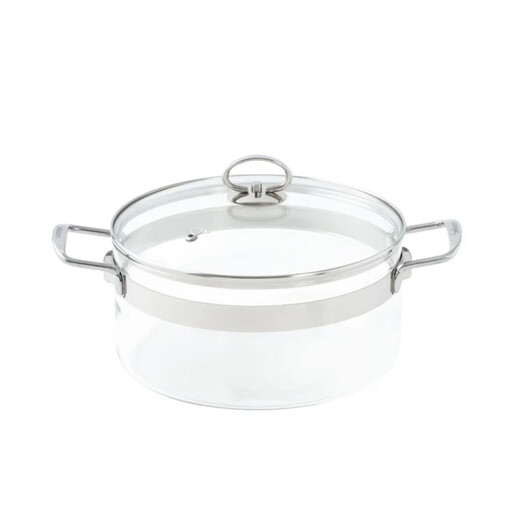
Why it's a great choice: With its generous 4.2-litre capacity, this stockpot is designed for family-sized soups, stews, and pasta dishes. Its transparency allows you to effortlessly monitor large volumes as they cook.
It addresses the pitfall of unsuitable capacity by offering a volume perfectly calibrated for family use, preventing oversized or undersized purchases.
Made from borosilicate glass, it is compatible with gas and electric stovetops, and is oven-safe up to 180°C. Its integrated pouring spout is a real everyday bonus.
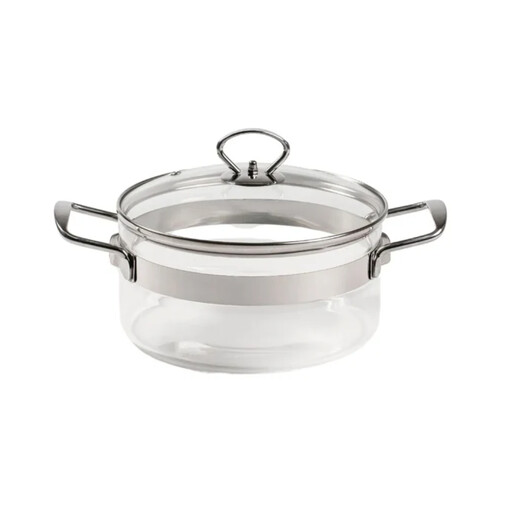
Why it's a great choice: Its compact 2.5-litre size is perfect for everyday meals, sauces, or side dishes. It's easy to store, even in small kitchens, and helps prevent energy waste.
This model clears up any ambiguity about the material: it is indeed made of borosilicate glass, guaranteeing the thermal resistance essential for stovetop cooking, unlike ordinary glass.
Versatile, it goes from the stovetop (gas/electric) to the oven, ideal for smaller portions. Its inert, PTFE/PFAS-free material ensures 100% healthy cooking.

Why it's a great choice: For those seeking a healthy solution primarily for the oven, storage, and reheating. Perfect for individual gratins, meal prep, and storing leftovers without any taste transfer.
This dish avoids the "universal compatibility" trap. Its use is clearly defined: oven, microwave, refrigerator, and freezer, but never on a stovetop. Clarity above all.
The quality of a benchmark brand (Pyrex) with ultra-resistant borosilicate glass. Its stackable design is a real space-saver in cupboards.
Can a glass stockpot really be used on a gas stove? Yes, provided it is made of borosilicate glass and the manufacturer clearly states it. It is advisable to use a moderate flame that does not extend beyond the base of the pot to distribute heat evenly. Avoid high flames that could "lick" the sides. In any case, consulting the user manual is always the best course of action.
How can I avoid thermal shock with a glass pot? The golden rule: avoid sudden temperature changes. Never place a hot dish on a cold or wet surface (like a stone countertop or a wet sink). Likewise, do not move it directly from the refrigerator to a preheated oven. Let it return to room temperature before washing it or exposing it to high heat.
Is cleaning a glass pot complicated? On the contrary, it's one of its main strengths. The non-porous surface of borosilicate glass prevents food from sticking. Washing with hot, soapy water is sufficient in most cases. To maintain its shine, hand washing is often preferable, even though many models are dishwasher-safe. Just remember to always let the pot cool down completely before immersing it in water.