
Livraison le jour même ou le lendemain

Qualité garantie

Débloquez vos offres de bienvenue: Livraison GRATUITE | Jusqu'à -80 % | 30 jours d'essai gratuits à JoyPlus
Téléchargez l'application
Glassware promises a healthier kitchen and a clean, minimalist aesthetic. What’s more satisfying than watching your food brown through a transparent dish, serving a visually stunning colourful salad, or storing leftovers without worrying about flavour transfer?? But be warned: not all glass is created equal. Between marketing claims and the realities of daily use, it’s easy to make a purchase you’ll regret. We’ll explain how to avoid the common pitfalls and choose products that truly deliver on their promises.
To prevent your investment from turning into a disappointment, here are the three most common mistakes to be aware of.
To sort through the options and invest in worthwhile products, here are the technical specifications you absolutely must check.
This is THE key strength of borosilicate glass. Thanks to the boron oxide in its composition, it has a very low coefficient of thermal expansion. What does that mean in practice?? It can withstand significant temperature changes without cracking or shattering. This is what allows you to take your glass oven dish from room temperature to a 180?°C oven without fear. Always check the manufacturer's specified limits—it’s an essential safety guarantee.
The other major advantage of glass is its safety. Borosilicate glass is an inert and non-porous material. It contains no PFOA, PTFE, or any coatings that could leach into your food. This makes it the ideal choice for a healthy, PFAS-free kitchen. The icing on the cake?: it doesn’t retain odours, stains, or flavours. Your vegetable soup will never have an aftertaste of yesterday's curry.
A good piece of cookware is, above all, a versatile one. Being able to use the same stockpot on the hob, in the oven, on the table for serving, and then in the fridge for leftovers is a kitchen game-changer. By the same logic, glass jars are perfect for a plastic-free kitchen organisation?: they allow you to beautifully store dry goods while keeping an eye on your stock levels.
To move from theory to practice, here is our selection of products suited for different profiles.
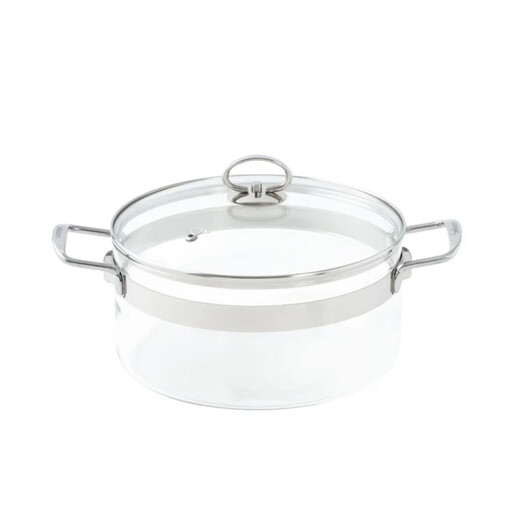
Why we chose it : With its generous 4.2-litre capacity, this glass pot is perfectly sized for family-sized soups, pasta dishes, or stews. Its complete transparency allows you to monitor cooking without lifting the lid, thus preventing heat loss.
It is made from genuine borosilicate glass, which guarantees excellent thermal shock resistance (up to 180 °C in the oven). Its compatibility is clearly stated : gas and electric, with the need for an adapter disc for induction.
Its large capacity and integrated pouring spout make it extremely practical for everyday meals. The material is completely inert and PFAS/PTFE-free.
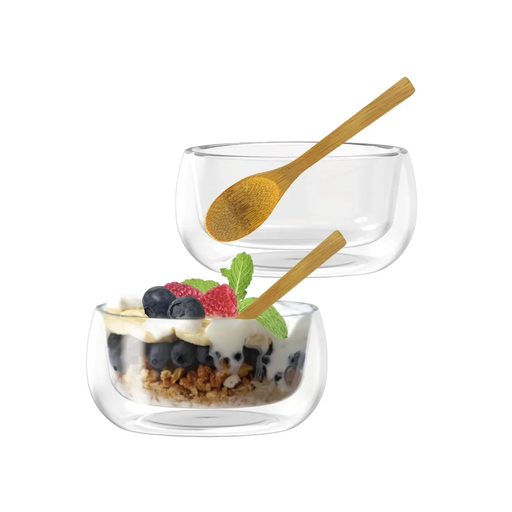
Why we chose it : Ideal for serving hot soups or frozen desserts, this double-wall bowl showcases your creations while protecting your hands from the temperature. Its minimalist design is a real asset for an elegant table setting.
The double wall isn't just an aesthetic gimmick ; it provides genuine thermal insulation. The borosilicate glass ensures durability and compatibility with the oven and microwave, making it as beautiful as it is functional.
The thermal insulation keeps food at the right temperature for longer, whether hot or cold. The set includes bamboo spoons for a turnkey serving solution.
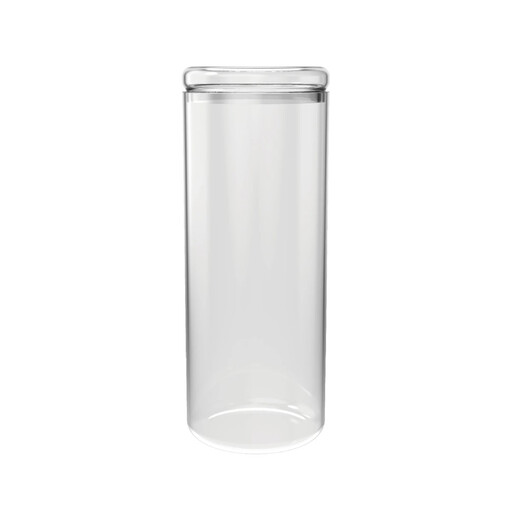
Why we chose it : This jar is the perfect alternative to plastic containers for storing dry goods (rice, pasta, coffee). Its transparency allows you to identify the contents at a glance and beautifies your kitchen shelves.
Unlike simple decorative jars, this is a true airtight storage jar. Its lid provides a perfect seal that protects food from moisture and air, preserving its freshness.
The combination of non-porous borosilicate glass and an airtight lid makes it a high-performance tool for a sustainable, plastic-free kitchen organisation.
We have curated a complete range of products for you that tick all the boxes : quality, safety, and durability.
No, not directly. Glass is not a magnetic material, which is a prerequisite for induction to work. To use a glass pot on an induction hob, you must place an adapter disc (sold separately) between the hob and the bottom of the pot. Always consult the manufacturer's recommendations.
Although very durable, borosilicate glass is still… glass. Therefore, avoid harsh impacts. For cleaning, hand washing with a soft sponge is often preferable to maintain its clarity over the long term, even though most products are dishwasher-safe. Most importantly, always let a hot dish cool to room temperature before plunging it into cold water to eliminate any risk of thermal shock.
Both types of glass are strengthened, but in different ways. Borosilicate glass is chemically reinforced (with boron oxide) to better withstand temperature changes. Tempered glass, on the other hand, undergoes a thermal treatment to make it more resistant to mechanical shocks. If it breaks, it shatters into small, less sharp pieces. For cooking, borosilicate glass is therefore more suitable due to its superior thermal stability.