
Same-day & Next-day Delivery

Quality Guaranteed

Unlock Your Welcome Offers: FREE Delivery | Up to 80% OFF | Free 30-day JoyPlus trial
Download the APP
Navigating the vast world of cookware can be a daunting task. Between marketing jargon and confusing spec sheets, it's easy to make a purchasing mistake—especially when you're looking for a healthy and durable material like a borosilicate glass pot. Drawn in by its transparency and non-toxic properties, you might end up with a product that cracks during its first use or fails to meet your needs entirely. To help you avoid this disappointment, let's break down the common pitfalls so you can make a smart investment.
Confusing "Heat-Resistant" with "Stovetop-Compatible": This is the number one trap. Most glass dishes are designed for the oven but cannot withstand the direct flame of a gas burner or the intense heat of an electric cooktop. Marketing often plays on this ambiguity, using the generic term "heat-resistant." The result: a pot that cracks, rendering it useless and potentially dangerous. It is therefore imperative to verify explicit compatibility with your specific type of cooktop.
Underestimating the Importance of the Glass Type and Lid: Not all glass is created equal—far from it. A product simply labelled "glass," without mentioning borosilicate, should be an immediate red flag. Standard soda-lime glass, which is very common, simply lacks the thermal shock resistance required for cooking. And the problem doesn't stop there: a poorly fitting lid or one made of low-grade plastic (which isn't oven-safe) completely defeats the purpose of using a glass casserole for healthy cooking.
To make an informed choice, you need to focus on the technical specifications that truly make a difference. These objective details will guarantee a long-lasting purchase you won't regret.
For a glass cooking vessel intended for stovetop use, only one material should be considered: borosilicate glass. Its unique chemical composition gives it a very low coefficient of thermal expansion. In simple terms, it can withstand rapid temperature changes without shattering, such as going from the refrigerator to the cooktop (while following proper precautions). Another major advantage is that it's a completely inert and non-porous material. It doesn't react with foods, even acidic ones, and doesn't retain odours or flavours, making it a PFAS- and PTFE-free pot by nature.
Before you pull out your credit card, scrutinize the product's pictograms and description to verify compatibility:
The key advantage of a transparent glass stockpot? Its transparency, of course. It allows you to monitor your cooking at a glance without lifting the lid, thus preserving heat and moisture. Don't overlook the capacity (a 4 to 5-litre model is generally suitable for a family of four) or the handle design. Make sure they are large enough for a secure grip with oven mitts, even when the pot is full and hot.
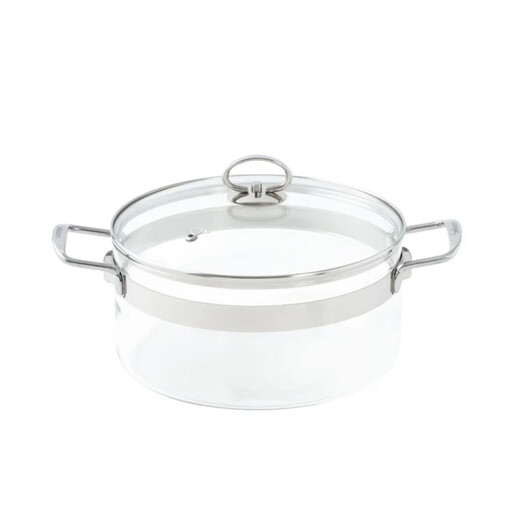
Why we chose it: With its 4.2 L capacity, it's perfect for family-sized soups, stews, or pasta dishes. Its inert borosilicate glass composition ensures 100% healthy cooking, with no chemical leaching (PFAS/PTFE-free) or odour transfer.
This model checks all the boxes: it's explicitly compatible with gas and electric cooktops and is oven-safe up to 180°C (350°F). It is genuine borosilicate glass, which sidesteps the two most common rookie mistakes.
Its total transparency allows for perfect visual monitoring of your cooking. Its non-porous material absorbs neither tastes nor odours, keeping flavours pure.

Why we chose it: For fans of *batch cooking*, this storage set is the ideal companion. Made from the same borosilicate glass, it allows you to store meals in the fridge or freezer and then reheat them directly in the oven or microwave (without the lid).
No more plastic containers that stain, warp, and can leach unwanted substances. Borosilicate glass guarantees 100% healthy storage and reheating.
A complete 10-piece set in two sizes. Airtight lids for optimal food preservation. Total versatility, from freezer to oven.
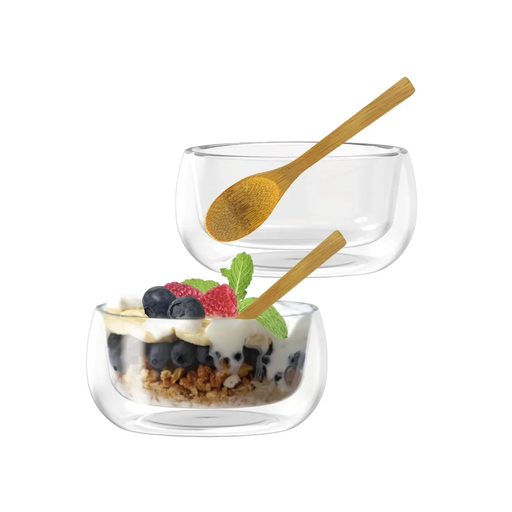
Why we chose them: These bowls showcase another facet of borosilicate glass. They are perfect for elegantly serving soup made in the stockpot, or for baking individual desserts like crème br?lée or chocolate lava cakes.
Unlike conventional dishware, these borosilicate bowls can withstand oven and microwave heat, eliminating any risk of breakage when baking desserts.
Their double-wall design insulates the contents, keeping food hot or cold for longer while protecting your hands. They come with bamboo spoons for an elegant finishing touch.
Discover our full selection of products that meet our quality criteria and safety standards.
Yes, but only if the manufacturer explicitly states it. Borosilicate glass is designed to withstand thermal stress, but it is crucial to always follow the product's instructions. As a precaution, we recommend gradual heating and avoiding extreme thermal shock (for example, never place a hot pot on a cold, wet surface).
To maintain its crystal-clear transparency, hand washing with a non-abrasive sponge and dish soap is the best method. Although many models are dishwasher-safe, repeated high-temperature washes can eventually dull the glass. For stubborn residue, a simple soak in hot, soapy water will do the trick.
The fundamental difference lies in thermal shock resistance. Borosilicate glass contains boron trioxide, which gives it excellent resistance to temperature changes without cracking. Tempered glass, in contrast, is standard glass that has been treated to improve its mechanical strength (against physical impact). However, it is much more sensitive to thermal shock, making it unsuitable for stovetop cooking. For cooking over a direct flame, borosilicate is therefore the only truly safe option.