
Livraison le jour même ou le lendemain

Qualité garantie

Débloquez vos offres de bienvenue: Livraison GRATUITE | Jusqu'à -80 % | 30 jours d'essai gratuits à JoyPlus
Téléchargez l'application
A cordless car polisher makes vehicle maintenance easier in a driveway, a garage far from a power socket or on a private parking area. It lets you apply wax, add protection or restore the shine to your bodywork without having to deal with a cable winding around the car. However, buying one requires a little thought: the wrong machine can prove tiring, offer limited battery life or leave marks on the paintwork.
A high maximum speed does not guarantee better results. When polishing and buffing a car, consistent movements, the choice of pad and the pressure applied are just as important as the number of revolutions per minute. A variable-speed car polisher allows you to start gently to spread wax, then gradually increase the speed according to the product and the surface being treated.
Values expressed in volts or ampere-hours do not, on their own, tell you how long the battery will actually last. The speed setting, pressure applied and temperature all directly affect running time. Also check whether the battery is included, removable and supplied with a suitable charger. Some models are sold as bare tools and require a compatible battery that you may already own.
A 125 or 150 mm backing plate lets you cover large body panels quickly. However, it is less manoeuvrable around handles, wing mirrors, wheels and pillars. For correcting car paintwork and working on details, a machine compatible with several backing-plate sizes saves you from having to change tools repeatedly.
A dual-action car polisher, also known as a random-orbital or dual-action polisher, combines rotation and oscillation. This movement spreads the work over a wider area and is more approachable for beginners learning to buff. It is particularly suitable for applying wax or protective products, as well as treating minor visual defects.
A rotary machine transfers movement more directly to the backing plate. It may be suitable for targeted work, but requires greater control over pressure, speed and the amount of time spent on one area. For home use, dual action generally offers a more gradual learning curve.
When applying wax or a finishing product, a low speed helps distribute the product without causing excessive splashing. Medium speeds are suitable for everyday polishing, while higher settings should be reserved for the uses specified in the instructions and for people already familiar with how abrasive compounds behave.
A cordless car buffer with several speed settings, a soft start or a speed display offers more precise control. Do not simply compare the advertised range: also check for a dial or buttons that are easy to operate, including while wearing gloves.
A machine that is too heavy soon becomes uncomfortable when working on the roof, bonnet or sides of an SUV. Weight, handle shape, vibration levels and ventilation are therefore very practical considerations. Also examine the kit contents: foam, wool or microfibre pads, spare backing plates and a storage bag can represent a significant extra cost if they are not included.
Before polishing and buffing your car, wash and dry the bodywork thoroughly. Work in the shade, on a cool surface, moving across small areas with a slight overlap. Do not persist with a deep scratch: a polisher cannot replace paint repair, and incorrectly used abrasive can reduce the thickness of the clear coat.
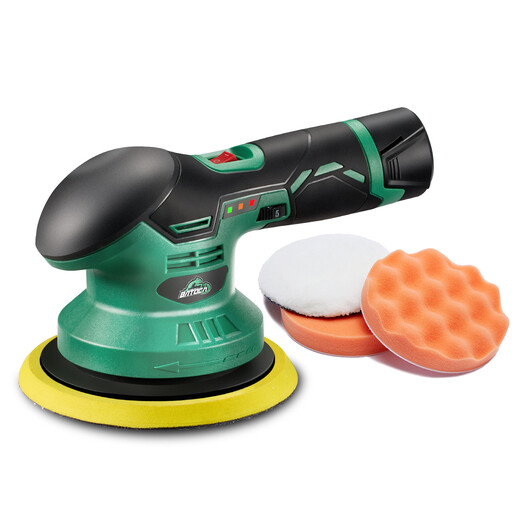
Why this choice suits this profile : Its 6-inch format and advertised weight of 3 pounds, or approximately 1.36 kg, are suitable for routine car or motorbike maintenance.
The 5 mm orbital movement and 6 speed settings mean you do not have to use the same setting for waxing and polishing.
12 V 2.0 Ah lithium-ion battery included, charger supplied and an advertised range of 2 500 to 5 000 rpm.
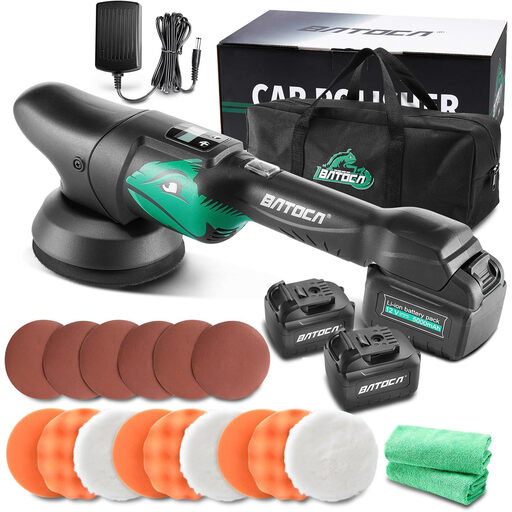
Why this choice suits this profile : Its two 5 Ah batteries and LCD screen are designed for long sessions on a saloon, SUV or motorhome.
The removable batteries reduce the risk of having to stop a session when the first one runs out.
Two batteries rated at 5 Ah, 6 speeds, soft start and a 125 mm backing plate.
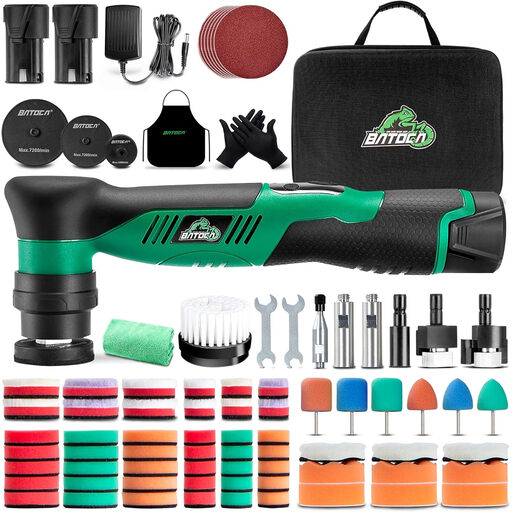
Why this choice suits this profile : Its small backing plates are suitable for headlights, badges, wheels, window surrounds and other hard-to-reach areas.
Its 3-in-1 system lets you choose between rotary movement, a 3 mm orbit or a 12 mm orbit depending on the area being treated.
Two advertised 12 V 2.0 Ah batteries, 6 speeds from 2 000 to 5 500 rpm, and 25, 50 and 75 mm backing plates.
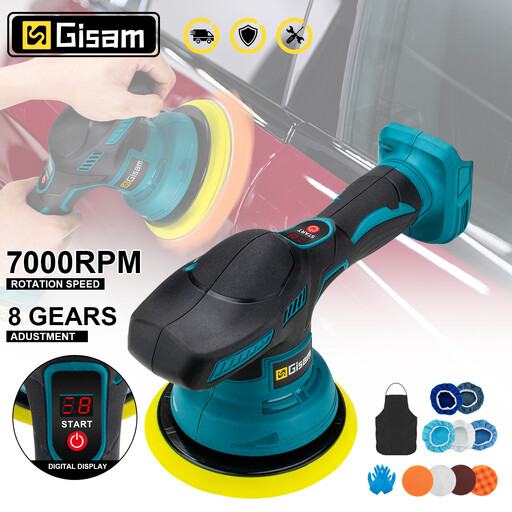
Why this choice suits this profile : Sold without a battery, this model may appeal to people who already own a compatible Makita 18 V battery from the B series.
Compatibility is limited to the Makita 18 V B-series batteries specified by the manufacturer: G and Ni-CD batteries do not work with this machine.
8 advertised settings, a range of 2 500 to 7 000 rpm, a 6-inch backing plate and several pads supplied.
We have brought together a complete, real-time updated selection of products that meet these demanding criteria as well as European safety standards.
Start at the lowest setting, or the medium setting recommended in the instructions. Apply a thin layer with a clean pad, using regular overlapping passes in a crosshatch pattern. For simple wax or a protective product, a high speed offers no benefit.
No. Depending on the condition of the paintwork and the product used, it can reduce the appearance of certain superficial defects, light marks or oxidation. A scratch that goes through the clear coat or reaches the colour layer requires a different solution. Always test on a small, inconspicuous area first.
Recharging generally uses very little electricity. The main costs to consider are pads, polishing products, wax and, over time, possible battery replacement. A model supplied with two batteries or several accessories can reduce the need for additional purchases, but check the references and availability of spare parts carefully.