
Same-day & Next-day Delivery

Quality Guaranteed

Unlock Your Welcome Offers: FREE Delivery | Up to 80% OFF | Free 30-day JoyPlus trial
Download the APP
A brilliant, mirror-like finish, free of swirl marks and protected for the long haul: this is the ultimate goal for any car enthusiast. To achieve this yourself, the cordless car polisher has become an indispensable tool, offering complete freedom of movement. The problem? The market is flooded with models making dazzling promises, and the wrong choice can quickly turn into a bad investment.
Before you take the plunge, it's best to know the pitfalls to avoid. Too many users end up with an unusable device due to recurring issues:
This guide is designed to arm you against these disappointments and help you identify the features that truly make a difference. The objective: a flawless result worthy of your efforts.
To avoid buyer's remorse, you need to read between the lines of product descriptions and focus on the specifications that genuinely determine the effectiveness and safety of your future polishing machine.
This is THE number one technical criterion, as it defines how the machine works on the clear coat.
For a battery-powered polisher, runtime isn't just about the advertised capacity (Ah). Two elements are essential to avoid running out of power:
The size of the backing plate, where the polishing pad attaches, determines its versatility and the areas you can treat.
A good polishing kit will often include multiple backing plate sizes or adapters for maximum versatility.
Rather than an endless catalogue, here is a selection of models that meet specific needs, taking into account the criteria we've just discussed.
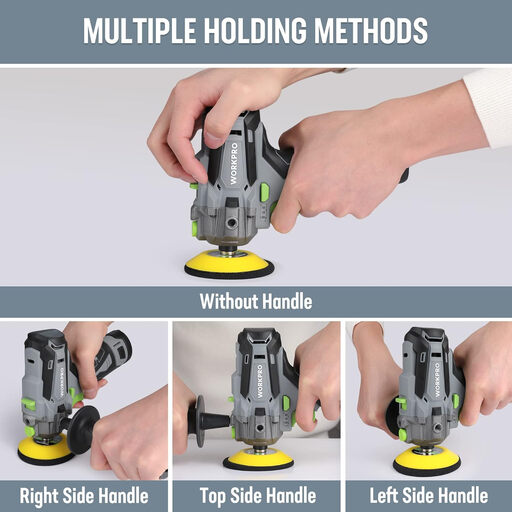
Why this model? Compact, lightweight, and very easy to handle, it comes with an ultra-complete kit to get started immediately, with no additional purchases needed. A smart choice for a first experience.
Supplied with two 2.0 Ah batteries and a fast charger (1hr), it overcomes the main hurdle of battery life. Its accessory kit is varied enough to get the hang of different tasks.
An unbeatable price-to-feature ratio for beginners, including a carrying case, foam pads, a wool pad, and even sanding discs.
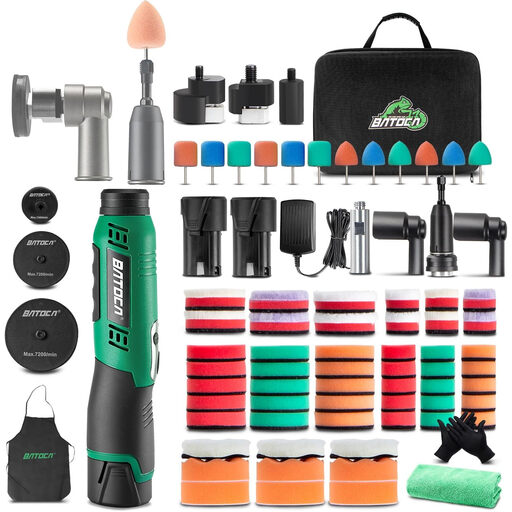
Why this model? Built for precision, it can access complex areas (logos, grilles, door pillars) that are inaccessible to a standard machine—places where the finish makes all the difference.
Its dual system (rotary and orbital) and multiple small backing plates (25, 50, 75 mm) avoid the trap of the "jack-of-all-trades" machine that's a master of none. Here, every nook and cranny has its dedicated tool.
Extreme versatility for detailing thanks to its two modes (DA & RO) and its accessories for very small surfaces. The two batteries guarantee non-stop work.

Why this model? Perfect for regular maintenance and treating an entire car. Its 125 mm plate and 8 mm orbit make it a balanced and effective tool for correction and finishing on large surfaces.
Battery life is its main strength. The two high-capacity 5.0 Ah batteries allow for uninterrupted work during long sessions, a decisive advantage to avoid running out of power in the middle of the roof.
Extra-long battery life and an LCD screen that displays the speed and battery level for precise control and optimized management of your work session.
We have put together a complete selection of products that meet our demanding specifications and current safety standards.
To put it simply, the rotary polisher is powerful and fast, but risky for a beginner because it can easily "burn" or cut through the clear coat. The orbital polisher (or random orbital) is much safer: its random motion prevents heat buildup and the formation of holograms, making it the ideal tool for hobbyists and for finishing steps.
Runtime heavily depends on the pressure applied, the speed, and the battery's capacity. For a 2.0 Ah battery, expect about 20-30 minutes of effective work time. With a 4.0 Ah or 5.0 Ah battery, you can hope for 45 to 60 minutes. This is why a model supplied with two batteries is so highly recommended for working with peace of mind.
Yes, most polishers are very versatile. With the right accessories (pads, sanding discs), you can use them to polish wooden furniture, sand small surfaces, clean tiles, or even shine metals like stainless steel or aluminum. Just be sure to always adapt the speed and pad type to the material you are working on.