
Same-day & Next-day Delivery

Quality Guaranteed

Unlock Your Welcome Offers: FREE Delivery | Up to 80% OFF | Free 30-day JoyPlus trial
Download the APP
A cordless car polisher makes looking after your vehicle easier when you need to work in a driveway, a garage without a nearby socket or a private car park. It lets you apply wax, revive dull paintwork and, depending on the movement you use, reduce the appearance of some superficial marks.
But product listings don’t always tell you everything. A high top speed doesn’t guarantee a perfect finish, and a comprehensive kit is only worthwhile if its accessories genuinely meet your needs. Here are the key things to consider before buying a cordless car polisher.
A machine advertised at 5 500 or 7 000 rpm won’t necessarily be suitable for every stage of the job. A moderate speed is generally easier to control when applying wax or a finishing product. Higher speeds can be useful for certain correction or sanding tasks, but they require greater care.
So look for a polisher with variable speed control and several clearly marked settings. A range from 2 800 to 5 500 rpm allows for more gradual adjustment than a machine that only operates at one speed.
A rotary polisher delivers a direct circular movement. It can be suitable for some correction work, but concentrates more heat and pressure on the surface. A dual-action car polisher, also known as an orbital or random orbital polisher, combines rotation with an offset movement.
This irregular movement spreads the work more evenly across the clear coat. However, you still need to clean the paintwork thoroughly, choose the right pad and avoid staying in one place for too long.
Dozens of discs, sponges and abrasive sheets can make a kit look like a great deal. But if it’s not practical to use, choosing the right consumables can be more difficult. Check the backing plate diameter, the attachment system and whether replacement accessories are readily available.
For everyday use, a 125 mm backing plate is a versatile size. Smaller 25, 50 or 75 mm plates are better suited to detail work, headlights, contours and hard-to-reach areas.
With a battery-powered polisher, voltage alone won’t tell you how long it will run. Check the capacity, measured in Ah, how many batteries are included and whether they can be replaced. With two batteries, you can carry on working while the second one charges.
A 2.0 Ah battery generally keeps the weight down. A 3.0 to 5.0 Ah model may offer a longer run time, but could be heavier. A charge indicator built into the handle or housing is also useful to help prevent the battery running out mid-session.
The orbital throw, measured in millimetres, is the range of the offset movement. A throw of 5 to 8 mm suits many finishing and waxing jobs. A 12 mm throw covers larger areas more quickly, but calls for a steady, controlled technique.
It’s essential to make sure the backing plate and pads are compatible. Don’t use a machine with a 125 mm backing plate with an accessory that is off-centre or too heavy. Always check the instructions before replacing a disc.
Weight, a non-slip handle and vibration levels all affect comfort, especially when working on a bonnet or roof. Look for an auxiliary handle, soft start, battery indicator and clear, unobstructed ventilation openings.
Before carrying out any work or making adjustments, remove the battery or unplug the machine. Wear safety glasses when sanding, and work on clean paintwork in the shade when the surface is cool to the touch. A polisher can’t replace paint repairs: deep scratches may have gone through the clear coat.
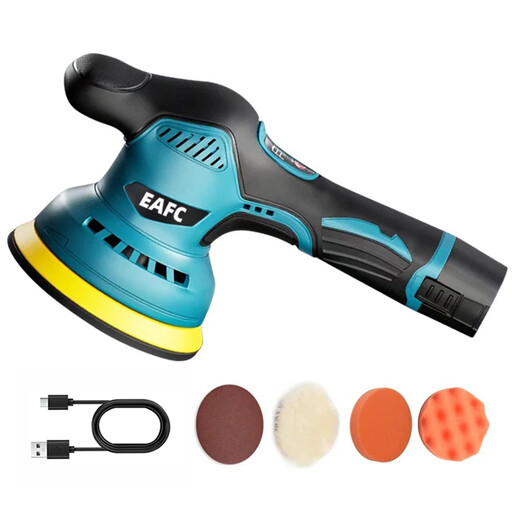
Why this is a good fit for this user: Its 125 mm size and eight settings make it a versatile first machine for applying wax and taking care of routine jobs, without relying on a mains socket.
The listing specifies a 0.9 cm eccentric throw and a hook-and-loop disc system. Both are worth checking to avoid time-consuming changes and concentrating the work in one area.
12 V, eight speeds from 2 800 to 5 500 rpm, rubberised handle and accessories compatible with a 125 mm disc.

Why this is a good fit for this user: The LCD screen and two 5 Ah batteries give you more precise monitoring, which is useful during longer car detailing sessions.
You can see the speed and battery information while using the machine, so you don’t have to rely on a vague promise about run time.
Two 5 Ah batteries, LCD screen, six speeds and an advertised 8 mm orbital throw with a 125 mm pad.
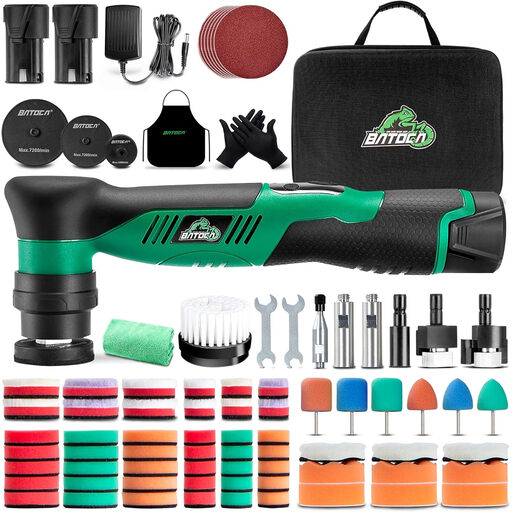
Why this is a good fit for this user: Its small backing plates are suited to headlights, badges, wheels and bodywork lines, where a standard plate can lack precision.
The kit offers more than just a large disc: it includes 25, 50 and 75 mm backing plates, as well as three advertised movement modes.
Two 2 Ah batteries, six speeds from 2 000 to 5 500 rpm and quick, tool-free shaft changes.
We’ve put together a complete, regularly updated list of products that meet these exacting selection criteria and European safety requirements.
During prolonged use, keep an eye on the housing temperature and make sure the ventilation openings aren’t blocked. If you need consistent power without interruptions for recharging, a corded car polisher, such as a 1 300 to 1 600 W model, may be better suited to a workshop. However, it offers less freedom of movement than a cordless car polisher.
Yes, as long as you choose a dual-action polisher with variable speed control and start gently. Don’t leave the machine stationary on one area, and start with a finishing pad rather than an aggressive abrasive.
It depends on the battery capacity, selected speed, pressure applied and temperature. To minimise interruptions, choose a kit with two removable batteries and a charge indicator.
The main costs are charging, pads and polishing products. The electricity used to recharge the battery is generally negligible, but accessories wear out at different rates depending on how often you use them, the type of product and how clean the paintwork is.