
Livraison le jour même ou le lendemain

Qualité garantie

Débloquez vos offres de bienvenue: Livraison GRATUITE | Jusqu'à -80 % | 30 jours d'essai gratuits à JoyPlus
Téléchargez l'application
Restoring your car's bodywork to its original showroom shine is a quest for many automotive enthusiasts. To achieve this, the cordless car polisher has become an indispensable ally, promising complete freedom of movement and professional-grade results. But be warned: the market is flooded with models making tempting promises that often hide major disappointments. Before you pull out your credit card, it's crucial to know the pitfalls to avoid so you can invest in a machine that truly meets your expectations. Our guide is here to help you cut through the noise and decode the spec sheets.
Between the appeal of new gadgets and inflated spec sheets, it's easy to make the wrong choice. Here are the three classic mistakes that turn a promising purchase into a real source of frustration.
You don't need to be an engineer to make the right choice. Focus on these few key points that determine the performance, safety, and versatility of your future cordless polisher.
The movement of the polishing head is the number one criterion.
The freedom of cordless comes at a price: battery life. Two indicators should be watched closely:
The size of the backing plate (the part where you attach the polishing pad) defines the work area.
Rather than an endless list, we've selected three models that cater to specific needs, keeping our performance and reliability criteria in mind.
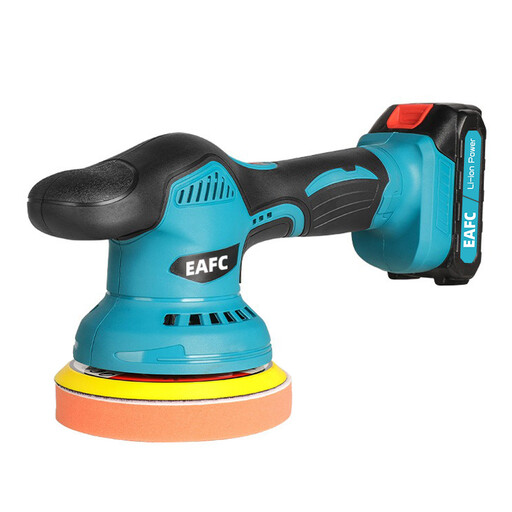
The Verdict : Ideal for maintaining your car a few times a year without breaking the bank or overcomplicating things. This kit provides the essentials to get started (polishing, waxing) with a machine that's easy to handle.
Its orbital motion makes it very safe for beginners, eliminating the risk of burning the clear coat. The kit includes the essential pads to get started, which prevents you from getting lost in buying accessories at the beginning.
8-speed adjustable control (2800-5500 RPM) to smoothly switch from waxing to light correction. Its feather-light weight (1.13 kg) makes it very maneuverable.
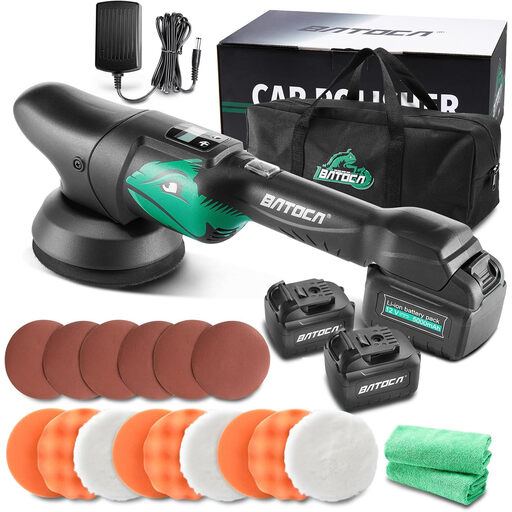
The Verdict : For those who regularly polish their vehicle and demand performance and endurance. The ability to work without interruption is crucial for a consistent result across the entire bodywork.
It directly addresses the battery life problem. With two 5.0 Ah batteries, you can polish an entire car without ever running out of juice. While one battery is on the machine, the other is charging.
The LCD screen that displays speed and battery level offers complete control. Its motor maintains a constant rotation speed even under pressure, guaranteeing a uniform finish.
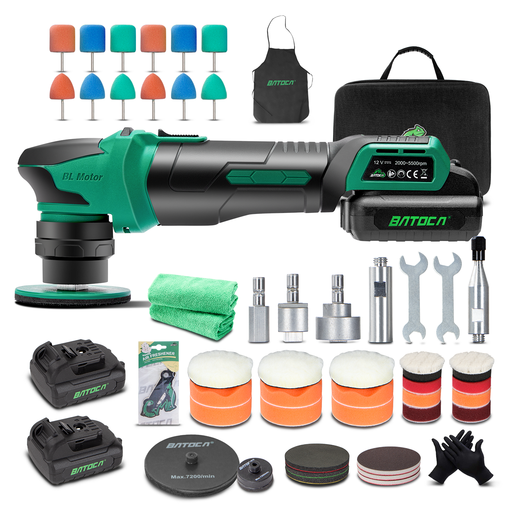
The Verdict : The machine for finishing touches and complex areas. It's the perfect complementary tool for tackling door pillars, bumpers, headlights, or wheels—areas where a standard polisher gives up.
It avoids the trap of bloated kits by focusing on its specialty. Its dual-mode (rotary and orbital) and multiple small backing plates (from 25 mm to 75 mm) give it formidable versatility for precision work.
Its brushless motor is a guarantee of power and longevity. The ability to switch between rotary and orbital modes with different diameters makes it the ultimate mini detailing polisher.
Discover our full selection of polishers, all chosen for their value for money and compliance with safety standards.
To put it simply: the rotary polisher is a powerhouse, highly effective for correction but can "burn" the paint if not handled correctly. It's reserved for experts. The orbital polisher (or dual action) is much safer, ideal for beginners and enthusiasts. It's perfect for removing micro-scratches (holograms) and applying waxes and sealants.
It all depends on the battery capacity (Ah), the selected speed, and the pressure you apply. With a 2.0?Ah battery, expect 20 to 30 minutes of actual work time. With a 5.0?Ah battery, you can hope for 45 to 60 minutes. That's why having a second battery is a game-changer, so you don't have to stop mid-job.
Absolutely, it's one of its shining applications (no pun intended!). For headlight restoration, a mini detailing polisher with a small backing plate (between 50 and 75?mm) is the ideal tool. It allows you to work with precision on the polycarbonate surface, first with sanding discs and then polishing pads, to restore them to perfect clarity.