
Livraison le jour même ou le lendemain

Qualité garantie

Débloquez vos offres de bienvenue: Livraison GRATUITE | Jusqu'à -80 % | 30 jours d'essai gratuits à JoyPlus
Téléchargez l'application
A car orbital polisher makes it easier to apply wax, restore shine to dull paintwork and visibly reduce certain swirl marks. However, not every machine is suited to the same jobs. High power does not guarantee a flawless result, nor does a battery described as ‘long-lasting’ tell you how long it will really last in use.
To avoid buying the wrong machine, focus mainly on the orbital movement, speed range, backing plate diameter, power source and supplied accessories.
A high maximum speed may seem appealing, but it is not necessarily useful for applying wax or achieving a fine finish. A variable-speed polisher should primarily offer a sufficiently gradual range so you can work at low speed, then increase it when buffing or carrying out light correction.
For private users, six speed settings are generally enough to adapt the movement to the product being used and the condition of the bodywork. The speed should always be increased gradually, and you should never leave the machine stationary in the same place for a long time.
A dual-action orbital polisher combines rotation of the backing plate with an eccentric movement. This action distributes the work more evenly across the surface, making it particularly suitable for beginners who want to apply wax, bring out the shine in a clear coat or reduce a few superficial marks.
It will not make a deep scratch disappear by magic. If your fingernail catches clearly in the scratch or the paint layer appears to be affected, it is best to proceed cautiously and avoid working the area too aggressively.
Even a correctly sized machine can produce an uneven result if the car polishing pads are too hard, worn or poorly cleaned. The foam, synthetic wool and product used should be selected according to the task: correction, buffing or protection.
Also check the attachment system. Velcro makes it easier to change pads and allows you to reserve several foam pads for different stages of the job.
The orbital throw directly affects how the machine works across the surface. A 5 mm throw is generally versatile and easy to handle. With 8 mm, the machine covers more surface with each pass, but it requires steady movements and carefully controlled pressure.
For occasional bodywork restoration, a dual-action orbital polisher with a soft start helps limit jolts when the foam pad comes into contact with the clear coat.
The 6-inch polisher format is suitable for many bodywork surfaces and allows you to cover a bonnet or roof quickly. A 125 mm backing plate, or approximately 5 inches, is easier to handle in narrow areas, on bumpers and on motorbikes.
Do not choose your pads based solely on their outer diameter: the backing plate, hook-and-loop backing and any dust-extraction holes must be compatible.
A cordless car polisher gives you welcome freedom of movement in a courtyard, a garage without a nearby socket or when carrying out a few quick touch-ups. In return, you will need to check the battery capacity, charging time and whether a second battery can be used.
A corded model avoids interruptions caused by recharging and may be better suited to longer sessions. In both cases, weight, the side handle, lock-on button and heat dissipation matter just as much as the stated power.
Before buying in France, check that the required safety information is provided, that instructions are available in French where necessary and that the applicable compliance requirements are met. The CE marking, where required, does not remove the need to use the machine in accordance with the manual: safety goggles, good ventilation and keeping away from moving parts remain essential.
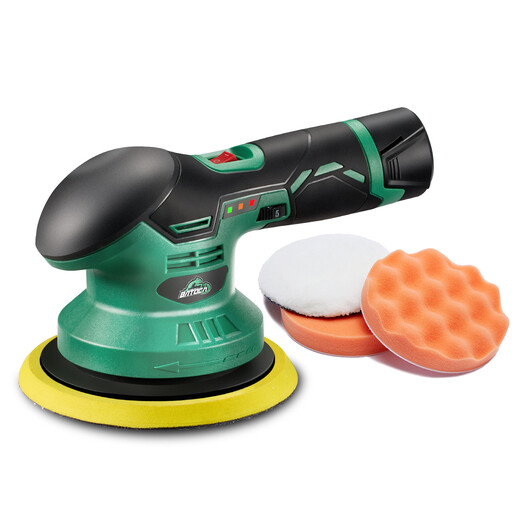
Why this choice suits this profile : This battery-powered polisher focuses on mobility and gradual use on cars, motorbikes, leisure vehicles and boats. Its 6-inch format is suitable for large painted surfaces.
The six speed settings prevent you from always working at maximum speed. The charge indicator helps you anticipate recharging the 2.0 Ah battery.
5 mm orbital movement, stated speed of 2 500 to 5 000 rpm, battery and charger included.
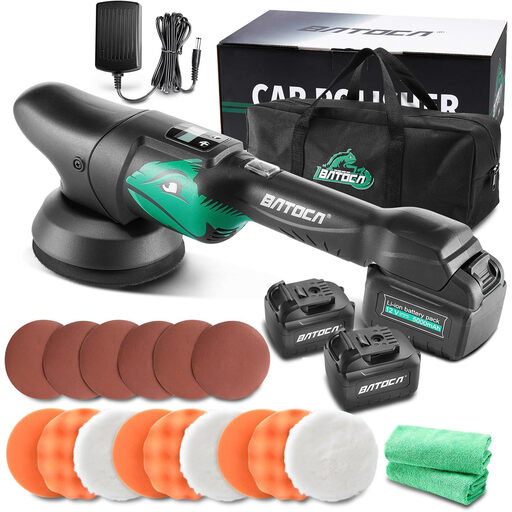
Why this choice suits this profile : Its equipment is aimed at users who want precise control throughout their polishing session, without a cable and with a spare battery to minimise breaks.
The LCD displays the speed and battery level, preventing guesswork when making adjustments. The kit is supplied with two 5 000 mAh batteries.
8 mm orbital throw, six speeds, 125 mm backing plate and stated charging time of 2.5 hours.
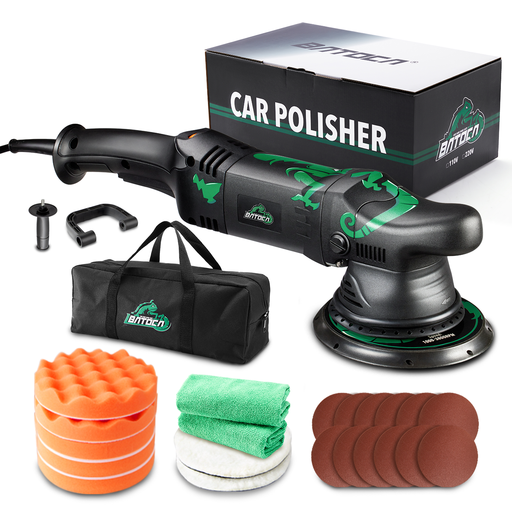
Why this choice suits this profile : This corded model is suitable for long sessions on cars, boats, motorbikes or painted surfaces requiring a continuous power supply.
Mains power prevents the machine from stopping when the battery runs flat. The six settings prevent you from working at 5 500 rpm, the stated maximum speed, for every task.
Stated 1 100 W motor, removable side handle, D-handle and speed range of 2 500 to 5 500 rpm.
For a light finish, a car polishing kit offering several foam densities makes it easier to move from correction to buffing. This set of eight pads includes waffle foam pads, a synthetic wool pad, a hook-and-loop backing plate and an M10 drill adapter. See the car polishing pads to check their dimensions and compatibility before use.
The 125 mm WORKPRO abrasive discs offer nine grits, from 60 to 600, with Velcro fastening and eight holes. They are more suitable for surface preparation and controlled sanding than for applying wax. When working on paintwork, start with a low-abrasion grit and test it on an inconspicuous area. The 125 mm WORKPRO abrasive disc set can complement a machine fitted with a compatible backing plate.
Start at a low speed to spread the product evenly, then follow the manufacturer’s recommendations. A high speed offers no benefit for simple application. Keep the machine moving and avoid edges and areas that are already warm.
No. Depending on the condition of the clear coat and the product used, it can reduce certain superficial defects, swirl marks or light oxidation. A deep scratch should be assessed beforehand and must not be treated by applying excessive pressure or repeatedly working the area.
You need to take electricity costs, battery wear and replacement pads into account. A model supplied with two batteries can reduce interruptions, while a corded machine avoids the need to buy additional batteries. In all cases, clean the foam pads after every session and replace them when they become misshapen or heavily soiled.