
Livraison le jour même ou le lendemain

Qualité garantie

Débloquez vos offres de bienvenue: Livraison GRATUITE | Jusqu'à -80 % | 30 jours d'essai gratuits à JoyPlus
Téléchargez l'application
A car polisher makes it easier to apply wax, polish the bodywork and carry out certain restoration tasks. However, choosing the wrong model can quickly become expensive, especially if it proves too powerful, poorly equipped or incompatible with the accessories available.
Before buying a car polisher, start by defining how you intend to use it: occasional maintenance, defect correction, headlight polishing or regular work on several vehicles.
A high speed setting does not guarantee better results. Excessive speed can heat the clear coat, mark the paintwork or accelerate pad wear. For applying wax or polishing bodywork, a moderate speed is generally easier to control.
On a rotary machine, movement is transferred directly to the backing plate. This can be suitable for certain correction tasks, but it requires more experience. An orbital polisher, also known as a dual-action polisher, combines several movements and is often more forgiving for beginners using it at home.
An orbital polisher does not remove the need to follow the manufacturer’s recommendations, work on a perfectly clean surface and avoid leaving the machine in the same place for too long.
A cordless polisher can be very practical in a driveway, car park or garage where no socket is easily accessible. However, check the stated battery life, the number of batteries supplied and their compatibility. Some models are sold without a battery or use a system specific to a particular range.
Polishing pads, foam pads, the hook-and-loop backing plate and charger also affect the true cost of the equipment.
For treating an entire car, a 125 to 150 mm backing plate allows you to cover large areas efficiently. For wheels, pillars, the area around headlights or badges, a compact model equipped with a 25, 50 or 75 mm backing plate offers greater precision.
A dual-action polisher with a 5 mm throw is an appealing compromise for routine maintenance. A larger throw can make certain correction tasks easier, but it requires careful control of pressure and movement.
Choose a machine offering several speed settings. The lowest speeds are generally suitable for applying wax, sealant or finishing products. Intermediate settings are suited to everyday polishing, while higher speeds are intended more for certain correction tasks, depending on the pad and product used.
Values expressed in revolutions per minute refer to no-load speed or the stated operating range. On their own, they therefore cannot predict the result you will achieve.
For cordless work, having two batteries helps minimise interruptions. The overall weight, including the battery, the side handle and the presence of a charge indicator also matter when working on a bonnet, roof or the lower sections of the vehicle.
Before first use, read the instructions, check that the backing plate is securely tightened and wear the recommended protective equipment. Always test the machine on an inconspicuous area.
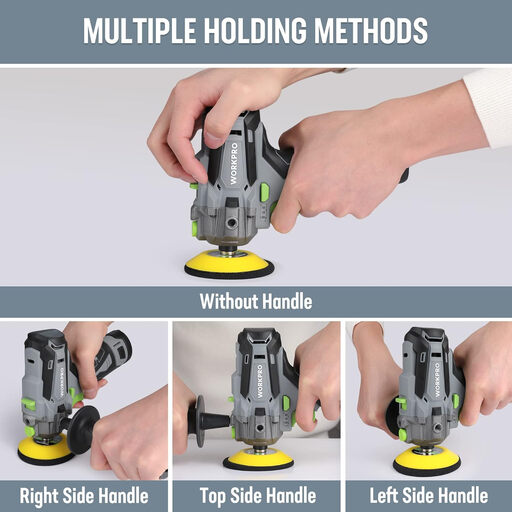
Why this choice suits this profile : Its compact 75 mm format and stated weight of 0.88 kg with the battery make it easier to work on small areas and carry out touch-ups while gradually getting used to the machine.
Its two speed settings, from 2 600 to 7 000 rpm according to the technical specifications, help prevent you from always working at full power. Two 2.0 Ah batteries are supplied.
The kit includes six foam pads, one wool pad, two polishing discs, a charger and three abrasive sheets.

Why this choice suits this profile : This cordless model combines an 8 mm dual-action throw, an LCD screen and two 5.0 Ah batteries. It is well suited to owners who want precise control over the settings.
The LCD screen displays the speed and battery level. Six power settings and soft start help reduce jolts during use.
The stated range is from 2 000 to 4 500 rpm. The specifications mention approximately 60 minutes of battery life and a charging time of 2.5 hours.
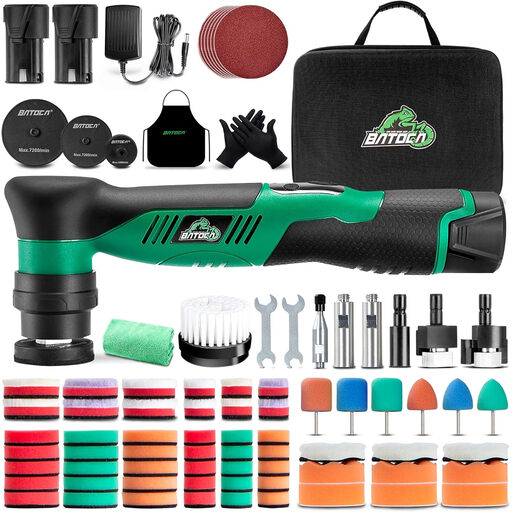
Why this choice suits this profile : Its three stated configurations — rotary, 3 mm dual-action and 12 mm dual-action — are designed for touch-ups, headlights, wheels and hard-to-reach areas.
The three 25, 50 and 75 mm backing plates prevent you from fitting a large disc to a small area. This gives you greater control and precision during touch-ups.
The kit contains two 12 V batteries and six speed settings, from 2 000 to 5 500 rpm according to the product specifications.
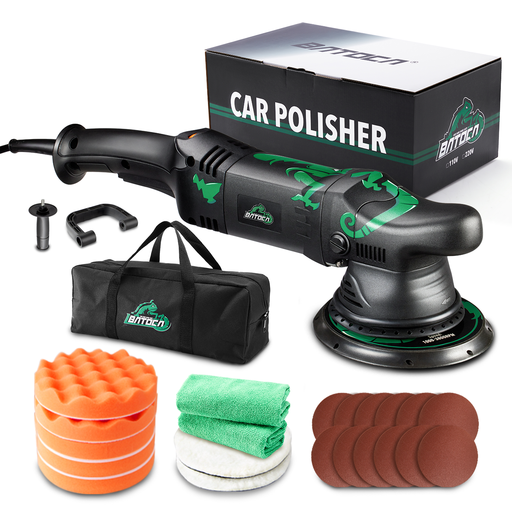
Why this choice suits this profile : Its corded power supply and 125 mm backing plate are suitable for long sessions on cars, motorbikes, boats or stone surfaces.
The cable means you do not have to rely on a battery during a long session. The stated 1 100 W motor and six speed settings provide a sufficiently wide adjustment range.
The choice of consumable depends on the condition of the surface. A firm pad is generally used to correct defects, while a softer foam pad is suited to finishing, waxing and polishing. Avoid using abrasive and finishing products on the same foam pad without cleaning it between uses.
The 100 mm synthetic wool polishing pad features hook-and-loop fastening and can be washed before being reused. To vary the levels of firmness, the 8-piece polishing sponge kit includes several foam pads, a synthetic wool disc and an M10 adaptor.
Before attempting to remove scratches, wash and dry the car thoroughly. Protect seals and sensitive plastics with masking tape, then work in small sections using regular passes. A scratch that has penetrated the paint layer will not necessarily disappear with a polisher. For headlight polishing, use accessories suitable for the material and follow the manufacturer’s recommendations.
Start at the lowest setting recommended in the instructions, using a soft pad and light pressure. Make overlapping passes without leaving the machine stationary. The ideal setting depends on the polisher, pad and product being used.
Battery life varies according to the battery capacity, selected speed, pressure applied and intensity of the work. Two interchangeable batteries allow you to continue working while the first one recharges. Check the manufacturer’s information rather than relying solely on the capacity stated in ampere-hours.
It can be easier to handle than a rotary model, but it still requires thorough preparation. Start on a small area, choose a suitable pad and regularly monitor the surface temperature.