
Same-day & Next-day Delivery

Quality Guaranteed

Unlock Your Welcome Offers: FREE Delivery | Up to 80% OFF | Free 30-day JoyPlus trial
Download the APP
Car detailing is the art of perfection. A glossy finish is good, but achieving a flawless shine in even the tightest corners is better. This is precisely where the cordless mini polisher comes in. Compact, precise, and free from the constraints of a cord, it's the essential tool for tackling complex areas?: logo contours, wheels, door pillars, and even headlight restoration.
However, the market is flooded with models making tempting promises that don't always hold up. Before you decide, it's wise to understand the common pitfalls to avoid investing in a tool that will let you down after just a few uses.
The appeal of going cordless can sometimes mask critical design flaws. Here are the key points to watch for to make an informed choice.
To avoid these pitfalls, focus on a few objective technical specifications. These are the true indicators of a cordless car buffer's performance and versatility.
Understanding the polishing head's motion is the first criterion to master.
The freedom of cordless operation depends entirely on the battery. Look beyond the marketing claims and check these two points?:
A mini polisher is designed for precision. Its versatility depends directly on the size of the backing plates it can accommodate. A good kit should offer several diameters, typically?:
Rather than an exhaustive list, we've matched specific models to user profiles to help you find the tool that truly fits your needs.
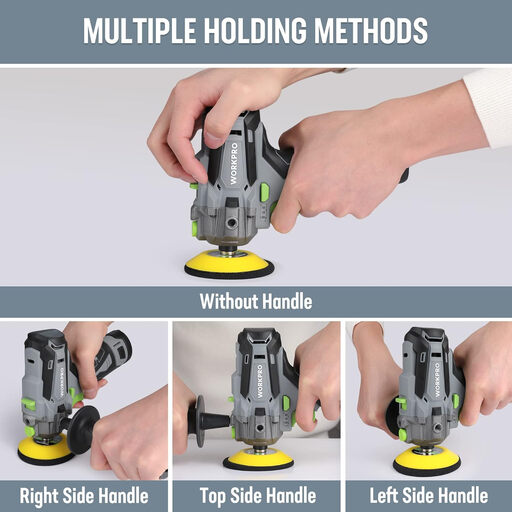
Why we chose it : This set is an excellent entry point for those who want to get seriously equipped without breaking the bank. It's designed for immediate, continuous use right out of the box, which is perfect for a first full restoration project.
It directly counters the battery life pitfall by including two 2.0 Ah batteries and a fast charger (1 hour). No more frustrating interruptions mid-job.
The kit is very comprehensive for its price : it includes an auxiliary handle, several polishing pads, a wool pad, sandpaper discs, and a practical carrying bag.
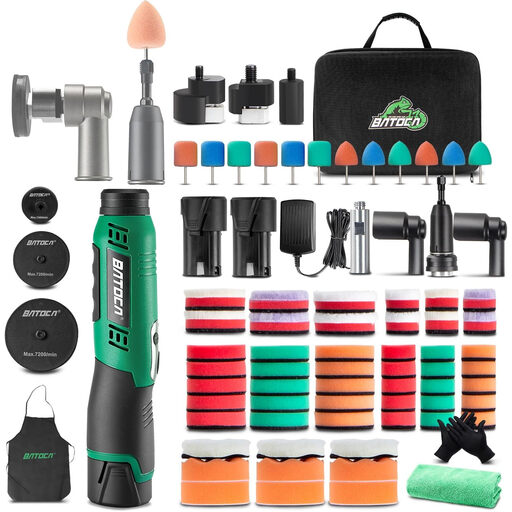
Why we chose it : For those who refuse to compromise on the details. This tool is a true miniature workstation, designed to adapt to any situation a meticulous detailer might encounter.
It tackles the pitfall of ineffective movement by offering a dual mode (DA & RO). You can switch from a safe orbital mode to a powerful rotary mode for targeted correction.
Its strength lies in its extreme versatility : it comes with 25 mm, 50 mm, and 75 mm backing plates, several extension shafts, and a full range of pads to tackle the most inaccessible areas.
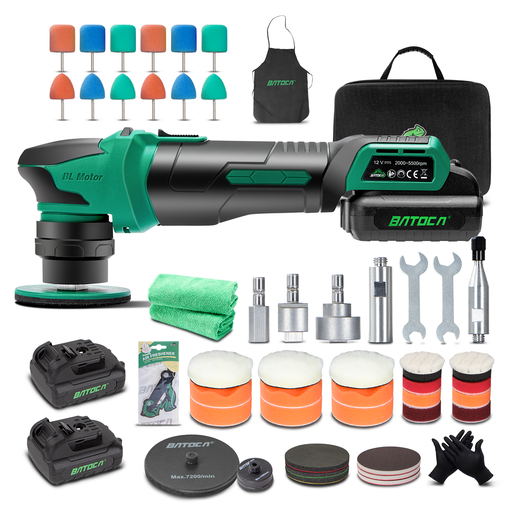
Why we chose it : Engineered for performance and durability, this professional polisher is aimed at those seeking maximum efficiency and features designed for heavy-duty use.
The brushless motor delivers more power, a longer lifespan, and reduced heat, preventing the performance drops and premature wear common in standard models.
The speed memory function is a real efficiency booster. The kit also includes two powerful 2.5 Ah batteries and extension shafts for maximum reach.
We have compiled a complete, up-to-date list of products that meet our demanding selection criteria and safety standards.
A rotary polisher spins on a single axis, offering high cutting power to correct significant defects. It requires some practice to master. An orbital (or random orbital) polisher uses a dual-action motion that is safer, generates less heat, and minimises the risk of leaving marks, making it ideal for beginners and finishing work.
This depends heavily on the model, battery capacity (measured in Ah), and the intensity of the work. For polishing with moderate pressure, a good-quality 2.0 Ah battery can provide between 30 and 45 minutes of runtime. This is why we strongly recommend choosing a kit with two batteries to work without interruption.
Absolutely. It's one of its most effective applications. With the right backing plate (usually 75 mm), wet-sanding discs, and the appropriate polishing pads, a mini polisher allows you to restore the clarity of polycarbonate lenses with precision and control, far more effectively than by hand.