
Livraison le jour même ou le lendemain

Qualité garantie

Débloquez vos offres de bienvenue: Livraison GRATUITE | Jusqu'à -80 % | 30 jours d'essai gratuits à JoyPlus
Téléchargez l'application
Getting your car's bodywork to shine like new: a satisfaction every car enthusiast seeks. The cordless car polisher has emerged as the ideal tool, promising freedom of movement and ease of use. But be warned, the market is flooded with marketing promises that often lead to disappointing purchases. As a product expert, my mission is to help you decode the spec sheets to make the right choice.
Before you take the plunge, beware of these 3 common traps that can be costly for unwary buyers:
To make the right choice, focus on a few essential technical specifications. These are what determine the performance, safety, and versatility of your future polisher.
This is arguably the most important criterion. It defines how the pad moves across the bodywork.
For a battery-powered polisher, two values need close attention:
These two elements have a direct impact on the work area and the quality of the finish.
Rather than an exhaustive list, we have selected models that each cater to a specific user profile.
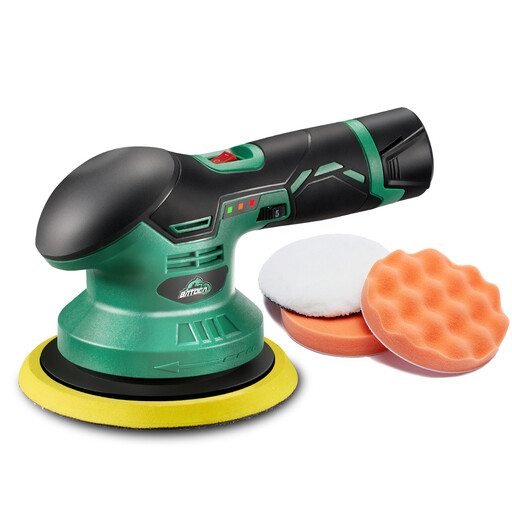
Why we chose it: This is the ideal starting point for anyone looking to get into polishing. Its orbital motion is very safe, and the basic kit provides the essentials for a first wax application or a light polish.
This model avoids the trap of bloated kits by offering a targeted and functional set of accessories. Its 2.0 Ah battery provides a realistic runtime for a polishing session, without making exaggerated promises.
Its 5 mm orbital motion is very forgiving: it prevents the formation of holograms and allows you to learn the proper techniques without risking damage to the paint.
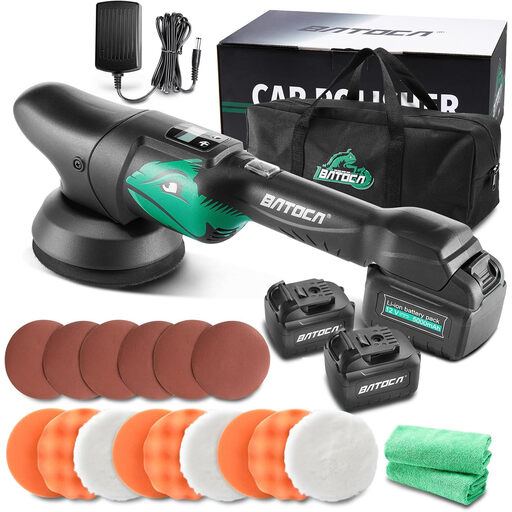
Why we chose it: A model designed for those who polish regularly and demand consistent results. Its powerful batteries, 8 mm orbit, and control screen make it a high-performance tool for correcting moderate defects.
This model solves the runtime problem with its two 5.0 Ah batteries, which ensure prolonged work without interruption. The LCD screen provides precise control over speed and remaining battery life, preventing unpleasant surprises.
The combination of consistent power, an 8 mm orbit, and high-capacity batteries allows for faster and more effective defect correction, while retaining the safety of an orbital motion.
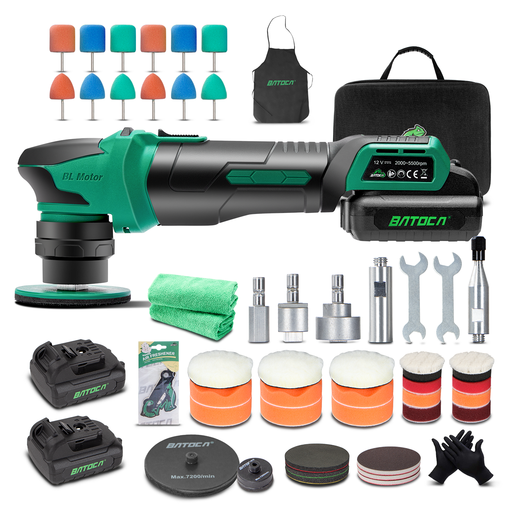
Why we chose it: This is the ultimate precision tool. It is essential for tackling areas inaccessible to standard machines: bumpers, mirrors, door pillars, emblems, or wheels. A must-have for a flawless result.
Rather than being a mediocre "do-it-all" tool, this model excels in its niche. It comes with suitable backing plates (25 and 75 mm) and a switchable system for maximum versatility on small surfaces, where larger kits fail.
Its dual system (rotary and orbital) allows you to switch from targeted correction to a perfect finish on the most complex areas. It offers a level of detail that only a mini battery-powered polisher can achieve.
Discover our complete selection of products that meet our strict selection criteria and current regulations.
What is the difference between an orbital and a rotary polisher? To put it simply: the orbital (or dual-action) polisher is safer and more versatile, ideal for beginners and regular maintenance. Its dual motion reduces the risk of overheating and holograms. The rotary polisher, on the other hand, is more powerful and aggressive. Designed for correcting major defects, it requires experience to be used safely.
What is the real-world runtime of a cordless polisher? The runtime depends on the capacity (Ah), the speed used, and the pressure applied. On average, a 2.0?Ah battery provides 30 to 45 minutes of light use (wax application). A 5.0?Ah battery can exceed an hour of work, even during polishing phases. To work without constraints, we highly recommend choosing a model that comes with two batteries.
Should I buy a complete polishing kit to get started? Not necessarily. A good car polishing kit for a beginner should contain the essentials: the machine, a charger, ideally two batteries, and 3 or 4 pads of different grades (for correction, finishing, and waxing). Polishing products (compounds, polishes, waxes) are often purchased separately to best suit the condition of your vehicle.