
Livraison le jour même ou le lendemain

Qualité garantie

Débloquez vos offres de bienvenue: Livraison GRATUITE | Jusqu'à -80 % | 30 jours d'essai gratuits à JoyPlus
Téléchargez l'application
A car polisher can restore shine to your bodywork, make wax application easier, and reduce certain visual imperfections. But choosing a polishing machine isn't just about comparing the RPMs on the spec sheet. An incompatible battery, the wrong backing plate size, or unsuitable pads can quickly turn a bodywork renovation into a wasted expense.
Here are the key factors to consider before choosing a cordless car polisher, a random orbital car polisher, or a corded car buffer.
A high speed isn't necessary for every stage. A lower speed is generally suitable for applying car wax, while a mid-range setting is better for polish and finishing work. High speed requires more control, especially on edges, corners, and areas where the paint layer is thinner.
A machine with multiple speed settings offers far more flexibility than a single-speed model.
A battery-powered polisher makes it easier to move around the vehicle, but its runtime depends on the battery capacity in amp-hours and the speed you're using. Also remember to check whether the battery and charger are included.
Some models are sold without a battery. The Gisam, for example, is designed for Makita 18 V series B batteries, including BL1830, BL1840B and BL1850B, with a recommended capacity of 2.0 to 5.0 Ah. It is not compatible with series G batteries or 18 V Ni-CD batteries. This check should be done before placing your order.
A car polishing kit may include several pads, but they aren't all intended for the same purpose. A wool or relatively firm pad can be used to correct certain defects, while a soft pad is better suited for finishing. A poorly cleaned accessory can also trap particles that might scratch the paint.
The attachment system, diameter, and compatibility with the backing plate matter just as much as the number of pieces included.
A random orbital car polisher, also called a dual-action machine, combines rotation with an eccentric movement. This design distributes the work over a wider area and offers a more progressive feel, which is particularly appreciated by beginners.
A rotary machine transmits movement directly to the backing plate. It can be suitable for targeted work, but requires consistent pressure and properly controlled speed. For a first purchase intended for a family car, a random orbital polisher with a soft start will generally be easier to control.
A backing plate of 125 to 150 mm covers large body panels effectively. For headlights, door handles, pillars, wheels, or tight areas, a smaller backing plate is more manoeuvrable. Some compact models accept backing plates of 25, 50, or 75 mm.
The orbital throw, measured in millimetres, directly influences the machine's behaviour. A small throw favours precision work, while a larger throw allows you to cover more surface area with each pass. In any case, start on an inconspicuous area and avoid applying excessive pressure.
A six or eight-speed adjustment allows you to adapt the machine to the product you're using and the stage you're working on. Also check:
For prolonged work, a corded model avoids interruptions from recharging. However, a cordless version remains very practical in a driveway, a garage far from a power socket, or for maintaining a motorbike, boat, or motorhome.
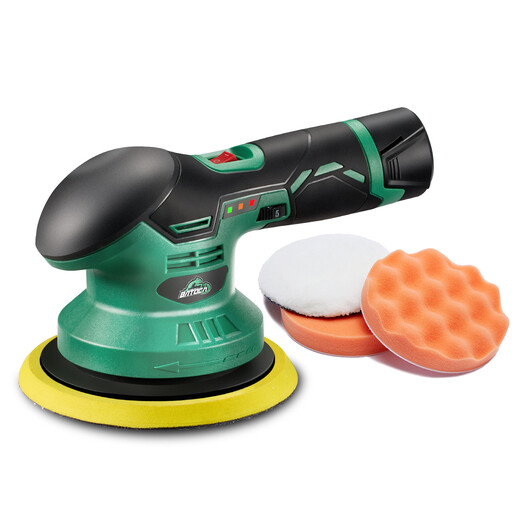
Why this choice suits this profile: This cordless car polisher comes with a 2.0 Ah lithium-ion battery and a fast charger. Its 5 mm random orbit and six speeds are suitable for routine maintenance on a car or motorbike.
The battery is included, so there are no extra purchases to make. The LED indicator lets you easily check the charge level before a session.
Battery and charger included, 150 mm backing plate, six speed levels and a stated weight of approximately 1.36 kg.

Why this choice suits this profile: Its LCD screen, two 5 Ah batteries and 125 mm backing plate are aimed at users who want to monitor speed precisely and work on large surfaces.
The two replaceable batteries minimise interruptions. The screen makes adjustments clearer than a simple dial without markings.
Two 5 Ah batteries, six speeds, LCD screen, stated speed of 2,000 to 4,500 rpm and 8 mm orbit.
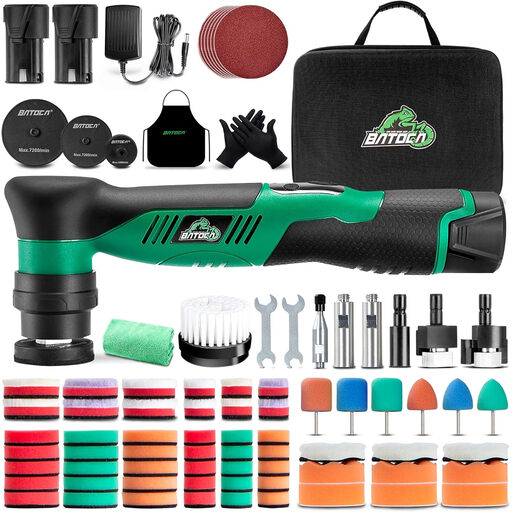
Why this choice suits this profile: This compact kit combines rotation, a 3 mm orbit and a 12 mm orbit. It's suitable for bodywork details, headlight polishing, badges and hard-to-reach areas.
The three movement modes prevent you from using a large backing plate on small surfaces. The two 2 Ah batteries let you alternate between sessions.
Backing plates of 25, 50 and 75 mm, six speeds from 2,000 to 5,500 rpm, two batteries and tool-free spindle change.
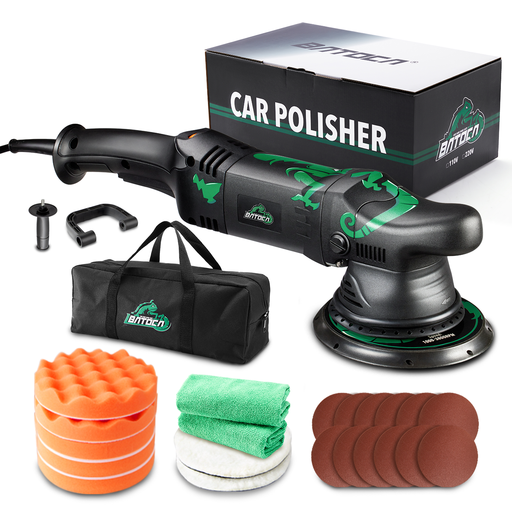
Why this choice suits this profile: This 1,100 W corded version is aimed at workshops and users who prefer continuous power for large surfaces, boats or motorhomes.
The mains power supply avoids the runtime limitations of a battery-powered polisher. The six-speed electronic adjustment prevents you from having to work at a single speed.
Stated power of 1,100 W, 125 mm backing plate, six speed settings from 2,500 to 5,500 rpm and side and D-handles.
Before you start polishing, wash and dry the bodywork thoroughly, then remove any visible contaminants. Work in the shade, on a cool surface, in small sections. Use clean polishing pads and check the result regularly.
For finishing, Meguiar's Ultimate Polish G19216F is presented as a pre-wax preparation product, supplied in a 473 ml bottle. Its spec sheet indicates it can be applied by hand or with a random orbital polisher at speed 3 or 4, followed by wiping off with a microfibre cloth. The manufacturer recommends testing it first on an inconspicuous area and advises against using the product on matte or satin finishes.
For small surfaces, the 100 mm faux wool pad with hook-and-loop attachment can be used with a compatible sander or polisher. It is stated to be washable and reusable. The 8-piece polishing sponge kit offers several textures, an M10 adapter and a hook-and-loop backing plate. Always check the diameter, attachment system and maximum permitted speed.
We've put together a comprehensive, real-time updated list of products that fully meet these strict selection criteria and European safety regulations.
A random orbital polisher with multiple speeds and a backing plate of around 125 to 150 mm offers a progressive learning curve. Start with a soft pad and a finishing polish on an inconspicuous area. Avoid edges and don't press too hard.
Runtime depends on the battery capacity, the speed selected and the pressure applied. A 2 Ah battery is suitable for short jobs, while two batteries or a 5 Ah capacity make longer sessions easier. Charging time and pad replacement also affect your working pace.
Choose cordless for greater mobility and for small jobs. Opt for a corded model for large body panels or frequent use near a power socket. In both cases, check the weight, backing plate diameter, availability of accessories and the safety instructions provided.