
Livraison le jour même ou le lendemain

Qualité garantie

Débloquez vos offres de bienvenue: Livraison GRATUITE | Jusqu'à -80 % | 30 jours d'essai gratuits à JoyPlus
Téléchargez l'application
A dead battery: every driver's nightmare, and one of the most frustrating roadside emergencies. The unnerving silence of the engine, a dashboard that's hopelessly dark… it's a situation we'd all rather avoid, especially in the middle of winter or far from help. Fortunately, there's a solution to get you back on the road in minutes, without needing a tow truck or another vehicle: the battery jump starter.
This compact device, also known as a portable starter or jump starter, has become an essential item to keep in your trunk. But with an overwhelming number of options on the market, how do you navigate the choices and select the model that's truly right for your needs? This guide breaks down the essential criteria and presents our selection of the best products to help you make the right choice.
By the Joybuy team, your product guide.
Before making a purchase, it's crucial to understand a few technical concepts that will make all the difference. Here are the key points to check to find the perfect jump starter for your vehicle and your usage.
This is the number one criterion, the one that determines if the jump starter will be able to revive your engine. Expressed in amperes (A), it comes in two distinct values:
For a compact or sedan gasoline car, a 600A to 1200A jump starter is generally sufficient. However, for a diesel engine (which is harder to start in the cold) or a large SUV, you should aim for models with 1500A or more. Simply ensure the device is 12V compatible, which is the case for almost all modern passenger cars.
Modern jump starters are true Swiss Army knives. Most include features that are very practical for both daily use and emergencies:
A good jump starter must include multiple safety features to prevent damage to your car's electronics or the device itself. Check for essential protections: short-circuit protection, reverse polarity protection, overload protection, overheat protection, and over-voltage protection. High-quality, robust, and well-insulated jumper clamps are also a sign of safety and durability.
To help you make your choice, we have reviewed several models based on their technical specifications, versatility, and suitability for different types of users.
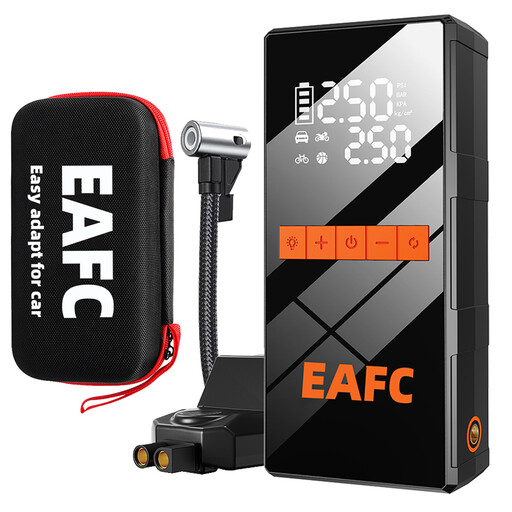
Why we love it: This model is the perfect example of a versatile tool. It combines a jump starter, air compressor, power bank, and LED light in a compact design. The ideal all-in-one solution to handle any roadside emergency.
Key features:
Who is it for? For drivers of compact cars, sedans, and small SUVs who are looking for an all-in-one device that can handle both a dead battery and an under-inflated tire. The ideal road trip companion for daily commutes and holiday travel.
See product details on Joybuy.fr
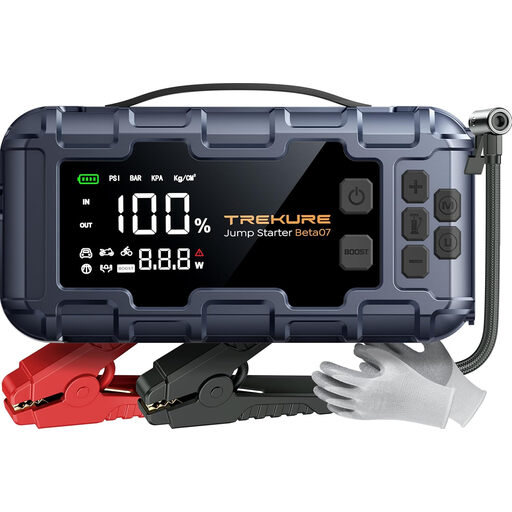
Why we love it: The TREKURE Beta07 plays in the big leagues. Its colossal starting power and compatibility with very large engines make it a top choice for the most demanding vehicles.
Key features:
Who is it for? For owners of large SUVs, 4x4s, commercial vans, RVs, or boats. In short, for anyone with a large-displacement vehicle. It's also a smart choice for semi-professional use or for equipping a small garage.
See product details on Joybuy.fr
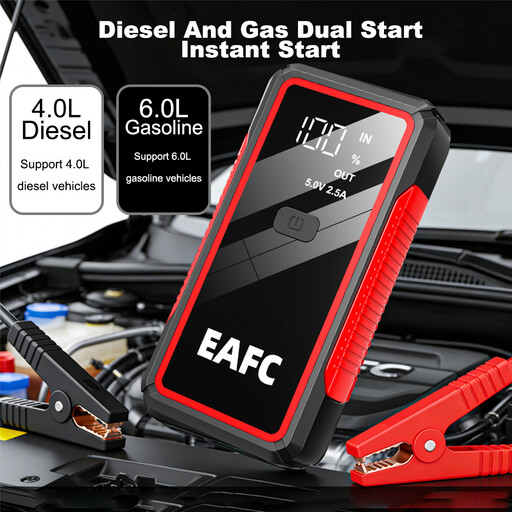
Why we love it: This model gets straight to the point: providing reliable starting power in an ultra-compact format. It's the perfect balance of performance, portability, and simplicity.
Key features:
Who is it for? For the driver looking for an efficient and discreet battery jump starter. It's perfect for the vast majority of cars, SUVs, and motorcycles, and slips easily into the glove box.
See product details on Joybuy.fr
Being well-prepared for roadside emergencies goes beyond just the battery. Good lighting is just as crucial, whether for changing a tire at night, inspecting the engine, or simply finding your belongings in the trunk. For a well-equipped garage or a complete emergency kit, be sure to explore our versatile lighting solutions.
Discover our selection of smart lights to complete your kit
1. What's the difference between a jump starter and a battery charger? A battery jump starter delivers a very intense, short burst of current (a "boost") to start an engine. Its purpose is not to recharge the battery. A battery charger, on the other hand, delivers a low current over a long period (several hours) to fully recharge a battery.
2. Can you leave a jump starter in your car permanently? No, you should definitely not leave it permanently connected. A jump starter should be stored charged in the trunk or glove box. Just remember to check its charge level every 3 to 6 months and recharge it if necessary so it's always ready for use.
3. Can a jump starter damage my car's electronics? No, not if you choose a modern model. They are all equipped with multiple safety systems (anti-reverse polarity, anti-short circuit, etc.) that make them safe to use. By following the user manual, the risk of damaging your vehicle's electronics is virtually zero.