
Livraison le jour même ou le lendemain

Qualité garantie

Débloquez vos offres de bienvenue: Livraison GRATUITE | Jusqu'à -80 % | 30 jours d'essai gratuits à JoyPlus
Téléchargez l'application
A dead battery: every driver's nightmare. A frosty winter morning, you forgot to turn off your headlights, and disaster strikes: the car won't start. It's a situation we've all dreaded. Fortunately, the jump starter, also known as an emergency starter, has become the essential accessory to keep in your glove box. Compact and increasingly powerful, it promises to get you out of a jam in minutes, without anyone's help.
The problem is, the market is flooded with models making tempting promises, and it's easy to get lost. How can you tell a reliable device from a useless gadget? To help you see things more clearly, our editorial team has decoded the spec sheets and identified the 3 most common pitfalls. The goal: to guide you toward a portable jump starter that truly fits your needs, without you throwing your money away.
To make an informed choice, forget the marketing hype for a moment and focus on the features that make a difference.
As you've gathered, peak current (or peak amps) should be taken with a grain of salt. The true measure of a booster's power is its starting current (or cranking amps). This is what indicates its ability to start the engine. For most gasoline cars, a starting current of 400 to 600 A is sufficient. However, for a jump starter for a diesel engine or a large SUV, aim for at least 800 A to be on the safe side, especially in cold weather.
Capacity, expressed in mAh (milliamp-hours) or Wh (watt-hours), measures the amount of stored energy. But be careful with the interpretation:
Always check the engine displacement (in litres) the booster is designed for. A model intended for a 3.0L gasoline engine will struggle with a 5.0L diesel. Reputable manufacturers are transparent about compatible engine sizes.
Finally, a jump starter worthy of the name must include an array of protections via its smart clamps. Demand at a minimum:
Rather than a long list, here are a few options that cater to different user profiles, based on the performance and safety criteria we've just discussed.
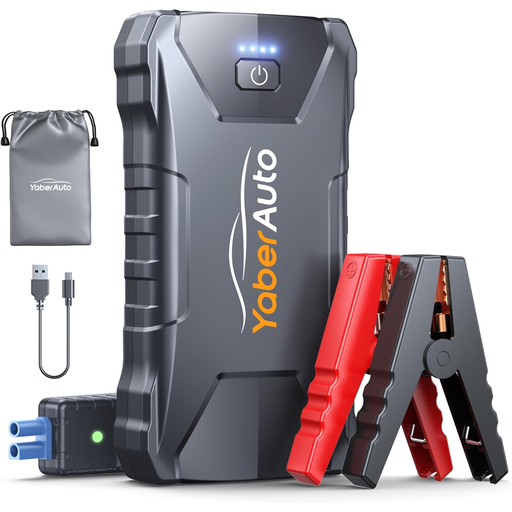
Why it's a great fit: Perfect for passenger vehicles (gasoline up to 7.0L), this is the ideal road trip companion for the prepared driver. Its ultra-compact size and feather-light weight (340g) ensure it has a prime spot in the glove box without ever getting in the way. The ideal backup solution for daily commutes.
It's all about transparency, clearly stating its engine compatibility and integrating 10 safety protections. This helps you avoid the disappointments of low-end models. Its 13,800 mAh capacity is consistent with its size and its function as a power bank.
Its excellent power-to-size ratio. The power bank function is a real bonus on the go, as is its 3-mode LED flashlight.

Why it's a great fit: Built for the heavy hitters: SUVs, vans, RVs, and large-displacement vehicles (gas and diesel up to 10.0L). This is the trusted tool for professionals and long-haul travellers for whom failure is not an option.
Here, the 4000 peak amps are no bluff: they are calibrated for large engines where conventional boosters throw in the towel. Its "BOOST" button allows you to force a start on the most stubborn batteries, a game-changing safety feature.
Its jump-starting firepower. Its all-metal clamps are built to last and ensure optimal conductivity.
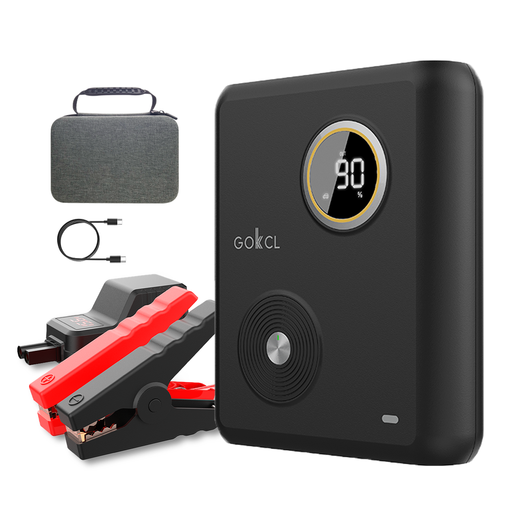
Why it's a great fit: Perfect for those looking for a "set it and forget it" solution. Its sodium-ion battery technology allows it to hold its charge for years and operate in extreme temperatures (-40°C to 80°C). A top-tier choice for rock-solid reliability.
It tackles the Achilles' heel of lithium boosters: their rapid self-discharge, which requires recharging them every 2-3 months. With a self-discharge rate of just 1% per month (according to the manufacturer), it remains ready for action even after a year in the glove box.
Its sodium-ion technology, a guarantee of very low self-discharge. It also stands out for its PD60W two-way fast charging and its exceptional operating temperature range.
Explore our full selection of jump starters, all rigorously selected for their performance and compliance with safety standards.
It all depends on its technology and how you use it. A standard lithium model has an average lifespan of 3 to 5 years. Its capacity naturally diminishes over time and with charge cycles. Newer technologies, like sodium-ion batteries, promise a much longer lifespan, supporting a significantly higher number of cycles.
Yes, and this is a critical point for most models. It is strongly recommended to recharge a lithium booster every 2 to 3 months, even if you haven't used it. This is an absolute must to preserve its battery and ensure it will be ready when you need it. Forgetting this maintenance is the number one reason why boosters themselves fail.
With a quality model, the risk is virtually zero. Its "smart" clamps are designed for this very purpose: they integrate protections that block any risky move, such as reverse polarity or a voltage spike. This is precisely why you should steer clear of entry-level models that skip these vital safety features. In any case, taking a quick look at the user manual before the first use is always good practice.