
Livraison le jour même ou le lendemain

Qualité garantie

Débloquez vos offres de bienvenue: Livraison GRATUITE | Jusqu'à -80 % | 30 jours d'essai gratuits à JoyPlus
Téléchargez l'application
A dead car battery is every driver's nightmare. Fortunately, a portable car jump starter is the simplest and fastest solution to get you back on the road without calling for assistance. However, with a saturated market and sometimes misleading marketing claims, it's hard to make sense of it all.
As a product selection expert at Joybuy, I'm here to help you see things more clearly. This guide breaks down the pitfalls to avoid and the criteria that truly matter when choosing a reliable car starter that fits your needs.
Marketers love impressive numbers, but they don't always reflect a device's real-world performance. Here are three essential points to watch out for to avoid buyer's remorse:
To make an informed choice, you need to focus on a few key technical specifications. These are what determine the true performance and reliability of your jump starter.
Forget peak current for a moment. The crucial information is the jump starter's compatibility with your engine's displacement, expressed in litres (L), and the fuel type.
A powerful jump starter isn't just the one with the biggest number on the box, but the one that is perfectly sized for your vehicle's engine.
The battery is the heart of the portable jump starter. Its technology directly influences its safety, durability, and ability to hold a charge.
If you're looking for an all-in-one device, pay close attention to the quality of the extra features.
Rather than an exhaustive list, here are a few options that cater to different user profiles, taking into account performance and reliability criteria.
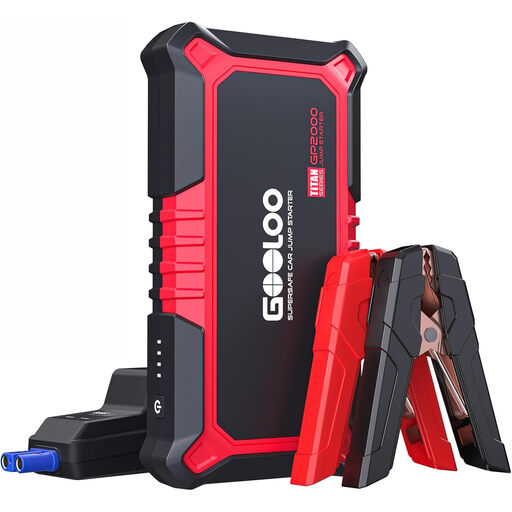
Why we chose it: The ideal solution for drivers of city cars, sedans, and SUVs who want a reliable and compact emergency device. It gets straight to the point: starting your car, and it does it well.
It doesn't bother with gimmicks. Its power is clearly stated for engines up to 8.0L gasoline and 6.0L diesel: a realistic promise tailored to the majority of vehicles, far from fantasy peak numbers.
10 built-in safety protections for risk-free use. Compact and lightweight (approx. 540g), it stores easily in the glove box.

Why we chose it: The perfect tool for owners of large SUVs, vans, or powerful diesel engines who are looking for an all-in-one road trip companion. It combines a muscular starter with a genuinely effective air compressor.
Here, the compressor is no gimmick. With its 150 PSI and automatic shut-off, it's a truly effective feature for tyre maintenance, fully justifying its status as the driver's Swiss Army knife.
High power (4500A) compatible with large engines (up to 9.0L gasoline / 8.0L diesel). Clear LCD screen displaying tyre pressure and battery level.

Why we chose it: For anyone who puts safety, durability, and peace of mind first. Its sodium-ion battery technology makes it a true long-term investment, designed to be forgotten in the car... until the day you need it.
It obliterates the self-discharge problem. With a loss of only 1% per month, it can stay in your trunk for several years on a single charge. It will always be ready when you need it.
Sodium-ion battery technology for enhanced safety and an operating temperature range of -40°C to 80°C. Exceptional lifespan (≥ 6,000 cycles).
We've compiled a comprehensive, up-to-date list of products that meet our strict selection criteria and safety regulations.
This depends on the battery technology and its manufacturing quality. For a standard lithium-ion model, it's recommended to check and recharge the device every 2 to 3 months to ensure it's operational. Newer models, especially those with sodium-ion batteries, have very low self-discharge and can hold their charge for over a year.
No, provided you use a quality device and follow the instructions. Modern jump starters are packed with smart protections (spark-proof clamps, reverse polarity protection, over-voltage protection, etc.). These safety features prevent any damage to the vehicle's electronics or battery, even if you accidentally connect the clamps the wrong way.
Rather than relying solely on peak current, check the compatibility with the engine displacement (in litres) indicated by the jump starter's manufacturer. As a general guide: