
Livraison le jour même ou le lendemain

Qualité garantie

Débloquez vos offres de bienvenue: Livraison GRATUITE | Jusqu'à -80 % | 30 jours d'essai gratuits à JoyPlus
Téléchargez l'application
A dead battery: every driver's nightmare. It always happens at the worst possible moment, leaving you stranded on the roadside. Faced with this classic automotive headache, the battery jump starter is the modern, life-saving solution. No more relying on another vehicle or waiting endlessly for a tow truck. The only catch: how do you navigate the jungle of available models?
As the Head of Product Recommendations at Joybuy, my role is to help you see things more clearly. This guide is designed to give you all the key information you need to choose the perfect portable car jump starter for your needs, based on concrete criteria designed for today's drivers.
Before diving into our selection, let's review the essential points for making the right choice.
The number one criterion for a jump starter is its peak current, expressed in amps (A). This value represents the burst of power the device can deliver in an instant to start your engine.
Always remember to check the jump starter's compatibility with your engine's displacement (in litres), information that is systematically provided by manufacturers.
A good jump starter must ensure risk-free use, both for you and for your car's onboard electronics. Recent models are all equipped with smart jumper clamps that integrate a full suite of protections. Make sure the model you choose offers at least the following protections:
These safeguards make the jump-starting aid accessible even to complete novices.
Today, a jump starter does more than just start your car. It's a true Swiss Army knife for the road. Among the most practical options, you'll find:
We have selected three models that stand out from the crowd with their technical specs and versatility, designed to meet different needs.
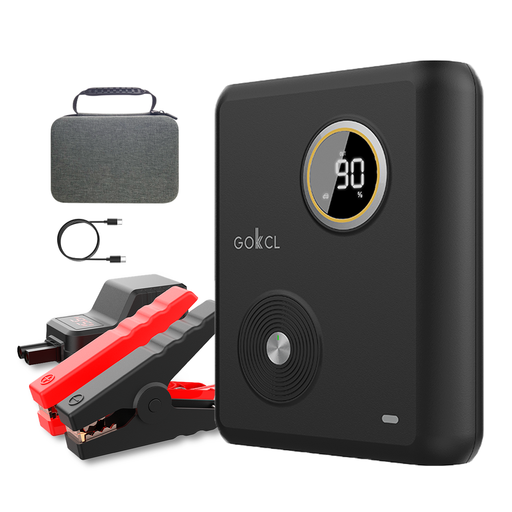
Why it stands out: The GOKKCL GK03 sets itself apart with its innovative sodium-ion battery. Unlike lithium batteries, this technology offers enhanced safety and an exceptional lifespan. It doesn't release oxygen when overheating, which eliminates any risk of fire or explosion. Its very low self-discharge also allows it to remain operational for 5 years without a recharge. That's unparalleled peace of mind.
Advantages:
Who is it for? For drivers who prioritise long-term reliability and uncompromising safety. A particularly wise choice for those living in regions with extreme climates (harsh winters, scorching summers) and who want a device they can forget about in their car.
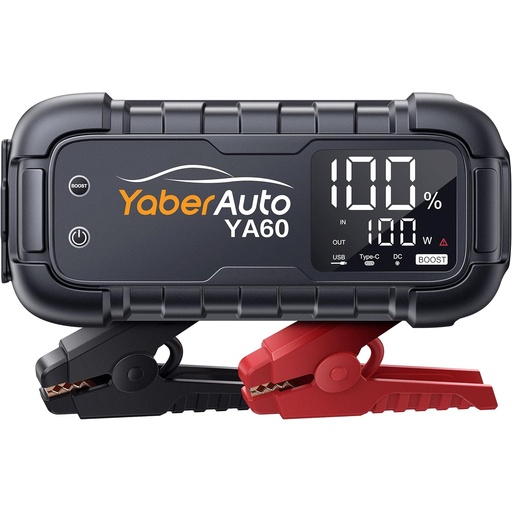
Why it stands out: The YaberAuto YA60 is a powerhouse. With an impressive peak current of 8000 A, it can start any petrol engine and diesel blocks up to 12.0L. Its 65W two-way fast charging not only allows it to fully recharge in 1.5 hours but also to serve as an ultra-fast power bank for laptops and other devices.
Advantages:
Who is it for? For owners of large-displacement engines, professionals, and adventurers who need a colossal and versatile power reserve, capable of starting a V8 as well as powering a campsite.
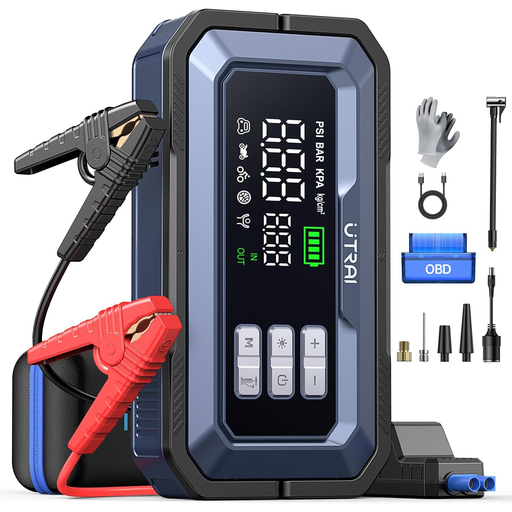
Why it stands out: The UTRAI JS-30 is much more than a simple jump starter: it's a complete emergency toolkit. In addition to its 7000 A of firepower, it integrates an air compressor (150 PSI), a 2000-lumen work light, and even an OBD2 fault code reader. This automotive Swiss Army knife not only starts your car but also helps diagnose a problem and reinflate a tyre.
Advantages:
Who is it for? For the forward-thinking driver who wants to be prepared for (almost) any eventuality. It's the ideal piece of equipment to keep in the boot for long trips, holiday getaways, or camping excursions.
Don't these three models check all your boxes? Or maybe you just want to see other options? Feel free to browse our complete selection. You'll find dozens of jump starters for all vehicles and all budgets.
? Discover our full selection of battery jump starters
For a compact car or petrol sedan, a 600 A to 1000 A jump starter is sufficient. For a petrol SUV or a small diesel, aim for between 1200 A and 1500 A. For large diesel engines (trucks, utility vehicles), it's recommended to go for a model with 2000 A or more. When in doubt, it's always better to err on the side of too much power rather than not enough.
It all depends on its battery technology and the climate conditions. Conventional lithium models don't handle extremes well: their operating range is typically between -20°C and 60°C. Leaving them in a car in the scorching summer sun or in the freezing cold of winter can degrade their performance and lifespan. Conversely, sodium-ion models like the GOKKCL GK03 can withstand much more extreme temperatures (-40°C to 80°C) and are designed to be kept in a vehicle year-round.
Absolutely not, provided you choose a recent model equipped with smart jumper clamps. These clamps incorporate multiple protections (anti-short circuit, anti-overvoltage, anti-reverse polarity...) that guarantee 100% safe use for your car's onboard electronics, even the most sensitive ones.