
Livraison le jour même ou le lendemain

Qualité garantie

Débloquez vos offres de bienvenue: Livraison GRATUITE | Jusqu'à -80 % | 30 jours d'essai gratuits à JoyPlus
Téléchargez l'application
A flat battery can bring a car, van or motorhome to a standstill at the worst possible moment. A portable car battery booster lets you restart independently, without needing another vehicle or a mains socket. But you still need to get to grips with peak current, electrical capacity and engine compatibility.
Before you place an order, take the time to check the features that really matter for your needs. Here are the pitfalls to avoid, the criteria to compare and a selection of models suited to different types of motorist.
A high amp rating might look reassuring, but peak current alone doesn't tell you whether a booster is right for your vehicle. The engine type, its displacement, the battery's condition and the outside temperature all affect whether a jump start will succeed.
A portable jump starter rated at 2,000 A or 3,000 A may work for some petrol and diesel cars. However, you should always check the limits set by the manufacturer. For a diesel vehicle, a model rated for 3.0 litres won't necessarily be up to the job on a large van.
The capacity expressed in mAh indicates the lithium battery's reserve, but it doesn't guarantee a precise number of starts. Conversion efficiency, temperature and the actual power delivered all come into play.
A 10,000 mAh booster will generally be more compact. A 16,800 or 21,800 mAh model will have a larger reserve for charging a phone or tablet. In any case, recharge the device after use and regularly while it's in storage.
Clamps that are too short, a cable that's too thin or an awkward connection can turn a battery booster into a real headache. At the very least, choose a model with reverse polarity protection, short-circuit protection, overcharge protection and overheat protection.
These safety features reduce the risk of mistakes, but they don't replace reading the manual. A car battery that is visibly damaged, leaking or frozen must not be jump-started with a booster.
Start by checking the system voltage: the models shown here are designed for 12 V vehicles. Then look at the maximum engine displacement stated separately for petrol and diesel engines. A motorbike, a city car, an SUV, a pick-up or a motorhome won't necessarily have the same requirements.
The starting current and the peak current are two different measurements. When the spec sheet gives both values, compare them rather than relying solely on the highest figure.
A lithium-ion battery generally allows a portable jump starter to be more compact than older lead-acid models. In particular, check the following points:
Store the device in a dry place and avoid leaving it for long periods in a cabin exposed to high heat. The recommended temperature ranges vary between models.
An emergency LED light with a flashing or SOS mode can be invaluable when working at night. An LCD screen lets you monitor the charge level or, on some devices, check tyre pressure.
Be careful not to confuse a booster with a car battery charger. The booster delivers a pulse to help the engine start; it doesn't replace a slow recharge or the maintenance of an ageing battery.
The same logic applies to a car air compressor: you need to assess it based on its pressure, flow rate and intended use. The Intex electric pump shown below works on 12 V and 230 V, but its spec sheet states it is not designed for high-pressure tyres.
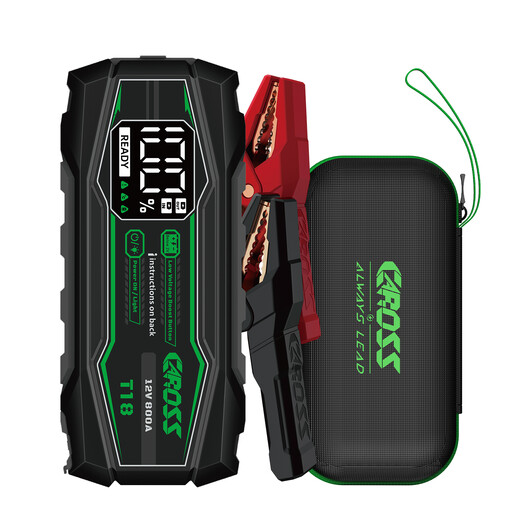
Why this choice suits this profile: Its compact size, 5.8 cm screen and carry case make it easy to handle for occasional use on a car, SUV or 12 V motorbike.
The spec sheet states reverse polarity and spark protection, plus a Boost function for very weak batteries. However, the manual notes that manual Boost mode requires extra care, as the protections are disabled.
800 A peak, 10,000 mAh battery, QC 18 W fast charging and stated compatibility up to 6.0 L for petrol and 3.0 L for diesel.
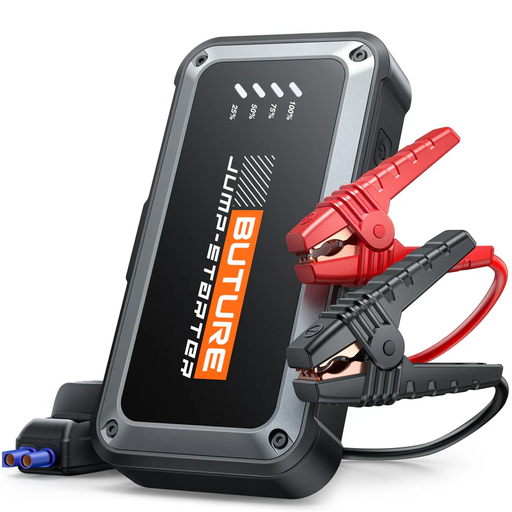
Why this choice suits this profile: It combines jump starting, device charging and lighting in a housing that is claimed to be water, dust and shock resistant. A relevant package for frequent journeys and outdoor activities.
The ten stated protections and smart cables reduce the risks associated with connection errors and overcharging. The manual recommends recharging every three months and advises against use on a damaged battery.
3,000 A peak, 16,800 mAh, two USB outputs and four LED modes. Stated compatibility reaches 9.0 L for petrol and 8.5 L for diesel.
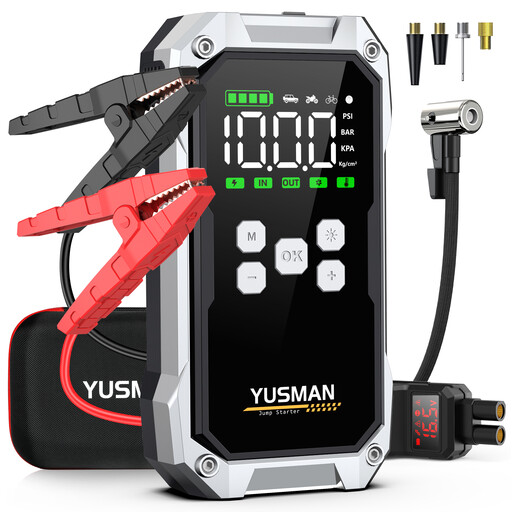
Why this choice suits this profile: Its built-in compressor appeals to drivers who want to combine emergency jump starting, occasional inflation and USB charging in a single device.
The screen displays pressure and the device includes reverse polarity, overheat and overcharge protection. Nevertheless, check the pressure recommended by your vehicle manufacturer.
5,000 A peak, 21,800 mAh battery, compressor rated at 150 PSI and compatibility stated up to 10.0 L for a diesel engine.
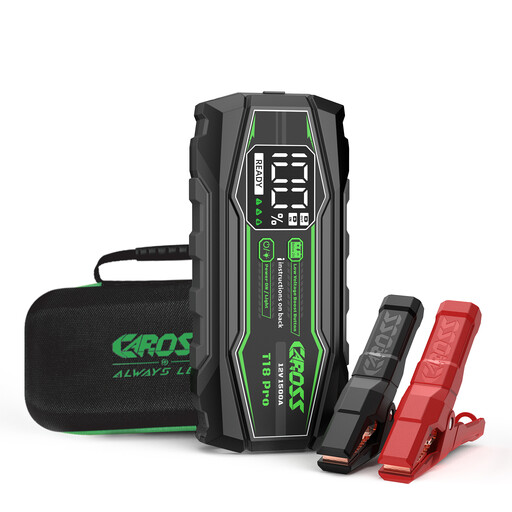
Why this choice suits this profile: Its 16,000 mAh battery, digital screen and carry case make it a suitable companion for long journeys, leisure vehicles and those who also want to charge their devices.
The spec sheet mentions a Boost function, spark-proof design and reverse polarity protection. Compare the displacement limits with your engine before buying.
1,500 A peak, 16,000 mAh, 5.8 cm LED screen, 18 W fast charging and protective case included.
Never let the clamps touch each other. After a jump start, a few miles of driving aren't always enough to recharge a very weak battery: a car battery charger may be needed for a full recharge.
Yes, provided the model is designed for both engine types and your vehicle's displacement stays within the stated limit. A petrol and diesel car booster must also be fitted with suitable cables and clamps. Always consult the manual before connecting it.
Its lifespan depends on the lithium battery, storage conditions, heat and maintenance. Recharge the device after each use or at the frequency stated by the manufacturer, often every two to three months. Avoid leaving it for long periods in a boot exposed to high temperatures.
No. The booster provides a one-off aid for starting, whereas the charger gradually recharges the battery. If the battery keeps going flat, have the battery and the vehicle's charging system checked.