
Livraison le jour même ou le lendemain

Qualité garantie

Débloquez vos offres de bienvenue: Livraison GRATUITE | Jusqu'à -80 % | 30 jours d'essai gratuits à JoyPlus
Téléchargez l'application
Watching your child take their first steps is a magical moment that all parents eagerly await. This key milestone in motor development raises its own set of questions: how can you help them build confidence without rushing them? What kind of support should you choose to ensure their safety? The baby walker, also known as a push toy, is a popular solution for offering support that is both stable and fun. Unlike a traditional sit-in walker, where the child is seated, a push walker encourages them to stand up and move forward at their own pace. This guide is here to help you make sense of it all and choose the perfect model, whether for your own child or as a gift for a one-year-old.
Faced with an overwhelming number of available models, certain criteria are essential for making an informed choice. Here are the key points to look for to find a baby walking aid that is both safe and stimulating.
The number one mission of a push walker is to offer reliable support. Check that the walker has a wide base to prevent any risk of tipping over. A crucial feature is the braking or wheel resistance system. Some models allow you to adjust the rotation speed of the wheels, which is particularly useful at the beginning, ensuring the walker never goes faster than the child. Also, make sure the materials are non-toxic (water-based paints, untreated wood) and that the corners are rounded to prevent bumps and scrapes in case of a fall.
A good baby walker is much more than just a support. It's also a true baby activity centre that stimulates their senses and fine motor skills. Today's models are packed with ingenious and varied activities:
These activities allow the child to take breaks from learning to walk while developing their hand-eye coordination, logic, and curiosity.
The wooden baby walker often wins hearts with its timeless aesthetic, sturdiness, and weight, which gives it excellent stability. It is seen as a durable toy that can even be passed down. Plastic models, on the other hand, are generally lighter and can incorporate more complex electronic features (music, lights). The choice will depend on your preferences for design, durability, and the type of activities you want to offer your child.
To guide you, we have scrutinised several models based on their design, features, and play potential.
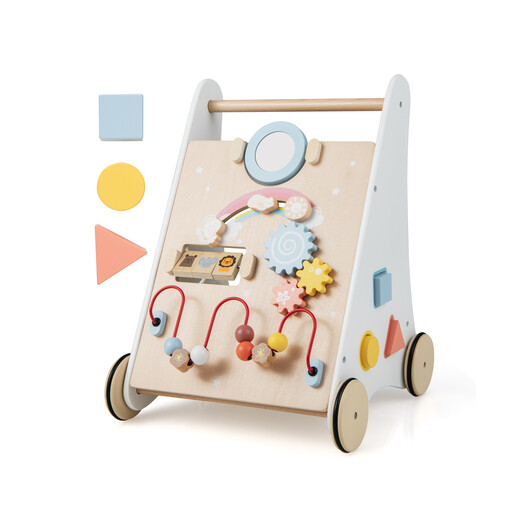
Why it stands out: This model combines the elegance of wood with a very comprehensive 7-in-1 approach. Its ergonomic design is crafted to support the child's natural posture. The small storage basket at the back is a detail that's as practical as it is fun, allowing your child to carry their favourite soft toys and treasures.
Advantages:
Who is it for?: Parents looking for a push toy for a 1-year-old that is classic, multifunctional, and durable, with a refined aesthetic that fits beautifully into a living room.
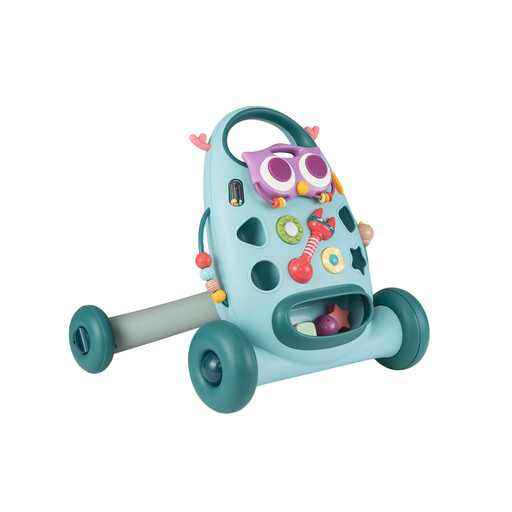
Why it stands out: Its greatest strength? Exemplary modularity. The activity panel is removable, allowing the child to play with it on the floor long before they can stand. The speed adjustment system on the rear wheels is a real bonus for adapting the walker to the child's progress.
Advantages:
Who is it for?: Families who love developmental and interactive toys, and who want precise control over the walker's speed to reassure both child and parents!
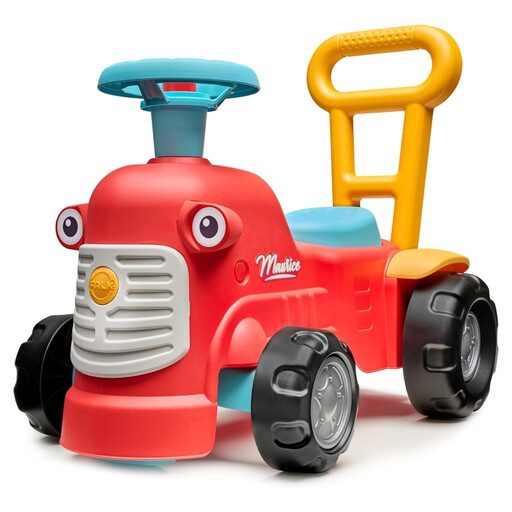
Why it stands out: This 2-in-1 product is a game-changer, serving as both a ride-on and a walking aid. Thanks to its backrest, the child can lean on it to push themselves along and take their first steps. Once walking is mastered, it transforms into a fun tractor to sit on. Being made in France from recycled plastic is a major selling point.
Advantages:
Who is it for?: Those looking for a long-term investment with a toy that grows with the child, transitioning from a walking aid to a first vehicle.
The baby walker is an excellent tool, but it's part of a broader family of toys designed for motor skill development. If you want to explore other types of ride-ons, rockers, or motor skill toys, we invite you to browse our complete category.
? Discover All Our Toys for Skill Development
The difference is fundamental. In a traditional sit-in walker, the baby is suspended in a harness and moves by pushing off on their tiptoes. A push walker, on the other hand, requires the child to be active: they must stand up, grip the handlebar, and coordinate their movements to move forward. This approach is unanimously considered more beneficial for a natural and physiological learning of walking.
There is no fixed age, as every child develops at their own pace. A push walker becomes relevant when the baby starts to pull themselves up to a standing position by holding onto furniture, usually between 10 and 12 months. The important thing is not to rush things and to always supervise its use.
Safety does not depend on the material, but on the overall design of the product. A well-designed wooden baby walker is often heavy, which gives it great stability. However, a plastic model with a wide base, non-slip wheels, and a low centre of gravity can be just as safe. The key is to check the stability of the structure, the quality of the finishes (no small parts that can come loose, rounded corners), and the presence of a braking or wheel resistance system.