
Livraison le jour même ou le lendemain

Qualité garantie

Débloquez vos offres de bienvenue: Livraison GRATUITE | Jusqu'à -80 % | 30 jours d'essai gratuits à JoyPlus
Téléchargez l'application
A baby walker can support play, early movement and the discovery of standing. However, this term covers products designed for very different uses. From seated walkers to push-along baby walkers and walking trolleys, the design has a direct impact on stability, footprint and suitable age range.
Before placing an order, three common mistakes are worth avoiding:
For a push-along baby walker, examine the width of the base, the weight of the frame and how comfortable the handle is to hold. Wheels with built-in resistance or speed adjustment can help prevent sudden starts, particularly on smooth flooring.
A baby walker with adjustable wheels can support several stages of learning, provided the adjustment mechanism is clearly explained and easy to use. On parquet or tiled floors, wheels with a non-slip, quieter coating can also help reduce sliding and noise.
The product must be used on a flat surface, away from stairs, thresholds, swimming pools and obstacles. Adult supervision remains essential.
An activity walker with a play centre focuses on buttons, gears, shapes, melodies and hands-on activities, whether the child is sitting or standing. A walking trolley, by contrast, is designed to support pushing and movement.
A 2-in-1 baby walker can be a practical choice when the activity panel can be removed or the structure adapts as the child grows. However, check the transformation mechanism, stability in each configuration and the product’s footprint within your home.
A seated walker is not designed for the same purpose as a push-along toy intended to support walking development. The product description should make this distinction completely clear.
A wooden baby walker appeals with its rigid construction and durable feel. Look for smooth surfaces, rounded corners, a comfortable handle and wheels suited to indoor flooring. Plastic may be lighter and easier to clean, but build quality and stability should remain the priorities.
Activity panels may contain small parts. Follow the recommended age guidance, regularly inspect the screws, wheels and removable components, and keep loose parts out of reach of younger children. For a musical baby walker, also check the sound level, battery type and access to the battery compartment.
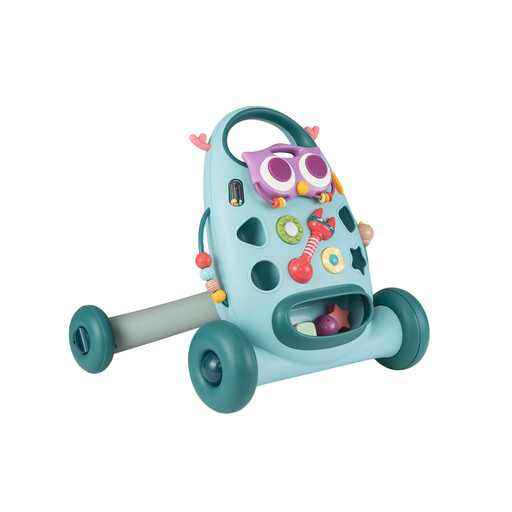
Why this model suits this profile: its removable oval panel and shape-sorting toy make it a good fit for families looking for a straightforward play solution at home.
The product listing highlights a specific function rather than an overwhelming catalogue of effects. Even so, check the dimensions, recommended age and wheel resistance before purchasing.
Removable panel and shape-sorting toy. A format suited to indoor play, subject to the complete information provided by the seller.
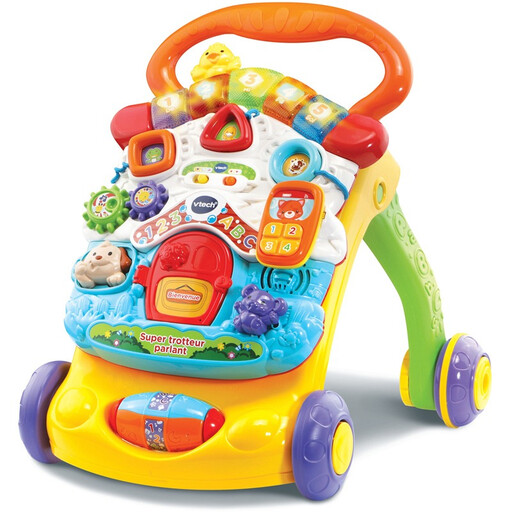
Why this model suits this profile: its design combines a removable activity centre with a push-along walker function, to be used as the child grows in confidence.
The wheel speed can be adjusted to suit different stages of development. However, the setting should be adapted to the flooring, and the panel must be properly locked before use.
Advertised for use from 9 months, with buttons, gears, illuminated touch points, shape sorting, sounds and melodies. Clean with a soft, slightly damp cloth.
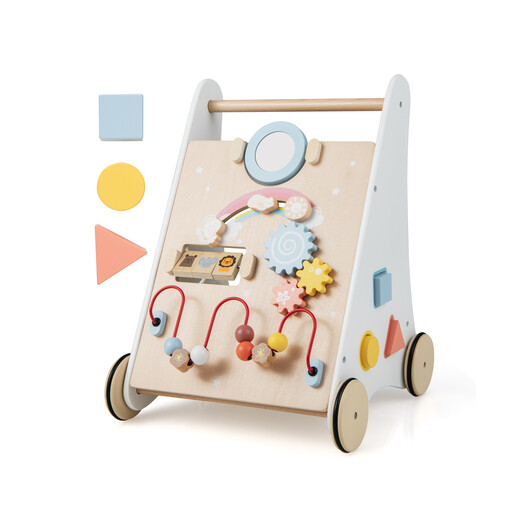
Why this model suits this profile: this wooden walking trolley is suitable for children beginning to pull themselves up and for households looking for a toy without electronic features.
Its rubber-edged wheels are designed to reduce noise and slipping. Speed should nevertheless be monitored on smooth floors.
Linden and MDF construction, several activities, storage basket, rounded corners and dimensions of 34.5 × 32.5 × 45 cm. Advertised for use from 12 months.
The Born Up Convertible Highchair Set + Roba Style Baby Walker requires an important clarification: its product listing describes it primarily as an adjustable high chair with a newborn bouncer, not as a walking trolley intended for first steps. It should therefore not be selected as a substitute for a baby walker. Its safety indications, including EN 12790:2009 and DIN EN 14988:2017, relate to the seating functions described.
We have brought together an updated selection of products that meet these selection criteria and the safety requirements applicable in France.
No. The age indicated by the manufacturer is a useful guide, but the child must also be able to maintain their posture correctly and use the product as intended. A push-along walker generally requires more balance than a seated activity centre. The instructions and adult supervision are essential.
These terms sometimes refer to similar products, but their designs can vary. A walking trolley is pushed using a handle and supports movement while standing. An activity walker may feature a play panel, while a seated model supports the child in a different position. Always check the description, dimensions and recommended age.
A musical model may require batteries to power its sounds and lights. The cost depends on frequency of use, battery life and whether compatible rechargeable batteries can be used. Wooden versions without electronic features reduce this ongoing expense, but the wheels, handle and assembly points still require regular inspection.