
Livraison le jour même ou le lendemain

Qualité garantie

Débloquez vos offres de bienvenue: Livraison GRATUITE | Jusqu'à -80 % | 30 jours d'essai gratuits à JoyPlus
Téléchargez l'application
A baby's first steps are an unforgettable milestone. To support them on this journey, a wooden baby walker is often the obvious choice: it's beautiful, durable, and aids in their development. But be careful—the market is saturated, and it's easy to be tempted by a model that turns out to be disappointing, or even dangerous. As editorial experts, our mission is to decode the technical specs for you and guide you toward a truly informed choice.
Before you fall in love with a design, here are the 3 pitfalls to avoid at all costs:
To make the right choice, you need to look beyond aesthetics. Here are the technical points that separate a simple toy from a genuine walking aid.
The number one job of a wooden push walker is to offer reliable support. Here are three points to inspect closely:
For a wooden developmental toy that will end up being chewed on, the composition must be impeccable.
The integrated baby activity centre should be an added bonus, not a source of distraction. Prioritise games that develop fine motor skills and logic:
These manual, battery-free, screen-free games transform the walker into an excellent gift for a one-year-old, which will remain useful long after walking is mastered.
Because every family is unique, we have selected models that meet different needs and budgets, all vetted against our criteria for safety and relevance.
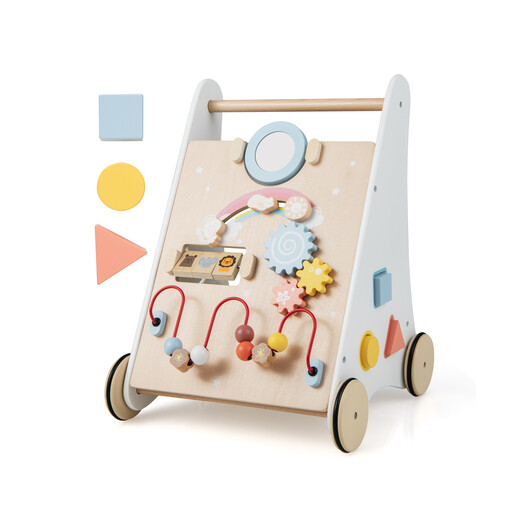
Why we recommend it: This is the archetype of a well-designed wooden walker. It combines a stable structure to secure those first steps with a range of manual activities that stimulate development, all without any electronics.
Its quality wood construction and wide base ensure excellent stability. The activities are 100% mechanical (shape sorter, abacus), thus avoiding overstimulation. The rubber-coated wheels guarantee quiet operation and protect your floors.
It's a 7-in-1 toy that supports learning to walk and then converts into an activity table. The small storage basket at the back for carrying favourite toys is the icing on the cake.
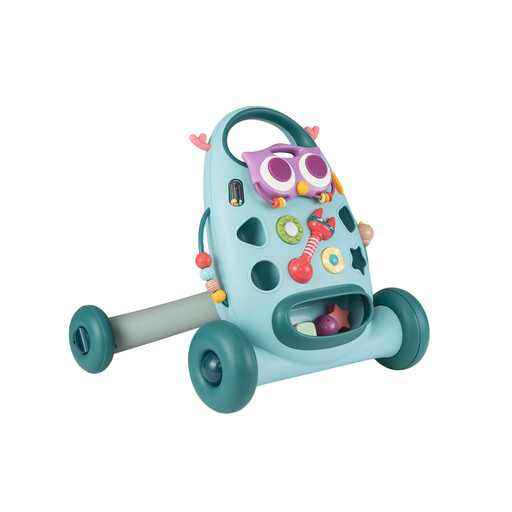
Why we recommend it: For families who prioritise versatility over an all-wood design, this plastic (PP and ABS) model is a smart alternative. Its main advantage: an electronic play panel that can be detached.
Stability is ensured by a triangular structure and an adjustable speed brake on the rear wheels. The fact that the play panel is removable allows you to clearly separate learning to walk from playtime, promoting better concentration.
Its 2-in-1 concept gives it great versatility. The walker helps with walking, and the activity panel can be used separately on the floor. This extends its lifespan well beyond the first steps.
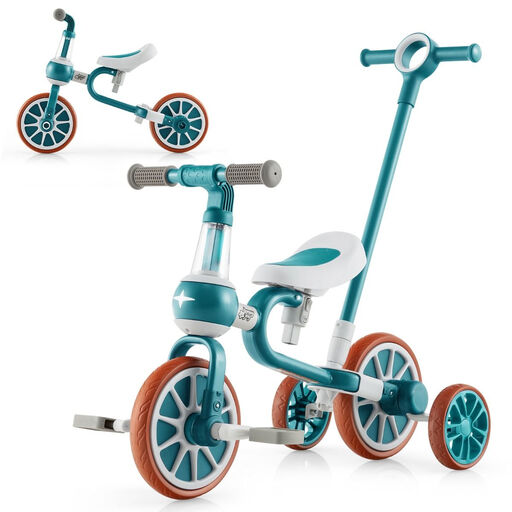
Why we recommend it: Note, this isn't a baby walker. It's an investment for the next stage, designed for children who are already walking (from 2 years old). It gently prepares them for learning to ride a bike by progressing through balance bike and tricycle stages.
It doesn't meet the need for a first walker, but it avoids the trap of a single-use toy. Designed to grow with the child from 2 to 4 years old, it's the definition of a smart, long-lasting purchase.
Its 4-in-1 modularity (balance bike, tricycle, pedal bike, and parent-push modes) is simply stunning. It supports the development of coordination and balance over several years.
We've put together a complete selection of products that meet our selection criteria and safety standards.
There's no magic age; it all depends on your child's individual pace. The walker becomes useful when your baby starts pulling themselves up on furniture and shows a desire to explore. Generally, this happens between 9 and 12 months. The golden rule: they must be able to stand on their own before leaning on a wooden push toy.
This is a question that worries many parents. It's crucial not to confuse a baby walker (or push toy) with a sit-in walker (where the child is suspended in a seat). Used correctly, a push walker encourages a child to find their own balance, straighten up, and adopt a natural posture. Unlike a sit-in walker, it doesn't support the child's weight or encourage them to walk on their tiptoes, a common criticism of the latter.
Adult supervision is, of course, the golden rule. Beyond that, a few simple steps are all it takes: