
Livraison le jour même ou le lendemain

Qualité garantie

Débloquez vos offres de bienvenue: Livraison GRATUITE | Jusqu'à -80 % | 30 jours d'essai gratuits à JoyPlus
Téléchargez l'application
A simple fan that just moves hot air around is no longer enough. With summers getting longer and the need for home comfort growing, the air circulator is emerging as a far more effective solution. But between promises of power, silence, and purification, it's easy to get lost. Some devices, despite appealing marketing, prove disappointing in practice. Here’s how to avoid common pitfalls and make an informed choice.
The market is flooded with models boasting attractive features, but not all of them deliver on their promises. Before you decide, watch out for these three common mistakes that often lead to buyer's remorse.
To avoid making a mistake, focus on objective data that measures the real performance of an air circulator.
This is the most important indicator for evaluating a powerful fan. Expressed in cubic metres per hour (m?/h) or per minute (m?/min), airflow measures the volume of air the device can move. High airflow, combined with a design that creates a concentrated stream of air (a "jet" effect), ensures air circulation throughout an entire room. For a 20 m? room, an airflow of at least 1,200 m?/h is a good starting point to feel a consistent effect.
Acoustic comfort is non-negotiable, especially at night or in an office. An ideal silent fan for a bedroom should not exceed 30-35 dB at a medium speed. For daytime use or in a noisier environment like a gym, a level around 50 dB can be perfectly acceptable. Always look for the noise level at several speeds, not just the minimum.
Beyond pure ventilation, modern features can make all the difference. A smart fan that can be controlled via a mobile app or voice commands offers highly appreciated flexibility in daily use. Bladeless fan models offer advantages in terms of child safety and ease of cleaning, while often featuring a more modern design. Finally, for those sensitive to allergens, an air purifier fan with a HEPA filter and a specified CADR is a worthwhile investment.
There's an ideal air circulator for every profile. Here are options that meet distinct needs, based on the objective performance criteria we've just discussed.
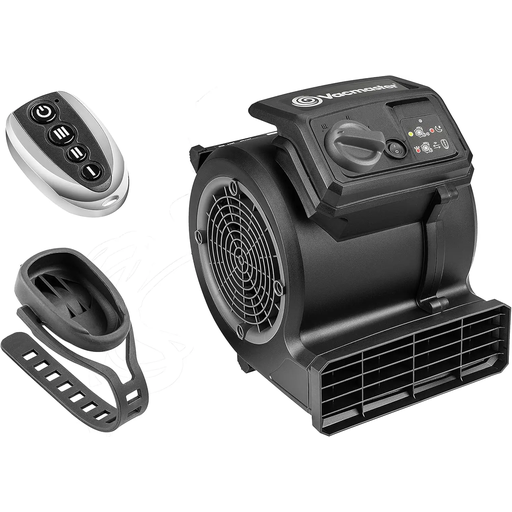
Why it stands out : Perfect for home or gym workouts. Its powerful, targeted airflow (over 54 km/h) and adjustable positioning (0°, 45°, 90°) allow you to direct cooling during exercise. The remote control, which can be worn on the wrist or attached to equipment, is a real bonus for not interrupting your session.
It doesn't just claim to be "powerful" in watts. It delivers a measurable and effective air speed. Its 49 dB noise level is very restrained for a device in this category, avoiding the usual trade-off between power and noise.
Robust "blower-style" design for a concentrated airflow and a convenient remote for sports use.
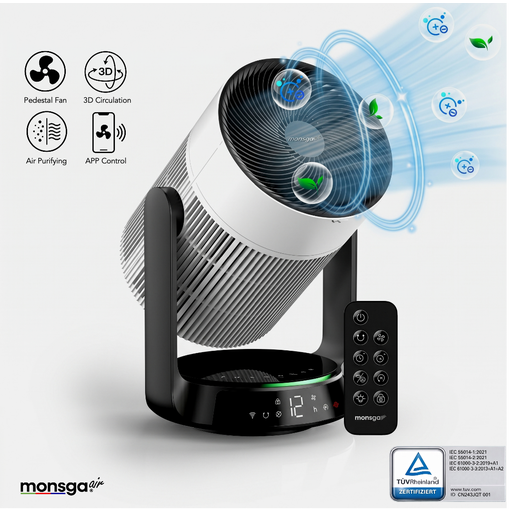
Why it stands out : Perfect for those sensitive to allergies, pollen, or indoor pollution. It combines effective ventilation with true air purification. Its 25 dB night mode makes it an excellent sleep companion.
It justifies its purifier function with a 280 m?/h CADR, a verifiable figure that sets it apart from fans with a simple pre-filter. Its quietness is not an empty claim : 25 dB is a very low noise level, ideal for nighttime.
Dual ventilation and purification function, 360° omnidirectional oscillation for complete room coverage.
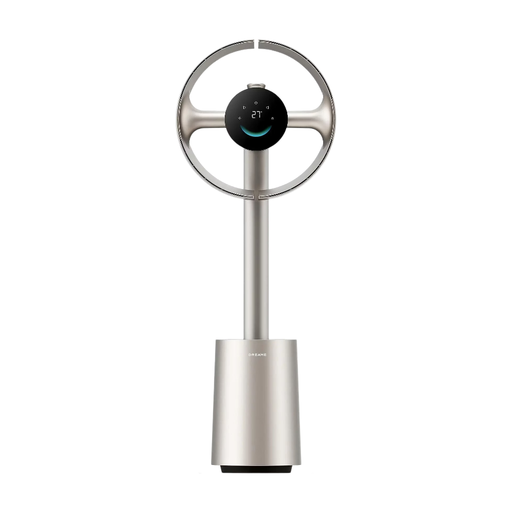
Why it stands out : For those seeking a high-performance device with a sleek design and the latest technology. This bladeless fan is also a design object. It's a true smart fan, with app control, voice commands, and automatic airflow adjustment based on ambient temperature.
Its design is not just for aesthetics. The GyroWing and AirBoost technologies provide very wide air diffusion and airflow multiplication, delivering a tangible benefit in terms of air circulation that goes far beyond a simple designer fan.
Advanced oscillation technologies for 270° coverage, smart temperature adaptation, and full control via app.
We have selected a full range of products for you that meet these strict criteria and current safety standards.
A standard fan simply creates a localized breeze that provides a cooling sensation on the skin. An air circulator is designed to move the entire volume of air in a room. Its airflow is more powerful and directional, creating a consistent circulation from floor to ceiling, eliminating stagnant air pockets, and evening out the temperature.
Modern models equipped with DC (direct current) motors are significantly more energy-efficient than older fans with AC (alternating current) motors. Using it alongside an air conditioner or heater helps to better distribute the treated air and reach the target temperature more quickly, which can help reduce the overall consumption of your main system.
A simple rule is to look at the device's airflow (in m?/h). Calculate the volume of your room (length x width x height in metres) to get a volume in m?. An effective air circulator should be able to exchange the air in the room several times per hour. For example, for a 50 m? room (about 20 m? with a 2.5 m ceiling height), a device with an airflow of 400 m?/h will renew the air 8 times per hour, which is a good ratio for effective circulation.