
Livraison le jour même ou le lendemain

Qualité garantie

Débloquez vos offres de bienvenue: Livraison GRATUITE | Jusqu'à -80 % | 30 jours d'essai gratuits à JoyPlus
Téléchargez l'application
Breathing cleaner air at home is no longer a luxury, but a necessity for many of us. Whether it's to soothe a stubborn allergy, banish bad odours, or simply improve your quality of life, an air purifier is becoming essential. The problem? The market has exploded, and with it, often opaque marketing. One device promises to purify 100 m? in cathedral-like silence (spoiler: it's not true), while another boasts a "near-HEPA" filter that barely filters anything.
Our mission is to separate fact from fiction. Forget the technical jargon and empty promises. This guide gets straight to the point: here are the pitfalls to avoid and the real criteria for choosing an effective HEPA air purifier that fits your needs and your budget.
Marketing is an art, and the air purifier industry's is particularly creative. Here are three promises to put under the microscope to avoid unpleasant surprises.
To sort through the options, focus on these three objective technical specs. They, not the marketing, define a device's true effectiveness.
The CADR (Clean Air Delivery Rate) is the number one performance metric. Expressed in cubic metres per hour (m?/h), it measures the volume of air the device can clean in one hour.
For optimal efficiency, it's recommended that the purifier can exchange the air in the room at least 3 to 5 times per hour. Here's a simple formula to estimate the required CADR:
CADR (m?/h) ≈ Room Area (m?) × Ceiling Height (m) × 3
For example, for a 15?m? bedroom with a 2.5?m ceiling, a CADR of around 112?m?/h (15 × 2.5 × 3) is a good starting point. For a large room air purifier for a 40?m? space, you'll need to aim for a CADR of at least 300?m?/h.
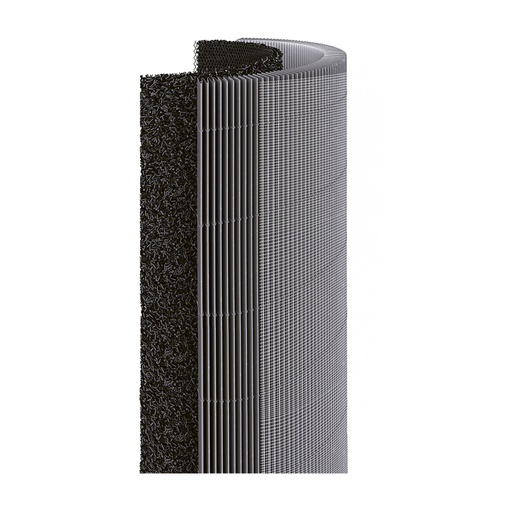
An effective filtration system relies on a winning trio:
Noise can be a deal-breaker, especially in a bedroom. Here are a few benchmarks to decipher the decibel (dB) label:
Always demand the figure for the quietest mode (night or sleep mode). It's the only one that truly matters for your comfort.
Rather than a long, drawn-out list, here is our curated selection. Each model was chosen for a specific use case, based on the technical criteria we've just detailed.
Why we recommend it: With its compact design and effective coverage up to 25 m?, it's perfect for a bedroom, office, or studio. It offers smart features often reserved for more expensive models, making it an excellent first purchase with unbeatable value for money.
It includes a true 3-in-1 filter (pre-filter, HEPA, carbon) and advertises a realistic coverage area without overpromising. Its night mode is designed to be discreet, avoiding the trap of excessive noise.
Control via the mobile app is a real luxury at this price point. Monitoring air quality and managing everything remotely is a rare and appreciated feature.
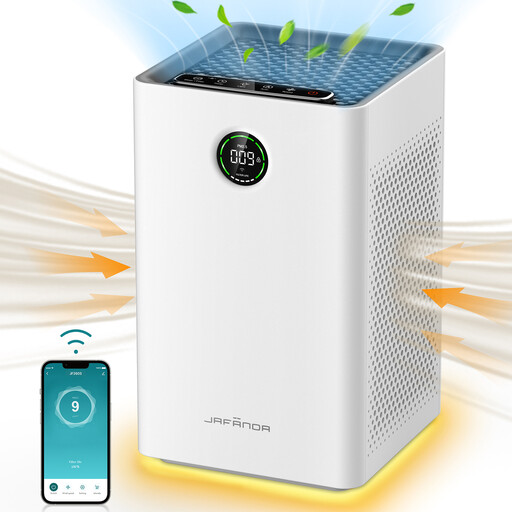
Why we recommend it: With a high CADR of 260 m?/h and a thick layer of activated carbon, it's built for large spaces and ruthlessly tackles pet hair, dander, and odours. Its compatibility with voice assistants makes it easy to integrate into a smart home.
No smoke and mirrors here: it's equipped with a certified True HEPA H13 filter. The manufacturer is transparent, providing clear data on air exchange rates, far from vague promises.
Its auto mode, driven by a PM2.5 particle sensor, adjusts the fan speed in real time. It does the work for you, so you don't have to think about it.
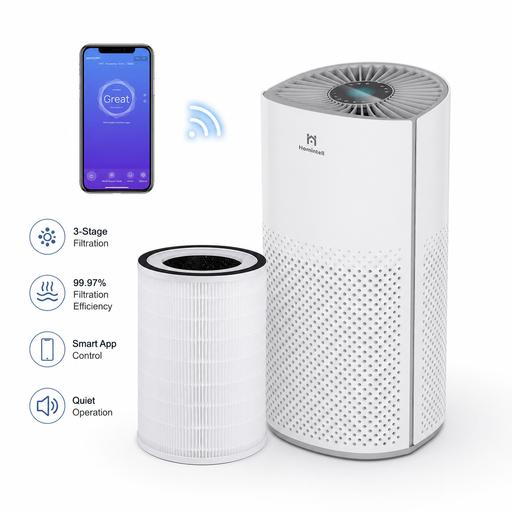
Why we recommend it: This is the **smart air purifier** that makes no compromises between performance and comfort. Ideal for those who love to control everything from their smartphone, it offers a virtually silent night mode and nice extra features like UV sterilisation.
It smashes the noise trap: its night mode is rated at just 20 dB, the equivalent of a whisper. Its filter is a true **HEPA H13**, guaranteeing serious filtration.
The winning trio: record-breaking silence, full control from your smartphone, and a light indicator that shows you the air quality at a glance.
Discover our full selection of purifiers that meet our performance criteria and European safety standards.
1. What is the lifespan of a HEPA filter and how often should it be changed? The lifespan of a HEPA filter depends on your indoor air pollution and how often you use it. On average, a replacement is recommended every 6 to 12 months. Most modern purifiers have an indicator light that tells you when the filter needs changing—no need to set a calendar reminder!
2. Is an air purifier really effective against pollen allergies? Yes, a model equipped with a true HEPA filter is highly effective. It captures airborne pollen grains, significantly reducing their concentration and alleviating symptoms (sneezing, itchy eyes, etc.) for allergy sufferers. For best results, run it with the windows closed during peak season.
3. Where should I place my air purifier for maximum effectiveness? Place it where you live: in the room where you spend the most time, like the bedroom or living room. Give it some breathing room: at least 30 to 50?cm of clearance on all sides to avoid blocking air circulation. Avoid sticking it in a corner or behind furniture.