
Livraison le jour même ou le lendemain

Qualité garantie

Débloquez vos offres de bienvenue: Livraison GRATUITE | Jusqu'à -80 % | 30 jours d'essai gratuits à JoyPlus
Téléchargez l'application
Contrary to popular belief, the air inside our homes is often far more polluted than the air outside. Pollen, dust, pet dander, volatile organic compounds (VOCs)... Faced with this invisible cocktail, purifying the air at home has become a priority for many families. The air purifier has emerged as the ideal solution. The problem? The market is saturated with models featuring vague, or even misleading, marketing claims. Before you take the plunge, it's crucial to know the common pitfalls to avoid investing in a device that's as noisy as it is ineffective.
The 3 Pitfalls to Avoid Before Buying an Air Purifier?:
To make an informed choice, forget the marketing hype and focus on objective data. Here are the three performance indicators to examine closely.
The CADR (Clean Air Delivery Rate) is THE most reliable performance metric. Expressed in cubic metres per hour (m?/h), it quantifies the volume of air the device can purify in one hour. To be effective, an air purifier should be able to cycle the entire volume of air in the room 3 to 5 times per hour.
A high-performance filtration system almost always combines three stages, each with a specific role:
Expressed in decibels (dB), the noise level is a point that should never be overlooked, especially for use in a bedroom. A good silent air purifier should offer a night mode or a minimum speed below the 30 dB mark, which is the equivalent of a whisper. Be sure to check the noise level at both minimum AND maximum speed to get a true sense of its discretion... or its potential for nuisance.
To help you sort through the options, here is our selection of models that check all the right boxes, each tailored to a specific need.
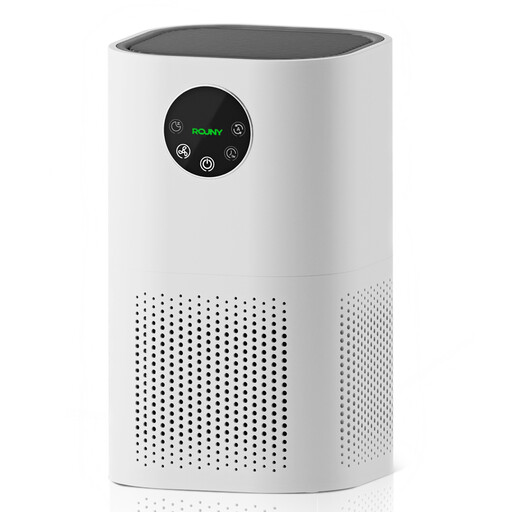
Editor's Verdict: Perfect for those who want clean air without sacrificing a peaceful night's sleep. Its ultra-quiet sleep mode makes it the ideal companion for a bedroom.
It tackles the noise problem head-on: its sleep mode is certified at ≤ 25 dB, the equivalent of a whisper. You can sleep soundly while it purifies the air.
Its HEPA H13 filter captures 99.97% of pollutants. With a CADR of 150 m?/h, it's perfectly sized for rooms up to 20 m?.
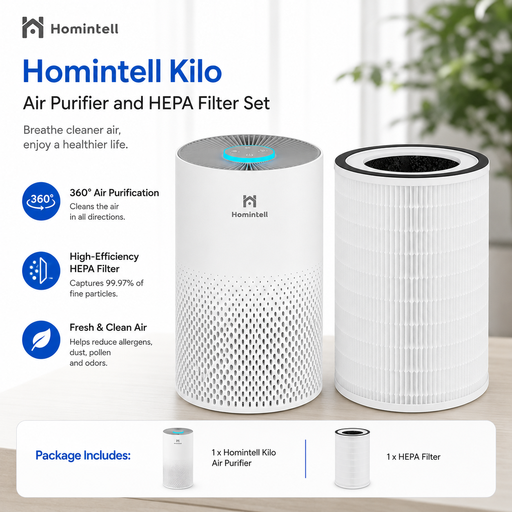
Editor's Verdict: The smart choice for an office, a small bedroom, or a first-time purchase. Compact and effective, its CADR of 150 m?/h is tailor-made for areas up to 20 m? without taking up much space.
It pre-empts the maintenance cost pitfall by including a replacement filter in the box. A welcome touch that ensures a good year of peace of mind. Its recommended area (≤ 20 m?) is honest and consistent with its CADR.
Its 3-in-1 filtration (pre-filter, HEPA, activated carbon) ensures comprehensive air treatment. The included replacement filter is a real bonus, guaranteeing over a year of worry-free use.
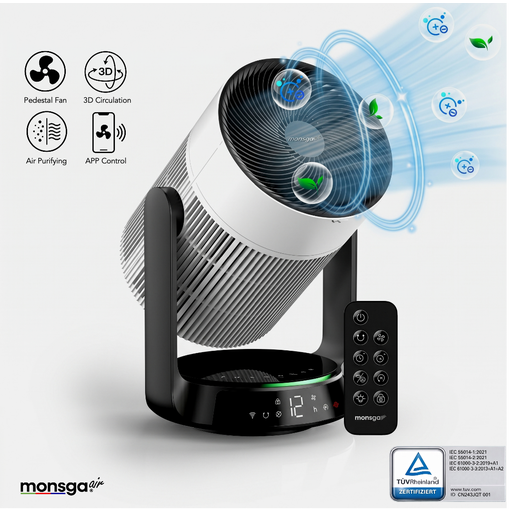
Editor's Verdict: The ultimate do-it-all device. This air purifier fan cools in the summer, purifies all year round, and can even help distribute heat better in the winter. Its powerful CADR of 280 m?/h allows it to effortlessly tackle large living rooms.
It avoids the trap of being a seasonal device that gets stored away. Its dual function makes it useful 365 days a year. Its powerful CADR ensures effective purification, even in a 35 m? living room.
A robust CADR of 280 m?/h paired with 360° oscillation to circulate purified air throughout the entire room. The mobile app control and 25 dB night mode are real advantages.
Discover our full selection of products that meet our performance criteria and European safety standards.
Generally, a HEPA filter and an activated carbon filter should be replaced every 6 to 12 months. It all depends on your usage frequency and the pollution level in your home. Most modern devices include an indicator light that tells you when the time has come. The pre-filter is often washable: cleaning it every 2 to 4 weeks is enough to maintain its effectiveness.
Place it in your main living space (living room, bedroom). Give it some breathing room: a clearance of 30 to 50 cm all around is ideal to avoid obstructing air circulation. Above all, don't tuck it away in a corner or behind furniture, as its effectiveness would be reduced to nothing.
Absolutely, provided you choose a model equipped with a true HEPA filter. This type of filter is specifically designed to trap the microscopic particles responsible for allergies: pollen grains, dust mites, mould spores, etc. The pro tip: during pollen season, let it run continuously with the windows closed to create a true anti-allergy sanctuary.