
Livraison le jour même ou le lendemain

Qualité garantie

Débloquez vos offres de bienvenue: Livraison GRATUITE | Jusqu'à -80 % | 30 jours d'essai gratuits à JoyPlus
Téléchargez l'application
A cluttered hallway, jackets piled on a chair or towels that refuse to dry properly: a wall-mounted coat rack helps you save space without adding another piece of furniture to the floor. But not every model meets the same needs. The number of hooks, the type of wall and the quality of the fixings all have a direct impact on the stability and lifespan of the installation.
Before buying a wall-mounted hook, it is therefore worth looking beyond its decorative appearance.
A 5-hook coat rack or 6-hook coat rack offers several hanging points, but that does not necessarily mean it can support six heavy coats. A double hook allows you to hang more items, but each hook generally has its own weight limit.
For a family, check:
A fixing suitable for concrete will not necessarily work with a plasterboard partition, hollow brick or an older wall. Unsuitable wall plugs can gradually work loose and may even cause the wall-mounted coat rack to fall.
Fixings are not always supplied. Identify the wall material before installation and choose suitable wall plugs. If you are renting, also check the terms of your tenancy agreement before getting out the drill.
A vintage coat rack or decorative wall hook can fit perfectly into your home, but the finish also has a practical role. Uneven metal edges can catch on fabrics, while a poorly protected surface may deteriorate in a bathroom or utility room.
Varnished wood, treated aluminium and hooks with rounded edges are all worth checking, although none of these features is an absolute guarantee. Location and maintenance are just as important.
Measure the available width in the hallway, corridor or behind a door. A model measuring 60 to 64 cm may suit a narrow wall, while a greater depth must still leave enough room to move around.
Height also deserves your attention. Long coats need sufficient clearance beneath the rack. Conversely, a wall-mounted hook installed in a bathroom can be positioned at a convenient height for towels.
A wooden wall-mounted coat rack adds a warm touch to a hallway. Pine and solid wood are well suited to this use, provided you avoid persistent moisture when the finish is not designed for damp rooms. MDF, used on some decorative models, allows for a wider range of shapes and finishes, but should be kept away from standing water.
Aluminium is resistant to corrosion under normal conditions of use. For a wall-mounted towel rail, however, check for a protective finish and wipe away water splashes regularly.
Before drilling, locate any pipes and cables. Use a spirit level and observe the spacing between the fixing points. Once the wall-mounted coat rack has been installed, check the screws and wall plugs regularly.
For maintenance, a soft cloth is usually sufficient. Avoid abrasive products on wood, distressed surfaces, ceramic and metal finishes.
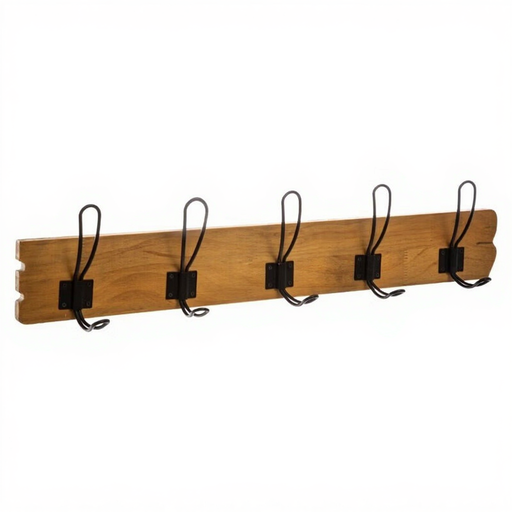
Why this choice suits this profile: Its compact dimensions and five double hooks are ideal for a family hallway or a corridor where every centimetre counts.
The product details clearly state that it has five double hooks, rather than simply giving a theoretical count of hanging points. The wall fixing must nevertheless be selected according to the wall material, as it is not supplied.
Pine frame and cast-iron hook system; stated dimensions of 63.6 × 14 × 9.5 cm.
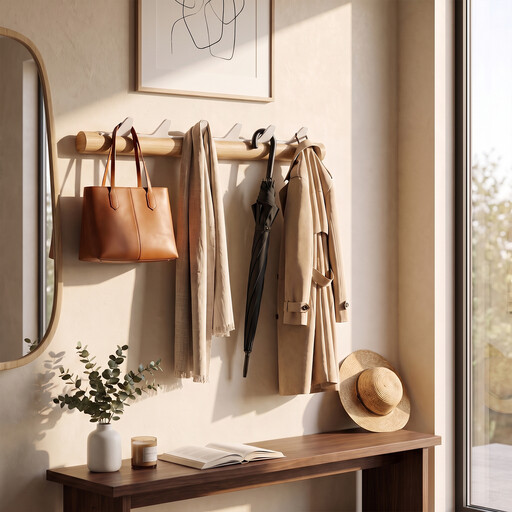
Why this choice suits this profile: The combination of solid wood and aluminium alloy hooks is aimed at those looking for both a strong decorative presence and detailed product specifications.
The product details specify the materials, varnished finish, rounded edges and stated maximum load of 66 lb, or approximately 30 kg. This capacity nevertheless depends on the wall and the anchors used.
FSC-certified rubberwood according to the product details; six hooks; finish stated to be resistant to water and rust.
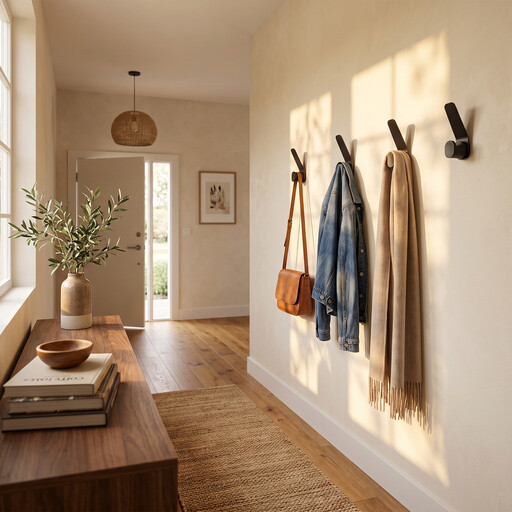
Why this choice suits this profile: The eight double hooks can be arranged according to the available space, including behind a door, in a bathroom or in a utility room.
Each hook is stated to support up to 11 lb, or approximately 5 kg. The grooved design also helps prevent items from slipping. The tightness of the fixings should nevertheless be checked regularly.
Treated aluminium alloy; double hooks; rear rubber pad designed to protect the wall and compensate for minor unevenness.
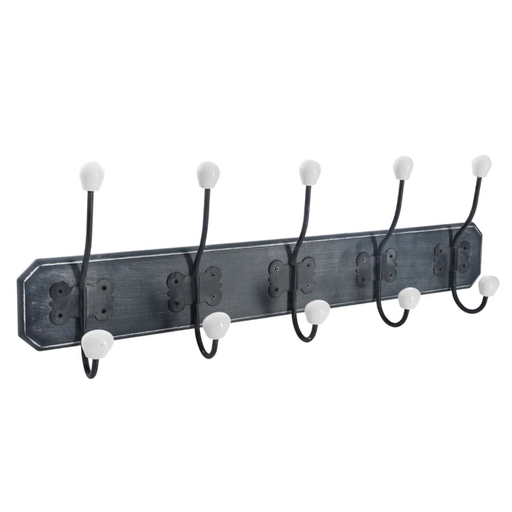
Why this choice suits this profile: Its panel with cut corners, aged steel details and ceramic balls add a decorative touch to a retro-inspired hallway.
The product details list the materials and specify that all five hooks are double. The ceramic elements require careful handling and indoor use only.
E1 MDF panel stated to be FSC-certified; double metal hooks; distressed finish and ceramic balls.
For a model intended for coats, bags and schoolbags, distribute the items across several hooks. In a bathroom, allow air to circulate and wipe away splashes to preserve the finishes.
We have put together a complete, real-time updated list of products that meet these strict selection criteria, as well as European safety regulations.
In a family hallway, install the hooks at a height that is accessible to adults and consider adding a lower hook for children. Also take the length of the coats into account so that they do not touch the floor or a piece of furniture.
Yes, provided you use wall plugs designed for plasterboard and observe their maximum load. For thick coats or heavy bags, locate a stud in the partition or add suitable reinforcement. The maximum load stated for the hook does not replace the load that the wall itself can support.
Its lifespan depends on the materials, frequency of use, humidity, load and quality of installation. Gentle cleaning and regularly checking the screws help limit premature wear. For wooden or MDF models, avoid standing water and harsh products.