
Livraison le jour même ou le lendemain

Qualité garantie

Débloquez vos offres de bienvenue: Livraison GRATUITE | Jusqu'à -80 % | 30 jours d'essai gratuits à JoyPlus
Téléchargez l'application
Choosing a wall hook? Seems simple enough. In reality, it's often a minefield. Between so-called ultra-strong adhesives that rip off paint and fixings that give way without warning, the headache is real. As a product expert for the editorial team, my mission is to cut through the noise for you. Let's forget the marketing jargon and find a reliable solution that's genuinely suited to your wall and your needs.
Before you start, watch out for these three common mistakes that are costly in both time and repairs:
To avoid these setbacks, a few technical criteria are all you need to make the right choice. They will guarantee a durable and secure installation, whether you want to hang a simple tea towel or a heavy mirror.
Choosing the mounting system is the first decision to make and depends entirely on your wall and the object you're hanging.
Golden rule: never choose a hook whose maximum load capacity exactly matches the weight of your object. Always allow for a comfortable safety margin.
Simple rule: Multiply the weight of your object by 1.5 or 2 to determine the minimum required load capacity for your hook.
For example, for a 4 kg frame, choose a hook capable of supporting at least 6 to 8 kg. This precaution compensates for surface imperfections and the stresses of daily life. For a valuable object or one hung above a bed or sofa, be uncompromising on this safety margin.
The hook's material affects its sturdiness as much as its look.
Instead of an endless list, here are our targeted solutions for three common scenarios.
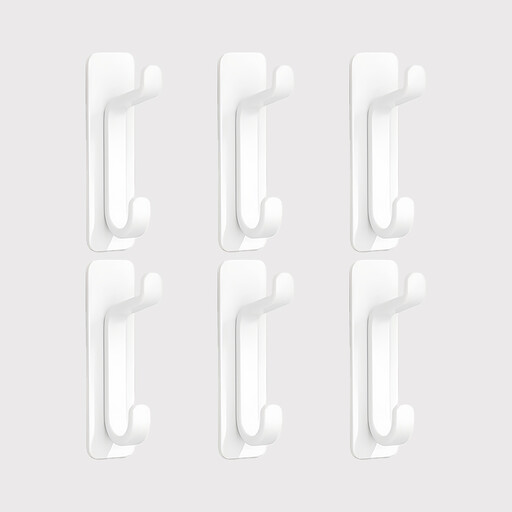
Why we love it: The perfect solution for organising your space without taking out the drill and saying goodbye to your security deposit. This set allows you to equip a kitchen or entryway with a uniform and discreet solution.
Unlike budget adhesives, its formula is optimised for smooth surfaces. It doesn't fall into the "universal hook" trap that ultimately holds nowhere. It's a reliable no-drill wall mounting solution for light-duty use.
Its stainless steel construction ensures good longevity, even in a kitchen or a poorly ventilated bathroom. The 6-pack offers excellent value for money.
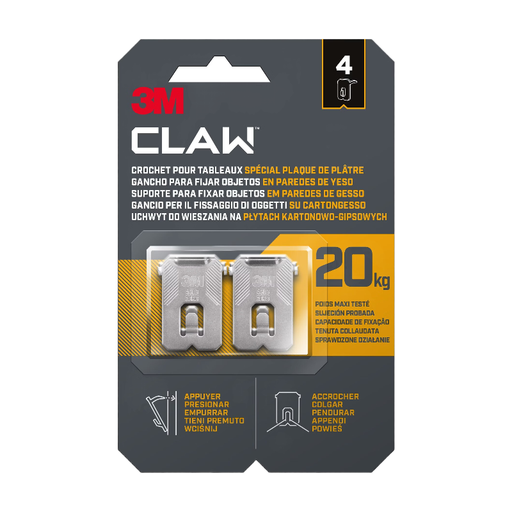
Why we love it: For hanging a heavy mirror or a valuable frame on drywall without having to find a stud behind the wall. Peace of mind is priceless.
Specifically designed for drywall, it bypasses the incompatibility problem. Its hardened steel claws lock into the back of the board to distribute the load, offering a high and reliable capacity (up to 20 kg).
Tool-free installation with a simple push of your thumb. It's the heavy-duty picture hanger solution that combines security with foolproof ease of installation, even for non-DIYers.
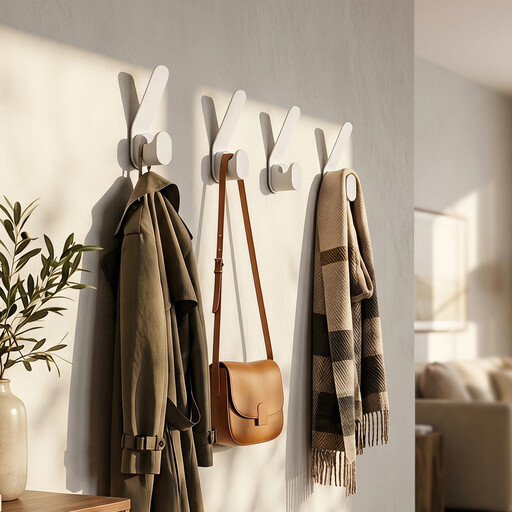
Why we love it: Essential for the entryway, bathroom, or kids' room, where coats, bags, and towels tend to pile up. The double-hook design maximises storage, and its sturdiness stands up to daily wear and tear.
No adhesive here, just a robust mechanical anchor screwed into the wall. It avoids the trap of unrealistic load capacities by providing a reliable fixing for a coat hook (up to 5 kg per hook).
Made of premium-quality aluminium, it is rust-resistant and very stable. The double-hook design is incredibly handy for optimising vertical storage.
Discover our full selection of wall fixings, all tested and approved by our experts for their reliability and compliance with European standards.
The longevity of an adhesive hook depends on the quality of the glue, the weight of the object, humidity, and the surface. A quality model, properly installed on a suitable surface, can last for several years for light use. In a bathroom, its lifespan will be shorter if the adhesive is not explicitly treated for moisture resistance.
To keep your wall pristine, removal is a key step. For foam adhesives, heat the base of the hook with a hairdryer (on a warm setting) for about thirty seconds to soften the glue. Then, slide dental floss or a thin plastic spatula behind the hook to gently "saw" through the adhesive. Any remaining glue residue will come off easily with a bit of rubbing alcohol or an adhesive remover. For models with a stretch-release tab (like Command), simply pull the tab slowly and parallel to the wall.
Absolutely, but only if you choose the right system. A simple screw in drywall will never hold. However, a dedicated drywall hook (with claws like the 3M CLAW or an expansion type like a Molly bolt) is extremely reliable. These systems are designed to distribute the weight over a large area on the back of the plasterboard, allowing them to support significant loads (sometimes over 20 kg) safely. The golden rule remains the same: read the instructions carefully and scrupulously respect the maximum load indicated.