
Livraison le jour même ou le lendemain

Qualité garantie

Débloquez vos offres de bienvenue: Livraison GRATUITE | Jusqu'à -80 % | 30 jours d'essai gratuits à JoyPlus
Téléchargez l'application
A gap between two floor coverings is quickly noticed, traps dust and can even make it awkward to walk through. A self-adhesive floor threshold strip conceals the join between laminate flooring, tiles or carpet, without drilling or additional adhesive. The key is to choose a model suited to your layout.
Before placing your order, three common mistakes are worth avoiding:
Here are the key criteria to consider when choosing a solution suited to your room, budget and level of foot traffic.
Measure the length of the join, as well as its width at several points. A floor transition profile should extend far enough on both sides to cover the joint, without obstructing doors or getting in the way of furniture installation.
A flat threshold strip is mainly suitable when both floor coverings are more or less level. If there is a significant height difference, it is better to choose a profile designed to compensate for an uneven level. A simple self-adhesive joining strip will not be enough to bridge a pronounced step.
The models featured here measure 122 × 4 × 0,3 cm or 1 m long, depending on the reference. A width of 4 cm is suitable for many household joins, but accurate measuring is still essential before installation.
Flexible PVC is very common for a wood-effect PVC finishing strip: it is easy to cut and can be cleaned with a slightly damp cloth. The product details below mention resistance to scratches, stains and abrasion. These indications refer to the material’s advertised characteristics and do not guarantee the same lifespan in every situation.
For a joint cover for laminate flooring, also check that the colour and pattern complement the existing floor covering. Black, brown, grey and cherry-effect finishes create very different looks.
A self-adhesive threshold strip is generally installed in three stages: measure, cut and stick. The surface must be clean, dry, dust-free and degreased. Avoid applying the strip immediately after washing the floor.
The models featured can be cut with scissors. If the strip has become slightly deformed during transport, the product details recommend gently warming it with a hairdryer to restore a flatter shape. Keep the heat moderate to avoid deforming the PVC or damaging the adjacent floor covering.
The following four references all use the same self-adhesive principle. They mainly differ in length and finish.
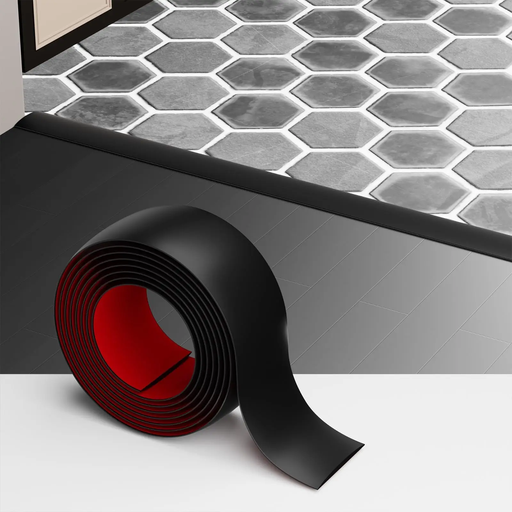
Why this choice suits this profile : At 122 cm long and easy to cut with scissors, this strip is well suited to a first DIY project in a living room, bedroom or kitchen.
Its clearly stated dimensions make it easy to check that the joint will be covered before installation, rather than choosing based on colour alone.
PVC, self-adhesive backing, black wood-effect finish and cut-to-length design.
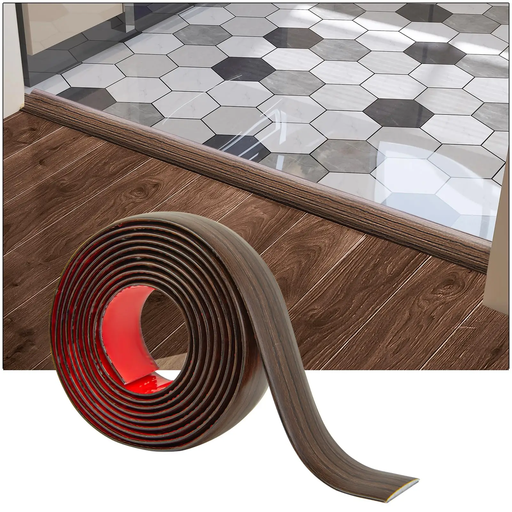
Why this choice suits this profile : Its brown tone and realistic grain blend into a warm interior, where the appearance of the join matters just as much as ease of installation.
A matching finish avoids the impression of a last-minute add-on. Even so, check the shade in the room’s natural light.
Flexible PVC, a surface advertised as stain-resistant and easy cleaning with a damp cloth.
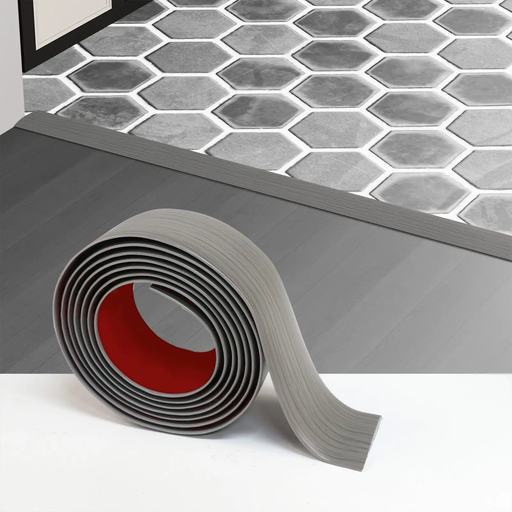
Why this choice suits this profile : Its one-metre format is suitable for a short join or several small areas, particularly in a home with frequent foot traffic.
Its shorter length reduces waste when installing it in several sections and allows you to adjust the strip precisely to the gap between the floor coverings.
Cuts with scissors, grey wood-effect finish and cleaning advertised as suitable with a damp cloth.
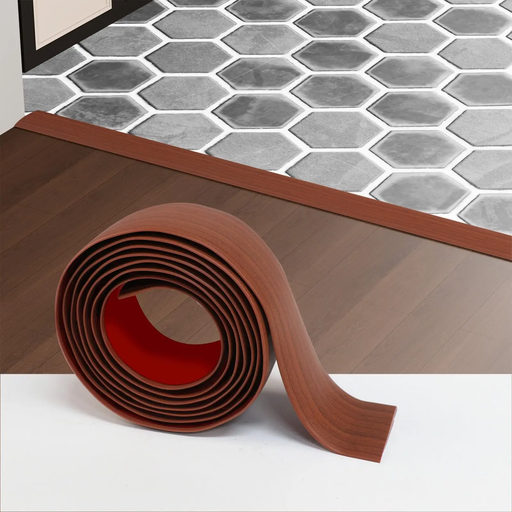
Why this choice suits this profile : Its cherry finish adds a distinctive decorative touch to a join between laminate flooring, tiles or carpet, without requiring extensive work.
Installation without nails or separate glue limits irreversible changes, provided the surface is compatible with the adhesive and properly prepared.
Flexible PVC, 4 cm width and cherry wood-effect finish.
For a transition between tiles and carpet, also check that the carpet does not bunch up beneath the strip. On laminate flooring, allow for the expansion gaps specified by the manufacturer: the profile must not prevent the floor covering from moving.
It can be used in a bathroom, particularly for a join between two floor coverings, in line with the information provided in the product details. However, the surface must be completely clean and dry at the time of installation. Avoid immersion and constant exposure to water. The adhesive’s hold depends on the type and condition of the floor, as well as the ambient humidity level.
Its lifespan depends on foot traffic, cleaning, how level the floor is, the temperature and how well the surface was prepared. The products are advertised as resistant to scratches, stains and abrasion, but the same lifespan cannot be guaranteed in every home. Keep an eye on the edges and replace the strip if it starts to lift or become distorted.
Yes. These models are designed to be measured, cut, stripped of their protective film and then stuck down with even pressure. Scissors are generally sufficient for cutting. However, a significant difference in height, a crumbly surface or a very uneven join may require a different type of finish and more extensive preparation.