
Same-day & Next-day Delivery

Quality Guaranteed

Unlock Your Welcome Offers: FREE Delivery | Up to 80% OFF | Free 30-day JoyPlus trial
Download the APP
So, your new parquet or that elegant tile flooring is finally installed. The only problem? That slightly unsightly transition between two rooms or two different types of flooring. The adhesive threshold strip emerges as the go-to solution: it's quick, requires no drilling, and is cost-effective. But be warned—behind this apparent simplicity lie a few traps that can quickly turn a quick fix into a long-term headache.
Before you rush to grab the first model you see on the shelf, let's review the three classic mistakes that lead straight to disappointment:
Knowing these pitfalls already stacks the odds in your favour for achieving a flawless, long-lasting finish.
To avoid falling into these traps, a few objective technical specifications make all the difference. These are the true guarantees of quality and durability for an adhesive door threshold.
Most adhesive threshold strips are made of PVC (polyvinyl chloride). And for good reason—this material has more than a few tricks up its sleeve: it's flexible, waterproof, and can be cut with a simple pair of scissors or a utility knife. A good PVC transition profile must be flexible enough to absorb minor differences in level, a very common scenario for a parquet-to-tile transition. Make sure the product description mentions good resistance to scratches and abrasion, which is essential for surviving in high-traffic areas.
The performance of a self-adhesive floor joint cover depends almost entirely on its adhesive. Manufacturers are often discreet about its composition, but one clue never lies: the clarity of the instructions. A quality product will always insist on surface preparation, which must be perfectly clean, dry, and degreased. This step is non-negotiable for a rock-solid bond. If the strip is delivered rolled up, it's often recommended to warm it slightly (with a hairdryer, for example) to make it more pliable and maximise its adhesive power just before installation.
Before you take out your credit card, take out a tape measure and precisely measure two things: the length of the join to be covered (often the width of a doorway) and the gap between the two floor coverings. The ideal floor transition strip should be:
Rather than a random list, we've matched products to typical user profiles. This will help you find a solution that not only sticks to your floor but also fits your project.
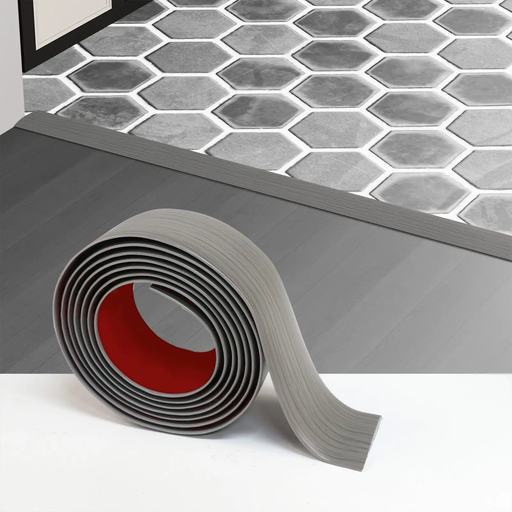
Why this choice? Perfect for the weekend warrior who just needs to finish a doorway transition. Its 1-metre length is economical, prevents waste, and its grey wood effect finish blends seamlessly into contemporary interiors.
Its PVC is calibrated for standard residential use. By following the installation instructions on a clean surface to the letter, the adhesive ensures a reliable hold and prevents premature peeling.
Easy to cut and install, delivering a flawless finish for a one-off project.
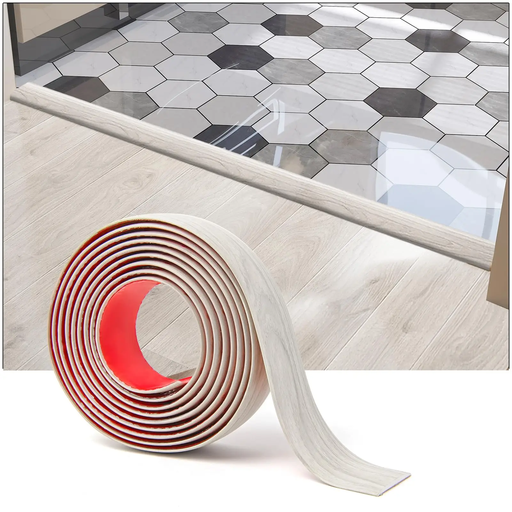
Why this choice? Ideal for anyone seeking a modern finish and a uniform look. The generous 3-metre length allows you to cover multiple doorways or a sliding glass door with a single roll, ensuring beautiful visual continuity. The "washed white" finish is a noticeable, bold aesthetic choice.
At 4 cm wide, it offers comfortable coverage that avoids the "too-narrow strip" trap. Its quality PVC is treated to resist discolouration and maintain its clean look over time.
Its long length is ideal for unifying large areas with a designer touch.
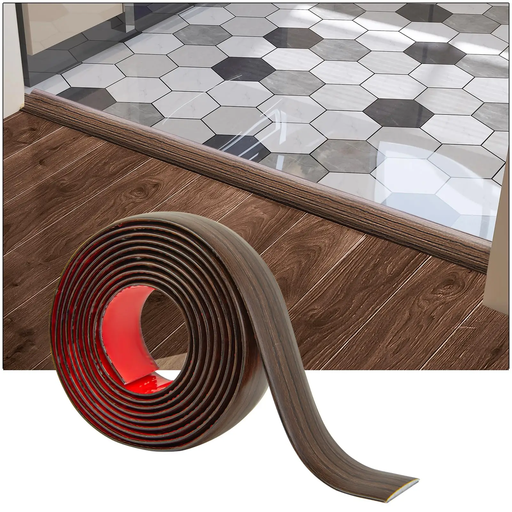
Why this choice? This is the ultimate all-rounder. The brown wood effect finish is a timeless classic that pairs well with most parquet, laminate, and even some tile floors. Its 1.22 m length is convenient for standard doorways.
The manufacturer highlights its resistance to scratches and abrasion—a key feature for combating premature wear in high-traffic areas and avoiding the trap of a quickly damaged material.
A believable wood look and a robust material, built for everyday life.
Discover our full selection of products that meet our quality criteria and current standards.
Its longevity depends on a winning combination: product quality, care taken during installation, and the intensity of foot traffic. A well-made model, installed by the book on a pristine floor, can last for several years in residential use. Its sworn enemy is moisture, so be cautious in bathrooms or laundry rooms.
Absolutely. In fact, that's one of the great advantages of flexible PVC. It's designed to "swallow" slight height differences, typically from 1 to 3 millimetres. For anything more, you'll need to look for specific profiles known as "level reducers."
The gentlest method: warm the strip with a hairdryer to soften the glue. Then, pull it up very slowly, starting from one edge. For any remaining adhesive residue, a cloth soaked in rubbing alcohol or an adhesive remover will do the trick. Always remember to test the product on an inconspicuous area first to ensure it doesn't damage your flooring.