
Livraison le jour même ou le lendemain

Qualité garantie

Débloquez vos offres de bienvenue: Livraison GRATUITE | Jusqu'à -80 % | 30 jours d'essai gratuits à JoyPlus
Téléchargez l'application
A gap between laminate flooring and tiles, an uneven join between carpet and vinyl flooring, or a crumbling sealant line can ruin the look of a room. A self-adhesive PVC floor transition strip lets you hide these imperfections without drilling into the floor or bringing out the heavy tools.
But you need to pick the right one. Nasty surprises often come from details that aren't mentioned on the product page. Width, adhesion, thickness, flexibility and moisture resistance: here's what to check before buying a self-adhesive threshold strip or floor joint cover.
A strip that's too narrow risks leaving the space between the two floor coverings visible. Measure the widest part of the gap, then add a small overlap margin. Models that are 4 cm wide work well for many standard joins, but they won't replace a wider profile if the two floors are significantly uneven.
Even a well-designed adhesive transition strip can peel off if it's placed on a dusty, greasy, damp or heavily textured surface. The base must be smooth, clean, dry and free from any wax or cleaning product residue.
On a porous or crumbly floor, the adhesive may also stick unevenly. In that case, test it on a small section before covering the full length.
A wood-effect PVC profile can blend into a laminate floor, while a black strip will create a deliberate contrast with light-coloured tiles. But looks alone won't tell you if the product is right for your situation. Also check the length, thickness, flexibility and usage recommendations, especially for a bathroom.
A model labelled for indoor residential use shouldn't automatically be considered suitable for an area constantly exposed to water.
The most common size in this selection is 300 × 4 × 0.3 cm: a strip 3 metres long, 4 cm wide and 3 mm thick. This length can cover one large join or several smaller areas after cutting.
Formats of 122 × 4 × 0.3 cm are easier to handle in a smaller space, such as a bedroom doorway or the join between tiles and carpet. For a short transition, a 1-metre model can also reduce waste.
Flexible PVC moulds to slightly uneven joins and is easy to cut with scissors. It generally resists splashes and everyday cleaning better than a paper finish. However, don't confuse moisture resistance with full waterproofing.
The thickness also needs to be compatible with foot traffic. A profile that's too thick can create a small step, while a model that's too thin may not hide a large gap as well.
Fitting a self-adhesive floor joint cover usually comes down to four steps:
If the strip has become slightly curved during transport, a brief blast of warm air from a hairdryer can help it regain its shape. Avoid overheating it and never apply it to a damp floor.
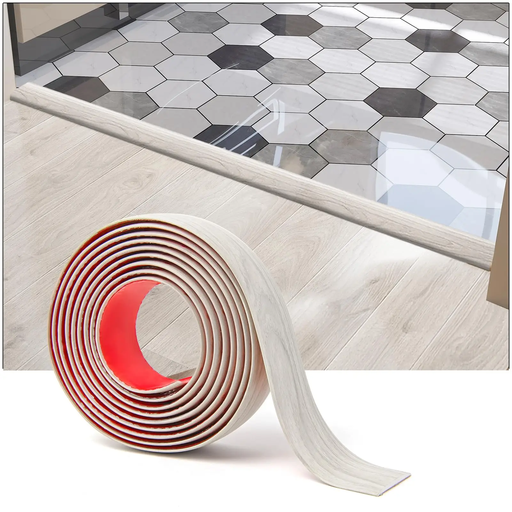
Why this choice suits this profile: its 3-metre length lets you tackle several joins around the home. Fitting is simple: cut the strip, peel off the protective film, then press firmly.
At 4 cm wide, it reduces the risk of choosing a strip that doesn't fully cover the gap.
Flexible PVC, 300 cm length, 4 cm width and 0.3 cm thickness, for transitions between laminate, tiles, carpet or vinyl.
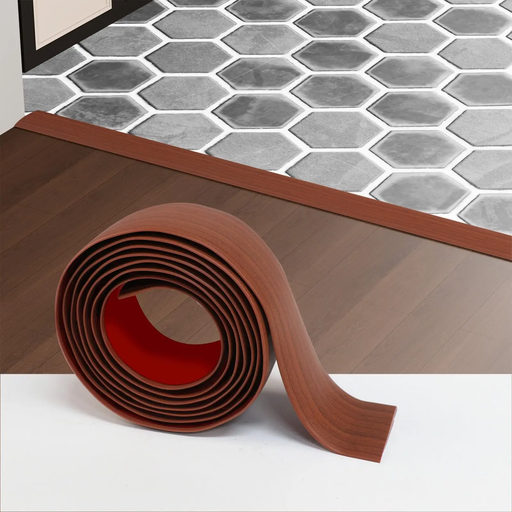
Why this choice suits this profile: its cherry wood pattern can complement a laminate floor and create a more polished visual continuity at the join.
Its shorter format makes alignment easier on a specific doorway and avoids paying for a length you don't need.
Wood-effect finish, flexible PVC, cuts with scissors and self-adhesive installation, no nails or extra glue needed.
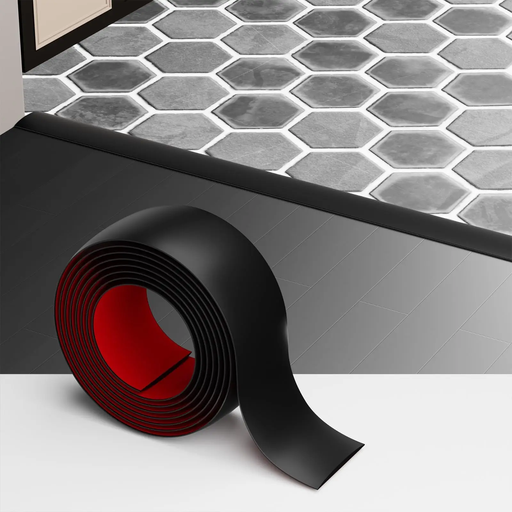
Why this choice suits this profile: its 3-metre length works well for large rooms or homes with several joins. The black finish clearly highlights the separation between floor coverings.
The product page specifies the installation conditions and recommends a dry floor, which helps reduce peeling caused by moisture or dirt.
PVC described as resistant to scratches, stains and abrasion, with maintenance limited to a simple wipe-down.
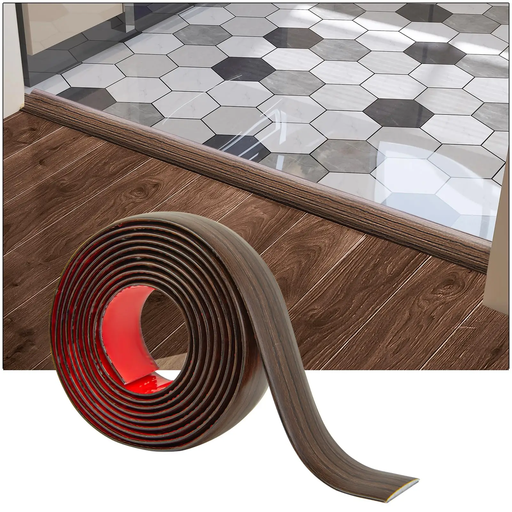
Why this choice suits this profile: its brown wood look naturally complements the warm tones of a living room, bedroom or kitchen.
The description mentions simple cutting and installation on a clean, dry surface, with no professional equipment needed.
Brown wood finish, PVC backing, 4 cm width and easy cleaning with a damp cloth.
Start by measuring the gap, then clean the surfaces thoroughly and let them dry. Cut the strip, position it without stretching it, and gradually peel off the protective film while pressing firmly. If it has been distorted during transport, a little gentle heat can help it regain its shape.
It all depends on the quality of the surface, how much foot traffic it gets, how well it's maintained, and its exposure to moisture. Installing it on a dry, smooth, degreased floor will help it stay in place over time. Check the ends regularly and replace the strip as soon as it lifts or becomes a nuisance.
Some models are described as moisture-resistant, but that doesn't mean they can withstand immersion or constant water flow. In a bathroom, check the manufacturer's instructions, dry the area thoroughly before fitting, and avoid spots where water tends to pool.