
Livraison le jour même ou le lendemain

Qualité garantie

Débloquez vos offres de bienvenue: Livraison GRATUITE | Jusqu'à -80 % | 30 jours d'essai gratuits à JoyPlus
Téléchargez l'application
Having a portable tire inflator in your trunk is no longer a gimmick; it's genuine peace of mind. Whether you're adjusting your tire pressure for the changing seasons or dealing with a slow leak on the side of the road, this compact tool can save the day. The problem: the market is flooded with models making tempting promises that often don't hold up. As experts in the Auto-Moto section, our mission is to help you cut through the noise. Let's break down the common pitfalls to avoid so you can make the right choice.
Navigating the jungle of portable compressors can quickly become a headache. Too many users regret their purchase, trapped by flaws that only reveal themselves with use. Here are the 3 classic mistakes you absolutely must not make:
To avoid falling into these traps, here are the technical specifications to examine closely. These are what separate a gadget from a truly reliable tool.
Here, it all depends on your habits and needs.
Don't be impressed by the 150 PSI (about 10.3 bar) displayed on every box. This is pure marketing, as a car tire rarely needs to be inflated beyond 2.5 bar (about 36 PSI). The real data to look at is the airflow, in liters per minute (L/min).
Simply put, higher airflow means less time spent on the side of the road. A convenience that is priceless.
Today's best inflators are true Swiss Army knives. Here are the features that make a difference:
To move from theory to practice, here is our selection of models that caught our attention. Each one is suited to a specific user profile, based on the criteria we've just detailed.
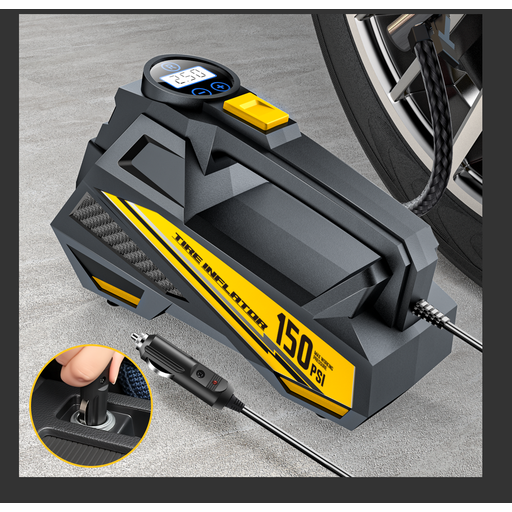
Why we recommend it: The perfect solution for those who want a "no-fuss" tool to forget about in the trunk. No battery to monitor, it's always ready for an emergency or a simple pressure check. Its simplicity is its greatest strength for occasional use.
By plugging into the cigarette lighter, it eliminates problem #1: a dead battery. It will work as long as your car starts, period.
Rock-solid reliability (12V power). Compact format, easy to store. Immediately intuitive, no-frills operation.

Why we recommend it: The perfect companion for those who juggle a car, motorcycle, and bikes. Completely wireless, with a decent 4000 mAh battery and preset modes, it offers formidable versatility. Compact enough to slip into a backpack.
It tackles two common plagues: slowness and inaccuracy. Its 17 L/min airflow is respectable for a quick top-up, and its pressure sensor is designed to be more reliable than average.
Decent inflation speed for its size. A true multi-tool: LED light, power bank. 5 smart inflation modes.
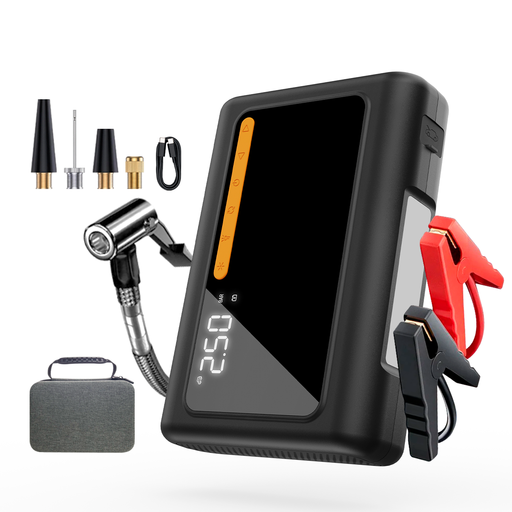
Why we recommend it: Much more than a simple inflator, this is the ultimate survival kit for any driver. It integrates a jump starter, a powerful compressor, a flashlight, and a power bank. For those who put safety above all else and want to be prepared for any eventuality.
It obliterates the phantom battery trap. Its sodium-ion technology boasts extremely low self-discharge, allowing it to remain on standby for several years (according to the manufacturer). In short, it will be ready to go even if you've forgotten it in the back of your trunk for months.
The ultimate all-in-one (jump starter + inflator). Very low self-discharge battery. Operates in extreme conditions (-40°C to 80°C / -40°F to 176°F).
We've put together a complete selection of products that meet our quality criteria and current safety standards.
What is the lifespan of a portable tire inflator? It all depends on the build quality and how often you use it. On a corded model, the motor will be the first thing to wear out. On a cordless one, the weak link is, unsurprisingly, the battery. A good lithium-ion battery will last 3 to 5 years (or several hundred charge/discharge cycles) before showing serious signs of degradation. A few simple steps can extend its life: store it in a dry place and, for battery-powered models, remember to do a full charge every 3 to 6 months to maintain the cells.
Can a cordless inflator reinflate a completely flat car tire? Yes, a good model is capable of it, but expect to use almost the entire battery for the job. A model with a battery of at least 4000-6000 mAh and a decent airflow (around 25 L/min) will take between 7 and 10 minutes to fully reinflate a standard tire (like a 195/65R15). After such an effort, the battery will likely be on its last legs. For large SUV or 4x4 tires, a more robust 12V corded model or a cordless one with a very large battery is highly recommended.
How can you verify the accuracy of the pressure gauge? Excellent question. The simplest and most reliable method is to cross-check it with a quality control pressure gauge (you can find one for about ten dollars at an auto parts store). Use your inflator, then immediately measure the pressure with your reference gauge. A small discrepancy of 0.05 to 0.1 bar (1-2 PSI) is acceptable. If it's more than that, you'll just have to account for it and adjust your target pressure on the inflator accordingly (for example, setting it to 2.6 bar to get a true 2.5 bar).