
Livraison le jour même ou le lendemain

Qualité garantie

Débloquez vos offres de bienvenue: Livraison GRATUITE | Jusqu'à -80 % | 30 jours d'essai gratuits à JoyPlus
Téléchargez l'application
A portable tyre inflator can get you out of trouble at home, at a motorway service area or before heading out on your bike. The problem is that product listings often highlight a single figure — “150 PSI”, for example — without specifying the actual airflow, battery life or usage limitations. To avoid buying the wrong product, it is better to compare several criteria and take your vehicle into account.
A high maximum pressure does not mean that a compressor will inflate a car tyre quickly. Airflow, expressed in L/min, generally has a much greater effect on the time required. A device rated at 150 or 160 PSI may be suitable for many inflatables while proving very slow on a completely flat tyre.
For a simple top-up, a compact electric tyre pump may be perfectly adequate. However, if you need to inflate several tyres or restore pressure after a significant loss, choose a higher airflow and a device that can run for long enough without overheating.
A cordless tyre inflator is convenient, but its battery inevitably imposes some limitations. Its capacity, expressed in mAh, is not enough to determine how many tyres you will be able to inflate. Tyre size, starting pressure, ambient temperature and the necessary breaks also play a part.
Some models need to cool down after a few minutes of use. For more intensive use, a compressor powered by 12 V may provide more consistent operation. Check the recommended operating time in the instructions and never leave the device running unattended.
Small portable compressors are generally designed for cars, motorbikes, bicycles and balls. They are not always suitable for lorry, trailer, motorhome or off-road vehicle tyres. Also check the type of valve supported and the attachments supplied.
Before ordering, check the recommended pressure in the vehicle handbook or on the label usually located in the driver’s door frame. The value shown on the tyre sidewall is a technical limit, not necessarily the recommended pressure for your vehicle.
When choosing a portable tyre pump, compare at least these three elements:
A portable air compressor with several preset modes makes everyday use easier. Manual adjustment is still valuable when the recommended pressure does not correspond to a standard value.
A digital pressure gauge should display the current pressure and target pressure clearly. PSI, bar or kPa units help avoid unreliable conversions, provided you select the correct unit before starting.
The automatic shut-off function switches off the rechargeable air pump once the programmed pressure is reached. It reduces the risk of over-inflation, but does not remove the need to check the setting or the valve seal. Attach the nozzle correctly to prevent leaks that could distort the reading.
A USB-C rechargeable battery makes transport easier, particularly for cyclists and motorcyclists. For regular car journeys, a model with a 12 V cable may be more suitable: it means you do not have to rely solely on the built-in battery.
Also remember to check:
For an electrical product sold in France, check the instructions, the contact details of the responsible person established in the European Union and the applicable marking shown on the product or its packaging. This information is more useful than a simple promise of power.
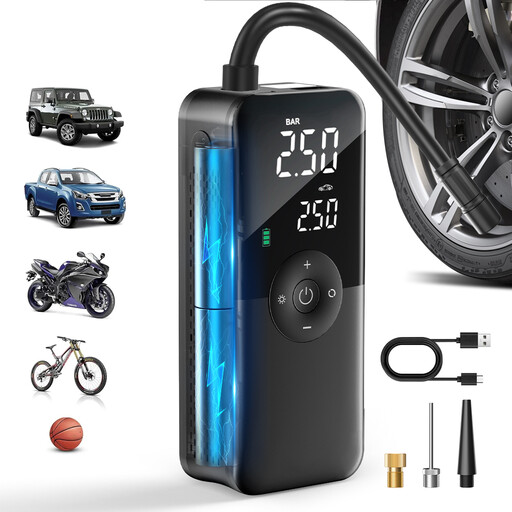
Why this choice suits this profile : its cordless design and car, motorbike and bicycle modes are ideal for occasional top-ups and motorists who want to keep a compact solution in the boot.
The listing mentions a digital pressure gauge, automatic shut-off and charging via a USB cable beforehand, making its operation fairly clear.
Stated maximum pressure of 150 PSI, cordless operation and automatic shut-off according to the description.
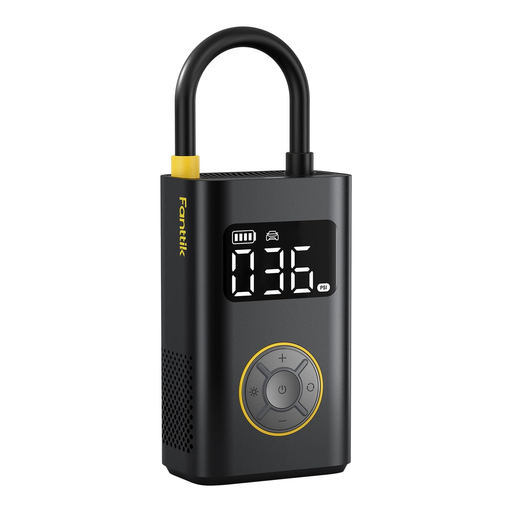
Why this choice suits this profile : motorists looking for a comprehensive interface will appreciate the car, motorbike, bicycle and ball modes, along with the display advertised as easy to read outdoors.
The description states that it can run for up to 23 minutes and features automatic shut-off, rather than relying solely on the maximum pressure.
Stated pressure of 150 PSI, 4+N modes, automatic shut-off and safety switch-off after a period of inactivity.
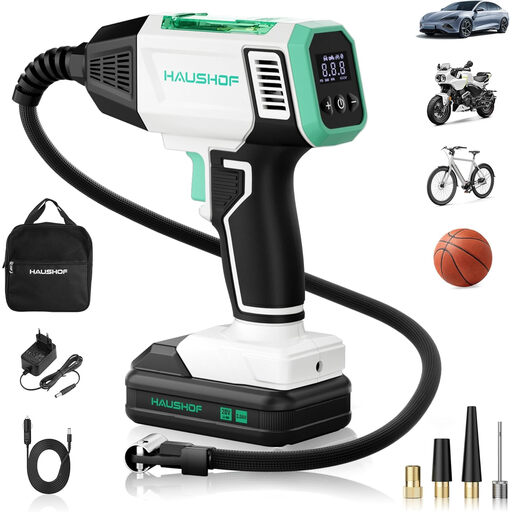
Why this choice suits this profile : its battery or 12 V socket operation is suitable for long journeys, camping and anyone looking to limit interruptions caused by recharging.
The listing recommends the wired 12 V power supply for extended use and reminds users to take breaks to allow the heat to dissipate.
Stated airflow of 22 L/min, maximum pressure of 150 PSI, four preset modes and cordless or 12 V power supply.
We have put together a complete, real-time selection of products that meet these selection criteria as well as European safety requirements.
A car, motorbike and bicycle inflator is primarily intended for topping up or dealing with occasional problems. It does not replace a tyre inspection in the event of a puncture, deformation or repeated loss of pressure. In this situation, have the tyre checked by a professional.
It depends on the tyre size, its initial pressure, the airflow and the battery’s charge level. The figures provided by manufacturers often relate to a specific scenario, such as a top-up of a few PSI. For a realistic estimate, look for information that clearly specifies the tyre size and starting pressure.
No. The stated maximum pressure does not guarantee compatibility with lorry, trailer or motorhome tyres. Check the manufacturer’s intended use, the type of valve supported and the length of the cable or hose. The compact models featured here are mainly intended for cars, motorbikes, bicycles and small inflatables.
Recharge it after use or in accordance with the instructions. Avoid storing it completely discharged and keep it in a cool, dry place. Even when the device is used infrequently, periodic recharging helps keep it ready for a journey or an unexpected breakdown.