
Livraison le jour même ou le lendemain

Qualité garantie

Débloquez vos offres de bienvenue: Livraison GRATUITE | Jusqu'à -80 % | 30 jours d'essai gratuits à JoyPlus
Téléchargez l'application
An underinflated tire the day before vacation or a dead battery on a Monday morning? It's every driver's worst nightmare. Faced with these hassles, the portable tire inflator has established itself as the essential accessory to always keep in your trunk. The problem? The market is flooded with models making tempting promises that, all too often, fall flat.
Before you make a purchase, learn to spot the most common marketing traps to prevent a purchase meant to give you peace of mind from turning into a costly disappointment.
To make the right choice, ignore the marketing speak and focus on objective technical criteria.
To find a reliable tool that will guarantee you true peace of mind, scrutinize these three technical points.
The power source determines how you can use your inflator.
These two values are inseparable when judging the true effectiveness of an inflator.
Extra options are only relevant if they meet a real need.
Rather than an endless list, we've selected models that cater to specific user profiles, based on the reliability criteria we've just covered.

Why we chose it: For those who want to make absolutely no compromises on safety. It combines a powerful jump starter, an efficient compressor, and battery technology designed for rock-solid reliability, even after being left in the trunk for a long time.
It tackles the "phantom battery life" trap head-on. Its sodium-ion battery has an extremely low self-discharge rate (about 1% per month, according to the manufacturer), allowing it to remain operational for years on a single charge.
Reliability and safety: The sodium-ion battery technology withstands extreme temperatures (-40°C to 80°C) and, unlike conventional lithium batteries, does not release oxygen if punctured, drastically reducing the risk of fire.
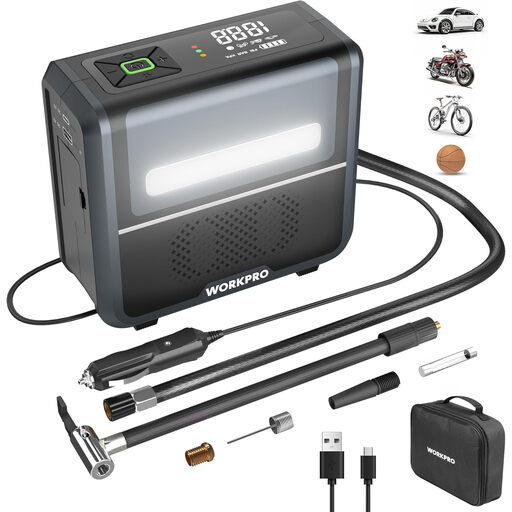
Why we chose it: Perfect for families and outdoor enthusiasts. Powerful enough for car tires, it also has preset modes for bikes and balls. Its dual power supply makes it particularly reliable for long trips or camping excursions.
It bypasses the risk of a dead battery thanks to its dual power supply. If the built-in battery is empty, simply plug its long 3.8m cable into the vehicle's 12V socket to continue using it without interruption.
Versatility and convenience: Its smart modes with automatic shut-off prevent any risk of over-inflation. The integrated storage compartments for cables and nozzles keep everything tidy and always ready for use.
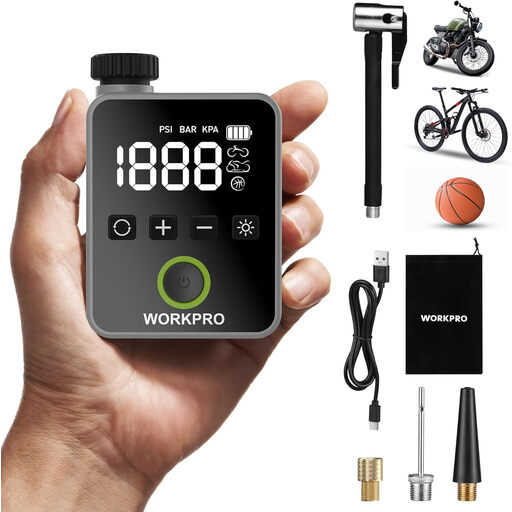
Why we chose it: For the urban driver or cyclist who primarily seeks an ultra-compact design. Small enough to slip into a glove box or backpack, it's perfect for regular top-ups and minor emergencies.
It doesn't fall into the disappointing "all-in-one" trap. This is a specialized inflator, compact yet surprisingly powerful for its size (up to 9.78 bar). It focuses on one job and does it perfectly, without false promises.
Ultra-portability: Weighing only 270g and including a storage pouch, its size and weight are its best features. It's the backup solution that takes up no space at all.
We have compiled a complete and up-to-date selection of products that meet our strict selection criteria and safety standards.
Yes, provided you choose a sufficiently robust model. A device with a battery of at least 4000-5000?mAh and an airflow greater than 20?L/min can reinflate a standard tire (e.g., from 0 to 2.4?bar) in 5 to 10 minutes. More compact models, however, are primarily designed for top-ups and are likely to struggle, or even drain their battery before finishing the job.
It all depends on your needs and the age of your vehicle. If your battery is starting to show its age, if you live in a cold region, or if you take long trips far from civilization, a multifunction car jump starter is a very wise investment. It covers you against the two most common breakdowns. For primarily urban use with a newer vehicle, a simple inflator may be more than enough.
Its longevity mainly depends on the quality of its battery and how often you use it. Conventional lithium-ion batteries generally last for 300 to 500 charge cycles. To preserve it, it's advisable to recharge it every 3 to 6 months, even when not in use. Newer models, like those with sodium-ion batteries, promise thousands of cycles and an extended lifespan. Finally, respecting the cool-down times recommended by the manufacturer to prevent motor overheating will also prolong the device's life.