
Livraison le jour même ou le lendemain

Qualité garantie

Débloquez vos offres de bienvenue: Livraison GRATUITE | Jusqu'à -80 % | 30 jours d'essai gratuits à JoyPlus
Téléchargez l'application
A flat or underinflated tire: every driver's nightmare. Fortunately, a good car tire inflator turns this hassle into a simple formality. But here's the problem: the market is flooded with models making tempting promises, and it's easy to make the wrong purchase. Before you pull out your credit card, it's crucial to know how to avoid the marketing traps that lead straight to a purchase you'll regret.
This guide is here to help: to give you the keys to choosing a reliable device that's truly suited to your needs, without being fooled by marketing hype. Let's break down the mistakes to avoid and the criteria that really matter.
To make the right choice, you first need to recognize the common pitfalls. Too many drivers end up with a useless device because of these three classic mistakes.
The Phantom Power Trap?: You fall for an ultra-compact and cheap "portable electric pump." The catch? It's designed for an air mattress or a beach ball, not for the high pressure of a car tire. Its power is negligible, the motor overheats, and the device gives up the ghost after two or three uses. A car tire requires about 2.5 bars (36 PSI), a performance these mini-pumps will never achieve.
The "All-in-One" Illusion?: Some products are sold as standalone inflators but are actually just accessories. The classic example: the digital tire inflator gauge that must be connected to an air compressor (not included, of course). Without the compressor, your purchase is completely useless. You thought you were getting a turnkey solution, but you only have one piece of the puzzle.
The Vague Specs Trap?: Steer clear of product pages that overuse terms like "high-performance" or "fast inflation" without providing any numbers. A reputable manufacturer will always display the maximum pressure (in bars or PSI) and the airflow rate (in liters per minute). Without this data, it's impossible to gauge what the device is really capable of.
To avoid these disappointments, three technical specifications should command your full attention. They are the true measure of a good car compressor.
This is the number one criterion. A car tire's pressure is typically between 2.2 and 2.8 bars. To work comfortably, your inflator must be able to deliver a much higher pressure, ideally between 7 and 10 bars (or 100 to 150 PSI). This headroom allows it to inflate the tire without straining and to quickly reach the desired pressure. A model with a precise digital gauge is a decisive advantage for safe, pinpoint-accurate adjustments.
The ease of use of your inflator will directly depend on its power source. Two main types compete:
Expressed in L/min, the airflow rate is simply the indicator of inflation speed. A weak airflow (10-15 L/min) will condemn you to long minutes of waiting for a single tire. Conversely, a portable air compressor with 30 L/min or more will get the job done much faster and without stress. For frequent use or for large tires (SUVs, vans), a high airflow rate is non-negotiable.
Rather than an endless catalog, here are products that check the right boxes for specific user profiles, based on the criteria we've just discussed.
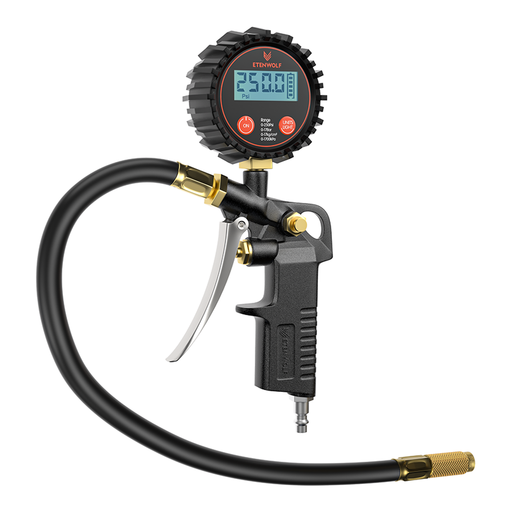
Why it's a match : This tool is for those who already own a compressor and demand surgical precision for their tire pressure. Ideal for regular maintenance or for mechanics enthusiasts who are serious about their settings.
It doesn't pretend to be something it's not. Its mission is clear: to measure and adjust pressure with formidable reliability, provided it's connected to an air source. It thus avoids the trap of an accessory being sold as a complete solution.
Calibrated precision : Compliant with the ANSI B40.7 Grade 2A standard, guaranteeing a reliable reading. Robust construction : Made of brass, stainless steel, and rubber to be ready for anything.
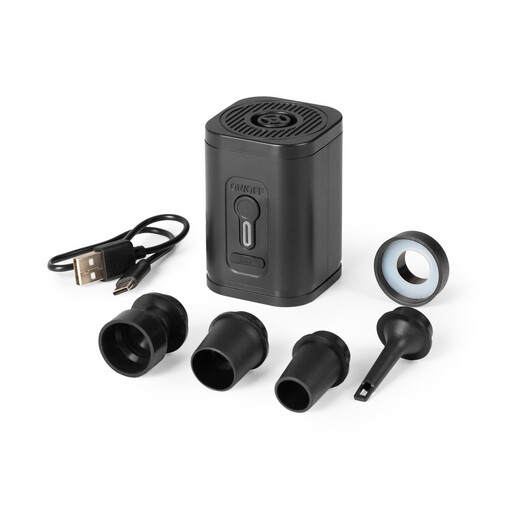
Why it's a match : This is the perfect companion for families, campers, and home use. Its mini size allows it to slip into a drawer or backpack to inflate air mattresses, pool floats, balls, and other low-pressure leisure items in a flash.
Through its honesty. The product page is upfront: this device is not made for high-pressure items like tires. It thus avoids the insufficient power trap by not overpromising.
Ultra-compact and lightweight : Easy to carry and store. Everyday versatility : Essential for a multitude of inflatable items at home, on vacation, or while camping.
Are the featured models not suitable for your primary use, tire inflation? Don't worry. We have selected a full range of compressors and pumps that meet our strict criteria for performance and safety.
The risk is minimal, especially if you take the precaution of using it with the engine running. When the engine is on, the alternator provides enough power to run the compressor without ever drawing from the battery.
These are simply two units of measurement for pressure. BAR is the most common unit in Europe, while PSI (Pounds per Square Inch) is the standard in North America. The conversion is simple: 1 BAR is approximately 14.5 PSI. The recommendations for your vehicle, which you can find on the sticker in the driver's side doorjamb, are almost always in bars in Europe.
Yes, that's the whole point! It's designed to stay in your trunk, ready to use when needed. To preserve its lifespan, however, avoid exposing it to extreme temperatures (in the scorching sun during summer or in severe cold during winter): the electronics and the battery (for cordless models) won't appreciate it.