
Livraison le jour même ou le lendemain

Qualité garantie

Débloquez vos offres de bienvenue: Livraison GRATUITE | Jusqu'à -80 % | 30 jours d'essai gratuits à JoyPlus
Téléchargez l'application
A portable tyre inflator can be a lifesaver on a motorway service station, in the garage, or before a bike ride. The trouble is, product specs throw numbers at you — maximum pressure, airflow rate, battery life — without always explaining what they mean in practice. A device rated at 150 PSI might prove impractical on an SUV, while a compact model could be perfectly adequate for a motorbike or simply topping up tyres.
Here are the criteria to consider to avoid a poor purchase, along with a selection of models suited to different uses.
A rating of 150 PSI or 160 PSI refers to a theoretical maximum pressure. On its own, it tells you nothing about how fast the inflator works. For a car, the airflow rate — expressed in L/min —, the motor power, and the device’s ability to run for several minutes are often far more revealing.
A compressor that can reach 150 PSI may be suitable for a car, motorbike, bicycle or ball. However, you need to look at the stated time to go from a completely flat tyre to the desired pressure. Performance also depends on the tyre volume and the device’s temperature.
A rechargeable tyre inflator is especially handy on the go, but battery life varies significantly depending on the pressure you need to reach. Some portable models claim 20 to 25 minutes of run time: that’s generally enough for top-ups, but much tighter when you need to reinflate several SUV or motorhome tyres.
Also consider the charging time, the type of cable supplied, and whether it can run on a 12 V power source. An electric tyre pump with a built-in battery is easy to carry, while a corded model will often be more practical for extended use near the car.
Without a readable pressure gauge, you’ll need a separate instrument to check the pressure. Conversely, an inflator with a digital pressure gauge lets you set a target value directly — provided you select the correct unit from PSI, bar and kPa.
Auto-stop saves you from having to hover over the device throughout inflation. However, it doesn’t replace checking the recommended pressure in your vehicle’s manual or on the sticker inside the door frame. Also check the included nozzles: Schrader valve for most cars and motorbikes, Presta adapter for some bicycles, and a needle for balls.
For versatile use, a stated maximum pressure of 150 to 160 PSI covers most everyday needs. The flow rate gives a more concrete comparison between devices: the Porbi Q19 and Q16 claim 26 L/min, compared to 20 L/min for the ETENWOLF S1.
For car tyres, focus mainly on the time needed for a top-up. The Porbi models claim around 30 seconds to bring a tyre back up to pressure, but up to 7 to 8 minutes per completely flat tyre under the stated conditions. These figures are indicative: tyre volume and battery charge level can affect them.
A capacity of 4,000 mAh is generally sufficient for a compact device intended for top-ups and occasional emergencies. The Porbi Q19 and Q16 claim around 25 minutes of use, with a charging time of 3.5 hours. A model running on 12 V avoids relying on a built-in battery, but you’ll need an easily accessible cigarette lighter socket.
For larger vehicles, check the cable length, cooling times and the manufacturer’s recommendations. Just because an inflator fits in the glovebox doesn’t mean it can reinflate several motorhome tyres in a row.
An emergency LED light offering continuous illumination or an SOS mode can prove invaluable during a night-time stop. It improves visibility around the valve, but obviously doesn’t replace a hi-vis vest, warning triangle or other required equipment.
Before inflating, immobilise the vehicle, avoid wet areas, and let the compressor cool down after prolonged use. With a cordless model, recharge the battery after each use and store the device away from high heat. For the Greenworks model, bear in mind that the 24 V battery and charger are sold separately, according to the product sheet.
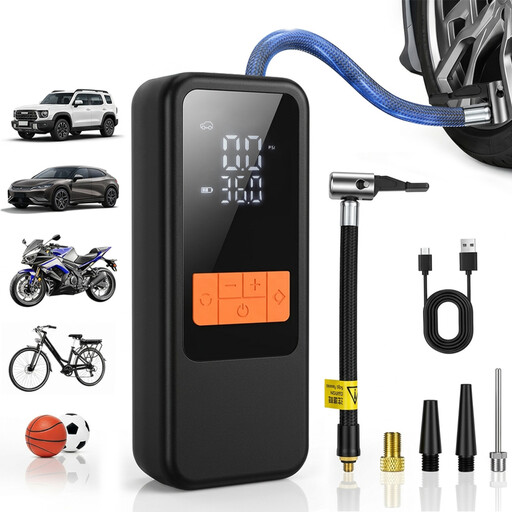
Why this choice suits this profile: This cordless model offers five dedicated modes for car, motorbike, bicycle and balls, plus a custom setting. A straightforward choice for top-ups at home and everyday journeys.
The 150 PSI maximum pressure isn’t its only selling point: the device also claims a flow rate of 26 L/min and features a pressure display.
4,000 mAh battery, approximately 25 minutes of run time, USB-C port and LED light with continuous illumination and SOS mode.
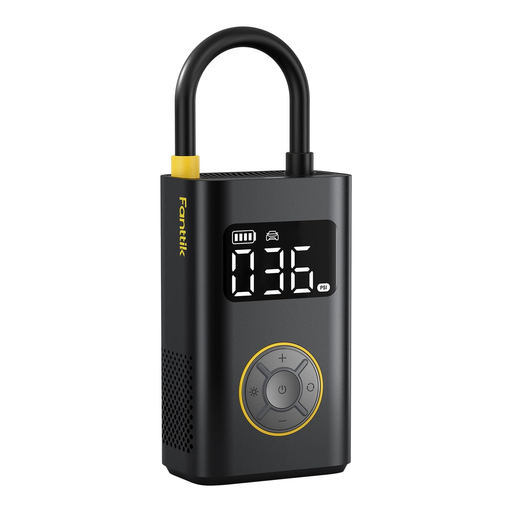
Why this choice suits this profile: Its dedicated modes and clear display cater to drivers who want to precisely adjust the pressure of a car, motorbike, bicycle or ball.
Auto-stop at the selected pressure means you don’t have to watch the device constantly. The spec sheet also claims a battery life of up to 23 minutes.
Stated maximum pressure of 150 PSI, 4+N modes, auto-stop and integrated hose storage.
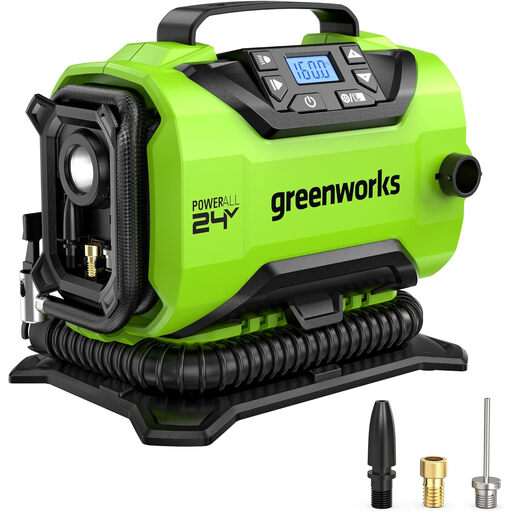
Why this choice suits this profile: Its two modes — high and low pressure — cover tyres as well as airbeds, balls and other inflatables. It’s particularly suited to camping and road trips.
The spec sheet clearly distinguishes between high and low pressure uses and states that the 24 V battery and charger are sold separately.
Stated pressure up to 11 bar, digital display, auto-stop, three adaptors and a 0.5 m hose.
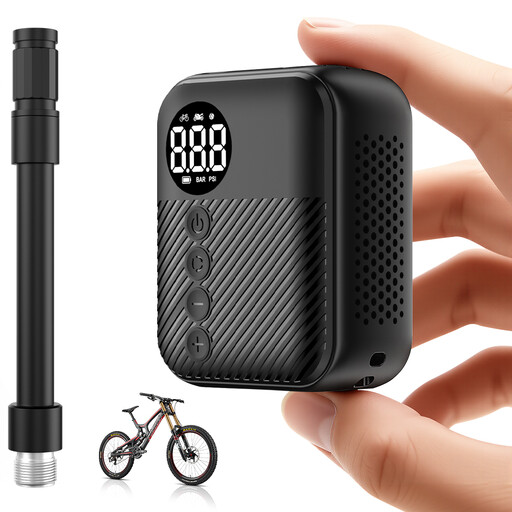
Why this choice suits this profile: Its pocket-sized format slips into a backpack, saddlebag or motorbike storage. It’s suitable for topping up bicycle, motorbike and even car tyres.
Its rechargeable battery and digital display mean you don’t need a power socket or a separate pressure gauge.
Compact size, built-in battery, digital pressure gauge and stated maximum pressure of 150 PSI.
We’ve put together a comprehensive, regularly updated selection of products that meet these demanding criteria, in line with European safety regulations.
A simple top-up can take a few tens of seconds, depending on the model and the pressure difference. A completely flat tyre will take significantly longer: in their reference scenario, the Porbi spec sheets indicate around 7 to 8 minutes. For an SUV or motorhome, compare the flow rate, battery life and any required cooling breaks.
A cordless car inflator is the most practical by the roadside or for helping out with a bike. A 12 V model may be better suited to extended sessions, provided you have an accessible socket and cable. For occasional use, portability usually wins out; for several large tyres, a continuous power supply will often be preferable.
Yes, provided the car, motorbike and bicycle inflator comes with the necessary adaptors and allows you to set the pressure with sufficient accuracy. Always use the value recommended by the vehicle or tyre manufacturer, then check the pressure once inflation is complete.