
Livraison le jour même ou le lendemain

Qualité garantie

Débloquez vos offres de bienvenue: Livraison GRATUITE | Jusqu'à -80 % | 30 jours d'essai gratuits à JoyPlus
Téléchargez l'application
An underinflated tyre isn't just an inconvenience: it's a genuine safety risk and a drain on your fuel. Keeping a portable air compressor in your boot is therefore the common-sense solution. The problem? The market is flooded with models whose marketing promises fall flat once you have them in your hands. As a product specialist at Joybuy, my role is to help you avoid the pitfalls. Let's break down the mistakes to avoid so you can invest in a device that truly delivers.
Too many drivers end up with a useless gadget on the day they really need it. Here are the two most common mistakes, often caused by slick marketing talk.
To avoid being misled, focus on these three technical points. They are what separate a gadget from a genuine tool.
It all depends on how you plan to use it.
These two values go hand-in-hand and are crucial for judging real-world performance.
Far from being gimmicks, these modern options simplify your life and make the process safer.
Here are a few options that meet specific needs, taking into account the criteria we've just discussed.
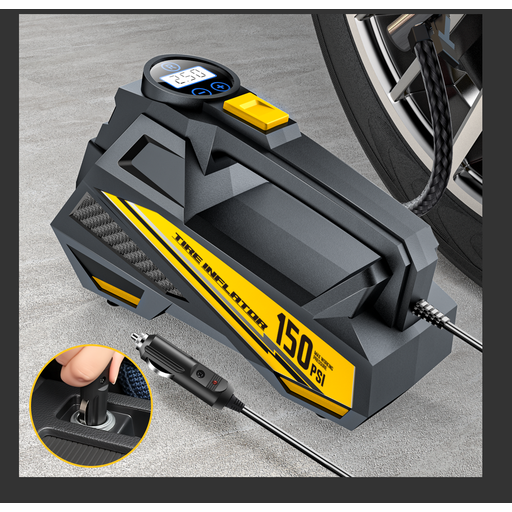
Why it's a great choice: Perfect for those who want a "plug-and-play" emergency solution to leave in the boot. With no battery to charge, it's always ready as long as your car can start. Its corded design ensures consistent power to handle a slow leak or top up before a long journey.
This model bypasses the problem of limited battery life by plugging directly into the 12V socket. You have a continuous power source to handle the situation without stress.
Reliability: No risk of a dead battery. Simplicity: Intuitive design for hassle-free emergency use.
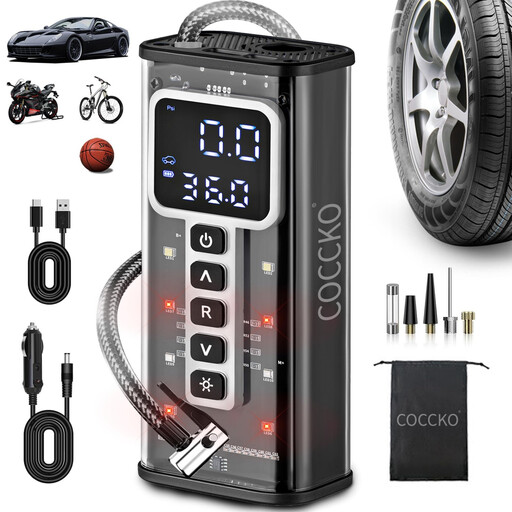
Why it's a great choice: For those who want a Swiss Army knife of inflation. Its 6000 mAh battery provides generous runtime for maintaining the tyres on the family car, the kids' bikes, and sports balls. The preset modes and automatic shut-off make it very easy to use, even for novices.
With a 6000 mAh battery and a stated airflow of 35 L/min, it tackles both issues: it offers real-world runtime and an inflation speed suitable for automotive use, not just a small top-up.
Long runtime: The 6000 mAh battery provides peace of mind. Versatility: 5 preset modes and a Power Bank function to charge a phone in a pinch.
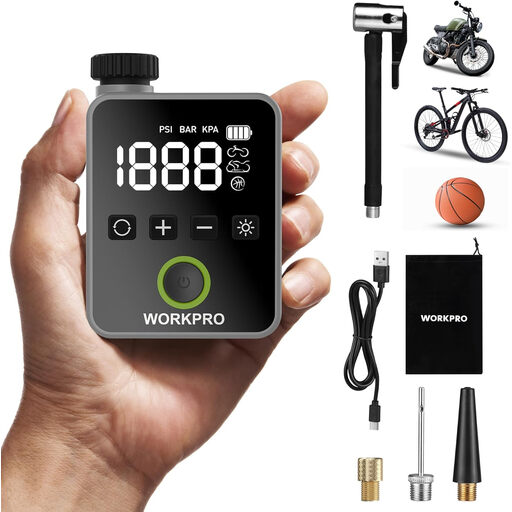
Why it's a great choice: For motorcyclists and cyclists, every gram counts. This 270g model is lighter than a smartphone and fits into a saddlebag or backpack. It's designed for quick pressure adjustments before a ride or for on-the-go repairs, without the bulk of a heavier model.
It doesn't pretend to inflate four 4x4 tyres. Its positioning is clear: extreme portability. It perfectly fulfils its mission, which is to handle smaller volume tyres (bike, motorbike).
Ultra-compact: Feather-light at 270g and pocket-sized. USB-C Charging: Recharges easily with the same cables as your other devices.
Discover our full selection of products that meet our performance criteria and safety standards.
The lifespan depends on the build quality and frequency of use. A well-made model, used for regular top-ups, can last several years. The usual weak points are the motor (which can overheat on low-end models) and the battery for cordless versions. A little tip to preserve the battery: recharge it every 3 to 6 months, even if you don't use it.
Yes, but under certain conditions. A good model with a robust battery (5000 mAh minimum) and a decent airflow (over 20 L/min) will be able to fully inflate a standard tyre (like a 195/65R15) from 0 to 2.5 bar. However, expect this to use up a large portion, if not all, of the battery. Weaker models will struggle or require cool-down breaks.
Yes, it's essential. An air compressor is power-hungry and can drain your car's battery in minutes, especially if it's already a few years old. By leaving the engine running, the alternator takes over and powers the compressor, thus protecting your car's battery. It's a simple precaution that will prevent you from turning a tyre problem into a starting problem.