
Same-day & Next-day Delivery

Quality Guaranteed

Unlock Your Welcome Offers: FREE Delivery | Up to 80% OFF | Free 30-day JoyPlus trial
Download the APP
An underinflated tire isn't just an inconvenience?— it's a safety hazard and a cause of increased fuel consumption. The portable air compressor has established itself as an essential tool in the trunks of many drivers, motorcyclists, and cyclists. However, the market is saturated with models making tempting promises that often fall flat.
As the Head of Product Recommendations at Joybuy, I'm here to separate fact from fiction. Let's cut through the marketing jargon and get straight to the point. To help you avoid a disappointing purchase, here are the 3 common pitfalls to watch out for and the criteria that truly matter when making your choice.
The Myth of "Infinite" Battery Life?: Some cordless models promise the world with battery capacities that look impressive on paper. The catch?? These figures are often measured under lab conditions, like inflating a single bicycle tire. In reality, for a car tire inflator, a battery under 4000?mAh will struggle to properly inflate more than one or two tires, potentially leaving you stranded when you need it most.
Confusing Pressure (PSI) with Airflow (L/min)?: Don't be blinded by the 150?PSI advertised prominently on the box. This maximum pressure is useless without sufficient airflow (measured in L/min). If the airflow is too low, your compressor will take forever to inflate a car tire, even if it can theoretically reach the target pressure. It's the airflow, not the maximum pressure, that dictates inflation speed.
"All-in-One" Features That Do Everything... Poorly?: On paper, a jump starter with a built-in compressor sounds like the perfect solution. But beware of entry-level models: their jump-starting function is often too weak to revive a diesel engine or a large gasoline engine in cold weather. As for the power bank feature, it can be so insignificant that it will drain the compressor's battery before it can even fully charge a smartphone.
To ensure you make the right choice, focus on the technical specifications that truly make a difference in day-to-day use.
This is the first question to ask yourself, as it determines everything else.
Rather than an endless list, we've selected three products for three different types of users, focusing on efficiency and practicality.
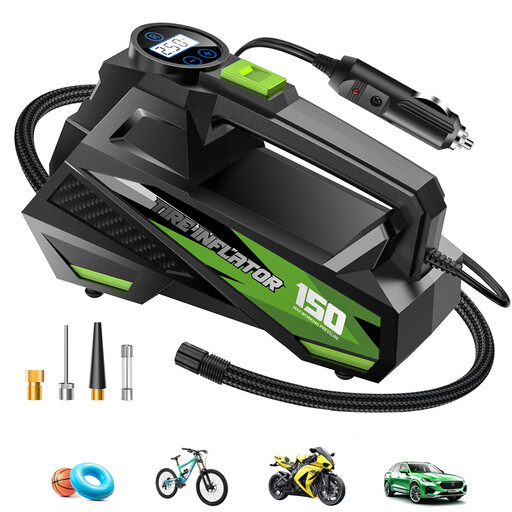
Why we picked it : Perfect for those who want a reliable and effective emergency solution without breaking the bank. Keep it in the trunk for unexpected situations—it gets straight to the point: inflating your tires, period.
As a corded 12V model, it completely bypasses any battery life issues. As long as your car's 12V outlet is working, so is the inflator.
Its simplicity and compact design make it the ideal, cost-effective emergency tool. The long power cord is a major plus, ensuring it can easily reach all tires.
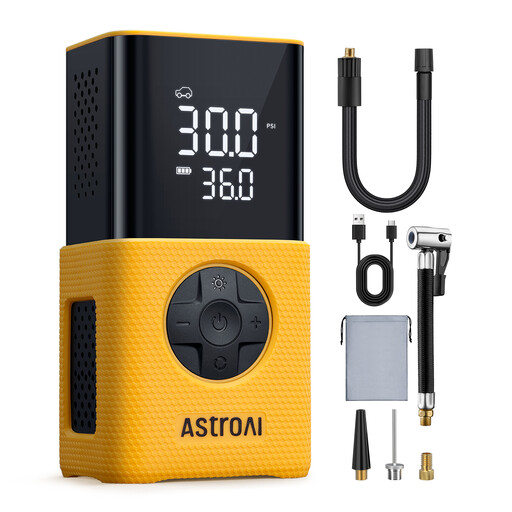
Why we picked it : This cordless compressor is the perfect ally for regular pressure maintenance and minor emergencies. Compact, equipped with a reliable battery and smart modes, it simplifies inflation for cars, motorcycles, and bikes.
With its 4000 mAh battery and 17 L/min airflow, it strikes the right balance between battery life and speed, avoiding the pitfall of disappointing performance. The auto-shutoff is a welcome safety feature.
Its cordless freedom, clear digital display, and preset modes make it incredibly convenient. The built-in LED light and backup power bank function are two bonuses that make a real difference.
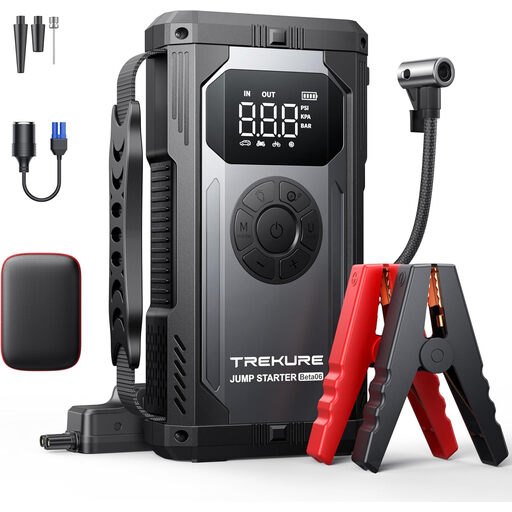
Why we picked it : This is the ultimate all-in-one solution for handling (almost) any roadside emergency. It combines a powerful jump starter, a high-performance air compressor, and a high-capacity power bank. Essential for long road trips.
It avoids the "master of none" trap. Its jump starter is powerful enough (up to 5500A peak) to revive large engines, and its compressor boasts a very respectable airflow of 35 L/min.
The true Swiss Army knife for drivers. A single device to manage dead batteries and flat tires, all while charging your devices when needed.
We have curated a full range of products that meet our performance criteria and European safety standards.
The lifespan of a portable compressor depends primarily on its lithium-ion battery. To preserve it, the golden rule is to recharge it at least once every three months, even if it's not being used. Also, avoid leaving the device in your car in direct sunlight during the summer or in extreme cold during the winter. With proper care, it will serve you well for several years.
Absolutely, if the engine is turned off. An air compressor is a power-hungry device. To avoid ending up with an inflated tire but a dead car battery, the solution is simple?: always keep your car's engine running during inflation.
Correct tire pressure is vital for your safety and the longevity of your tires. You can find the recommended pressure in several places?:
Be careful not to confuse this value with the pressure indicated on the tire's sidewall itself?: that number represents the maximum pressure the tire can withstand, not the recommended operating pressure for your vehicle.