
Same-day & Next-day Delivery

Quality Guaranteed

Unlock Your Welcome Offers: FREE Delivery | Up to 80% OFF | Free 30-day JoyPlus trial
Download the APP
A slow puncture, an underinflated tyre before a long journey or a flat battery can quickly turn an ordinary trip into a real headache. A portable car air compressor lets you inflate a tyre without having to find a petrol station. Some multi-function models can also be used as a car jump starter, a portable charger or an emergency LED light.
However detailed they may be, product listings don’t always tell you everything about an appliance’s limitations. Here are the key things to consider before you buy, followed by a selection to suit different needs.
A device advertised as delivering 150 PSI won’t necessarily inflate a tyre faster than a model with a lower rating. This figure refers to a theoretical maximum pressure, which is often far higher than the pressure a car tyre actually needs. You’ll usually find the recommended pressure in your vehicle’s handbook or on a label on the bodywork, often around the driver’s door.
When comparing two models, also look at the airflow rate, the stated inflation time and the maximum continuous running time.
A cordless electric tyre inflator is especially convenient, but only if its battery is sufficiently charged when you need it. By contrast, a 12 V car compressor plugged into the vehicle’s accessory socket depends on the car and the length of its cable.
A dual power supply — a built-in battery and a 12 V cable — gives you more flexibility. It can be particularly useful on the road, at a campsite or when your vehicle is parked far from a mains socket.
Automatic shut-off reduces the risk of exceeding the pressure you’ve set, but you still need to check the recommended value. The built-in pressure gauge may not be entirely accurate, so for a precise or important adjustment, compare its reading with a separate pressure gauge if necessary.
A compressor won’t repair a damaged valve or a serious puncture. Its main purpose is to inflate a tyre temporarily or make up for a loss of pressure.
Choose a device that displays units commonly used in France, including bar, with the option to convert to PSI or kPa. A tyre inflator with automatic shut-off lets you set a target pressure before you start inflating.
For a car, a maximum pressure of 150 PSI is well above what you’ll typically need. This extra capacity can be useful for bikes, balls, mattresses and other inflatables, provided you use the right nozzle and keep an eye on the pressure.
Cordless models are handy for a motorbike, bicycle or car parked out of reach of a cable. Check how many tyres the manufacturer says you can inflate on a single charge, bearing in mind that results vary depending on tyre size, starting pressure and ambient temperature.
Overheat protection and allowing the compressor to rest between cycles are essential. Some devices advise against more than 10 minutes of continuous use.
A compressor with an LCD screen usually shows the measured pressure, target pressure and battery level. Preset modes for cars, motorbikes, bicycles and balls make the device easier to use, but you should always check the suggested pressure.
Remember to check:
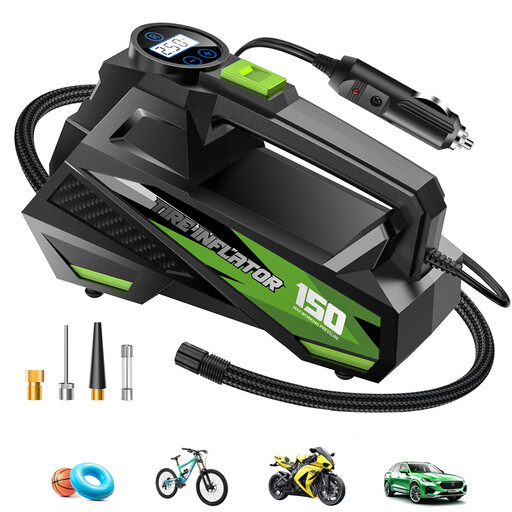
Why it suits this need: This wired model is a good choice if you want to keep a simple inflator in the boot for car, motorbike or bicycle tyres.
Its cable is long enough to avoid relying on a built-in battery that might run flat at the wrong time. However, the motor should always be used in accordance with the instructions provided.
A portable design, a 12 V power supply and stated compatibility with several types of vehicle.
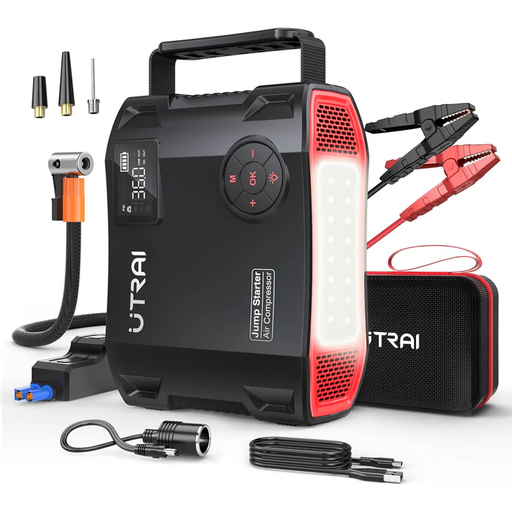
Why it suits this need: It’s designed for drivers looking for versatile equipment for long journeys, SUVs, vans or outdoor activities.
The LCD screen, automatic shut-off and stated safety protections make it easier to monitor inflation and help ensure safe connections.
A compressor rated at 150 PSI, a 27 000 mAh battery, a 12–16 V output and a 1 600-lumen LED light, according to the product listing.
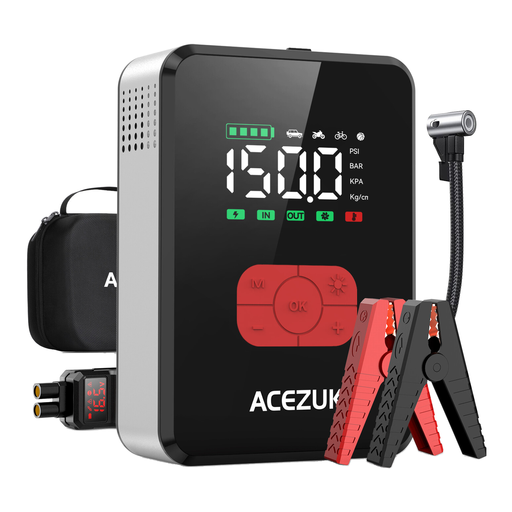
Why it suits this need: This multi-function model may appeal to owners of larger vehicles, travellers and anyone who prefers to combine several pieces of emergency equipment in one device.
The product listing mentions four preset modes, a 3.3-inch screen, automatic shut-off and smart cables with alerts.
A stated starting current of 7 000 A, a 150 PSI compressor, a power bank function and a three-mode LED light.
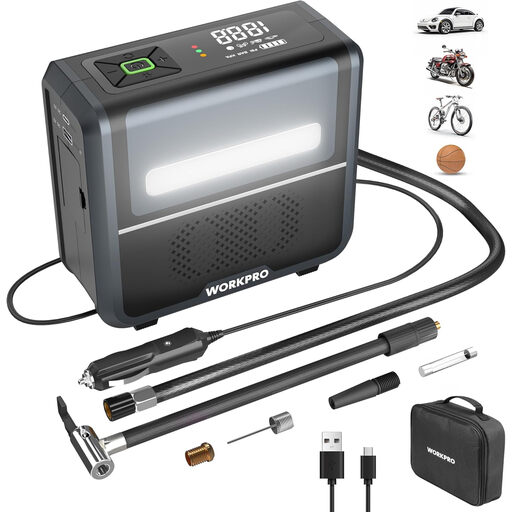
Why it suits this need: Its cordless design and accessories make it suitable for a range of uses, from cars and motorbikes to bicycles and leisure activities.
Dual power — from the battery or via a 12 V cable — reduces the risk of being left without an option when the built-in battery is nearly flat.
A stated battery capacity of 3 × 2 500 mAh, a three-colour screen, automatic shut-off, a power bank function and a lamp with an SOS mode.
We’ve put together a comprehensive, regularly updated selection of products that meet these criteria, as well as the applicable European safety requirements.
Yes, provided the device is designed to be used with your vehicle’s 12 V socket and the instructions allow it. If recommended by the manufacturer, run the engine to reduce the risk of draining the battery. Unwind the cable fully and let the compressor cool down between longer periods of use.
It depends on how often you use it, ventilation, whether you allow it to rest and how it’s stored. For a rechargeable model, follow the manufacturer’s recommendations and recharge the battery regularly — generally every three to six months if it’s not being used for an extended period. Also avoid excessive heat, damp and knocks.
The 150 PSI figure is the stated maximum pressure, not a pressure you should use every time. The same device may be suitable for these different types of tyre thanks to its modes and adaptors. However, always use the pressure recommended by the manufacturer of your vehicle, bicycle or inflatable equipment.