
Livraison le jour même ou le lendemain

Qualité garantie

Débloquez vos offres de bienvenue: Livraison GRATUITE | Jusqu'à -80 % | 30 jours d'essai gratuits à JoyPlus
Téléchargez l'application
By Joybuy, our automotive tech expertPublished: August 26, 2026
A dead battery or a flat tire at the wrong moment can turn the most routine trip into a nightmare. The jump starter with compressor has emerged as the all-in-one solution for handling these unexpected events. The problem? The market is saturated with marketing promises that make the choice daunting. Between inflated power figures and disappointing secondary features, it's easy to make the wrong decision.
This guide is here to help you see things more clearly. We'll break down the pitfalls to avoid and identify the technical specifications that truly matter, so you can choose a reliable device that's perfectly suited to your needs.
The appeal of a multifunction tool is strong, but certain design flaws can render it almost useless in a real-world situation. Here are the points to watch closely to avoid buyer's remorse.
To make an informed choice, forget the marketing claims and focus on objective data. Here are the three parameters you must check.
Peak current is an indicator, but compatibility with your engine is THE decisive criterion. Reputable manufacturers always specify the maximum engine displacement (in liters) for both gasoline and diesel engines that their device can start.
Pressure (in PSI or bars) indicates the compressor's maximum force, but it's the air flow rate (L/min) that determines its speed.
A good multifunction jump starter must be practical for everyday use. Its battery capacity (in mAh) and the speed of its charging ports are therefore fundamental.
Rather than an endless list, we've selected products for specific user profiles. It's up to you to find the one that fits your needs.
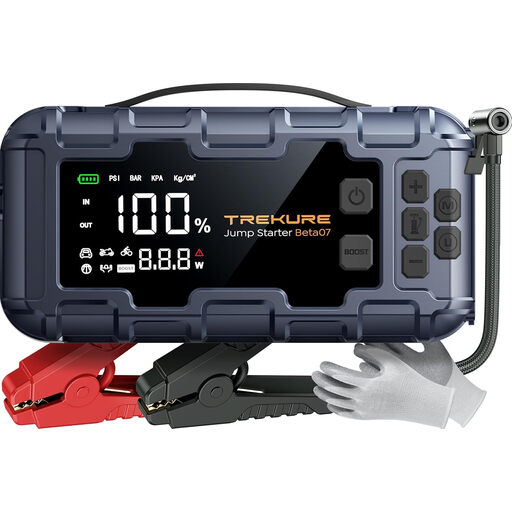
Why it stands out : Ideal for drivers of SUVs, RVs, or commercial vehicles with large-displacement engines. Its high power and efficient compressor make it a powerful ally for long trips and the most demanding situations.
Its stated compatibility with diesel engines up to 12 L proves that its power is more than just a marketing number. Its compressor, with a 45 L/min flow rate, avoids the sluggish inflator trap, and its 45W USB-C PD port ensures fast, versatile charging.
High starting power (6000 A) suitable for large engines. Fast compressor (160 PSI, 45 L/min). Smart 3.3-inch screen for clear and precise monitoring.
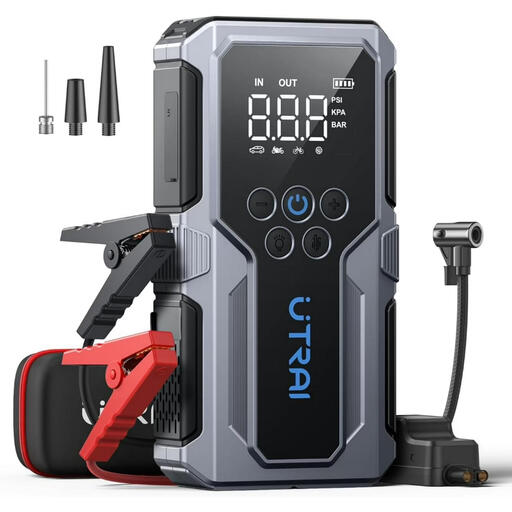
Why it stands out : Perfect for owners of city cars, sedans, or motorcycles. Its compact and lightweight design allows it to be easily stored in a glove box or backpack, offering a complete and discreet emergency solution.
It focuses on balance: its 3000 A power is clearly matched with reasonable engine sizes (up to 8.5L gas/6.5L diesel). The inclusion of Quick Charge USB and USB-C ports makes it a truly effective power bank for modern devices.
Compact and lightweight design (1.2 kg). High-capacity battery (15000 mAh) with fast-charging ports. LCD screen for precise control of the compressor's pressure.
We've put together a complete selection of products that check all the boxes in our guide and meet current safety standards.
Diesel engines require more power than gasoline engines due to their higher compression ratio. Instead of relying solely on peak current, trust the manufacturer's stated compatibility in terms of engine displacement (L). For a 2.0L diesel, a jump starter capable of starting diesel engines up to 6.0L or 7.0L will offer a comfortable safety margin, especially in winter.
Yes, these devices are designed to be stored in a vehicle. However, extreme temperatures (heatwaves in summer, frost in winter) can degrade the lithium-ion battery over the long term and reduce its performance. To preserve its lifespan, it's advisable to check its charge level every 3 to 6 months and recharge it if necessary.
No, they are two distinct tools. A jump starter provides a high current for a short period for an emergency jump-start. A standard 12V car battery charger, on the other hand, is used to slowly recharge a battery over several hours and maintain its charge. The jump starter is a one-time troubleshooting solution; the charger is a maintenance tool.