
Livraison le jour même ou le lendemain

Qualité garantie

Débloquez vos offres de bienvenue: Livraison GRATUITE | Jusqu'à -80 % | 30 jours d'essai gratuits à JoyPlus
Téléchargez l'application
An underinflated tyre at the worst possible moment, a dead battery on a cold winter morning... these situations are a nightmare for many drivers. The portable air compressor has become an essential accessory for greater self-sufficiency and peace of mind. However, the market is flooded with models making tempting promises that don't always hold up. To help you navigate the options, our editorial team has decoded the spec sheets to help you make the right choice.
Before you start shopping, here are the 3 most common pitfalls to avoid when buying a portable air compressor.
To avoid buyer's remorse, focus on the features that truly make a difference in everyday use.
As we've seen, pressure alone is meaningless. A good tyre inflator must first and foremost offer the right balance between pressure and flow.
Most recent models include a digital pressure gauge with an auto-shutoff feature: you set the desired pressure, and the device stops on its own. This is an incredibly convenient function to prevent any risk of over-inflation.
The choice of power source will depend on your habits and your need for freedom.
If you're drawn to a multi-function model, don't overlook the specs of the jump starter. The peak current (in Amps) indicates its starting power to revive an engine.
Here are a few options that cater to different user profiles, taking into account performance and reliability criteria.
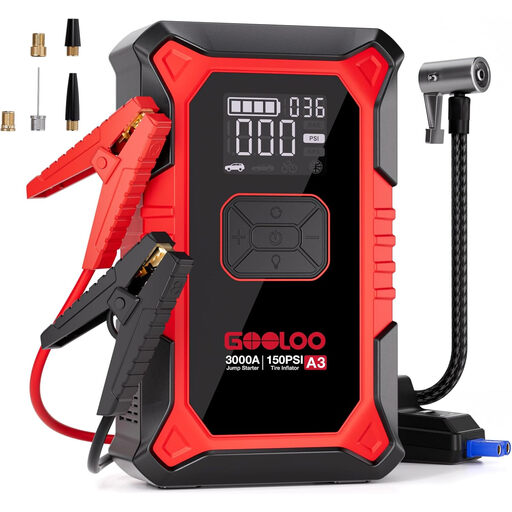
Why it's the right choice for this user: Perfect for those who want peace of mind with an all-in-one solution to keep in the glove compartment. It addresses the two most common breakdowns (flat tyre, dead battery), making it a true roadside survival kit.
It avoids the "mediocre Swiss Army knife" trap by delivering solid specs for its two main functions: a peak current of 3000 A, capable of starting large engines, and a generous airflow of 35 L/min for rapid inflation.
7-in-1 versatility (jump starter, compressor, power bank, LED light...). High starting power, compatible with petrol (9.0L) and diesel (6.5L) engines.
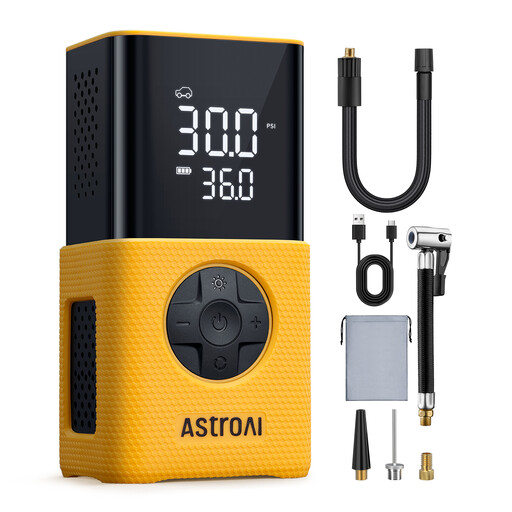
Why it's the right choice for this user: For cyclists, motorcyclists, and scooter riders, every gram counts. Ultra-compact and lightweight (460 g), this model slips into any backpack or saddlebag. It's peace of mind at your fingertips.
It doesn't try to do everything, but it does one thing perfectly: inflate. It avoids the misleading spec sheet trap by advertising a realistic airflow of 17 L/min, perfect for two-wheelers and topping up a car tyre.
Its feather-light and ultra-compact design. A 4000 mAh battery sufficient for several bike or motorbike tyre inflations. Its precise digital screen with preset modes.
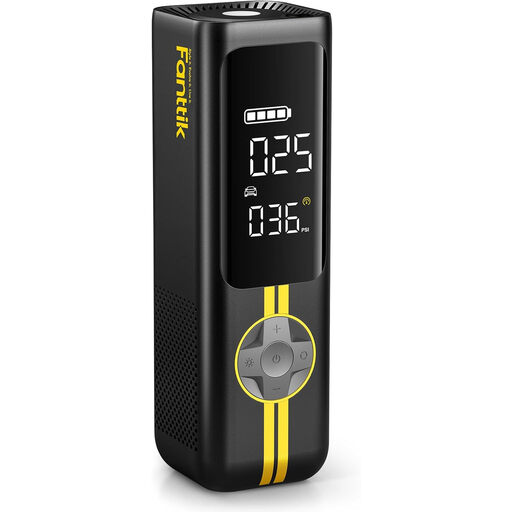
Why it's the right choice for this user: Designed for those who demand performance and endurance. Ideal for SUV owners or families with multiple vehicles, for whom inflation speed and the ability to handle multiple tyres in a row are non-negotiable criteria.
It tackles the two biggest weaknesses of entry-level compressors head-on: slowness and overheating. Its advanced cooling system allows it to run longer without a break, while its inflation speed makes it a powerful ally for large tyres.
Its above-average inflation speed. Its effective cooling system for prolonged use. Its long 46 cm hose, practical for reaching valves on large wheels.
Discover our full selection of products that meet our performance criteria and European safety standards.
It all depends on the health of its lithium-ion battery. To preserve it, a good practice is to recharge it every 3 to 6 months, even when not in use. Above all, avoid leaving it in a car in direct sunlight or extreme cold: extreme temperatures are the number one enemy of batteries and can damage them irreversibly. A well-maintained device will easily last you for many years.
The risk does exist. This is especially true if your car battery is already a few years old or if you need to reinflate several large tyres. To avoid this, the simple habit to adopt is to always start your car's engine before plugging in and using the compressor. This way, the alternator provides the power, without draining the battery's reserves.
Absolutely. The vast majority of portable compressors come with a set of nozzles, including the essential adapter for Presta valves (the thin valves on road bikes) in addition to Schrader valves (those on cars). You just need to use the "bicycle" mode or manually set the pressure, which is often high for this type of tyre (between 6 and 8?bars). The auto-shutoff function is your best ally here to achieve the perfect pressure without risking bursting the inner tube.