
Livraison le jour même ou le lendemain

Qualité garantie

Débloquez vos offres de bienvenue: Livraison GRATUITE | Jusqu'à -80 % | 30 jours d'essai gratuits à JoyPlus
Téléchargez l'application
A sponge might seem simple to choose. Yet not all surfaces tolerate the same level of scrubbing. A face that is too abrasive can leave marks on a ceramic hob, a non-stick pan or a shiny sink. On the other hand, a sponge that is too soft may hold onto grease and require more washing-up liquid.
Non-scratch scouring sponges offer an interesting compromise, provided you check their design and actual uses. Here are the criteria to examine before buying, along with a selection suited to different household profiles.
A green, grey or silver fibre alone cannot tell you whether a sponge is suitable for delicate surfaces. The mention “non-abrasive” or “non-scratch” should be accompanied by clearly stated uses from the manufacturer.
Even with a sponge advertised as scratch-resistant, grains of sand or hard residues trapped between the fibre and the surface can cause marks. Frequent rinsing and a test on an inconspicuous area are therefore strongly recommended.
A sponge presented as durable can quickly lose its shape if it stays damp, holds onto grease or is used on dirt it wasn’t designed for. The recommended replacement frequency, whether it can be washed, and its drying time matter just as much as its claimed durability.
A sponge designed for scrubbing pans is not necessarily suitable for glass or limescale in the bathroom. Similarly, an anti-limescale sponge intended for the bathroom may prove impractical for absorbing liquids in the kitchen. The choice should first depend on the surface and the type of dirt to be tackled.
For a sponge for delicate surfaces, look for a face described as non-scratch and intended for hobs, pans, glass or enamel surfaces. Soft fibres, non-scratch scouring particles and materials specially designed for gentle cleaning are preferable to metal pads.
The mention “non-scratch” does not, however, mean “compatible with all surfaces without care”. It is best to follow the instructions and carry out a test on a small area, especially when dealing with a shiny or treated surface.
A cellulose sponge made from plant fibres, such as cotton, wood pulp or flax, can absorb water and produce an effective lather with washing-up liquid. It is suitable for everyday cleaning of plates, worktops and splashes.
Also consider its thickness and how it feels in the hand. A size of around 10 cm is generally easy to handle for washing up, while a flexible model can more easily reach corners, taps and seals.
A machine-washable sponge or one that is dishwasher-safe can reduce replacements, provided you follow the temperature and instructions from the manufacturer. After each use:
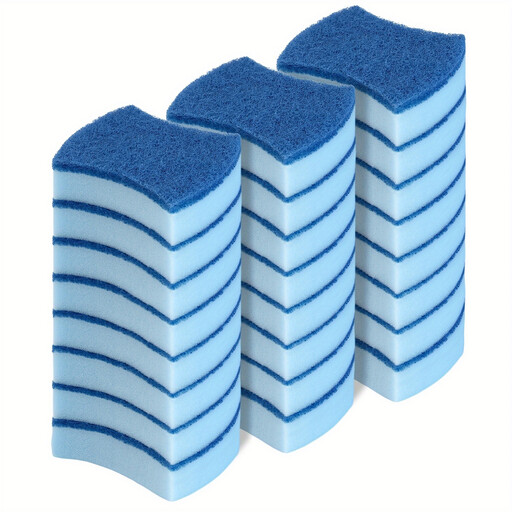
Why this choice suits this profile: This pack of 24 is ideal for households that want to build up a supply for the kitchen, bathroom and everyday cleaning, without having to buy multiple different types from the start.
Its two-sided design separates wiping from scrubbing action. It reduces the risk of using a surface that is too aggressive on glass or non-stick utensils, provided you carry out a test first.
Pack of 24 sponges, size 10.5 × 8.3 × 3 cm, with absorbent cellulose foam and a non-scratch scouring layer.
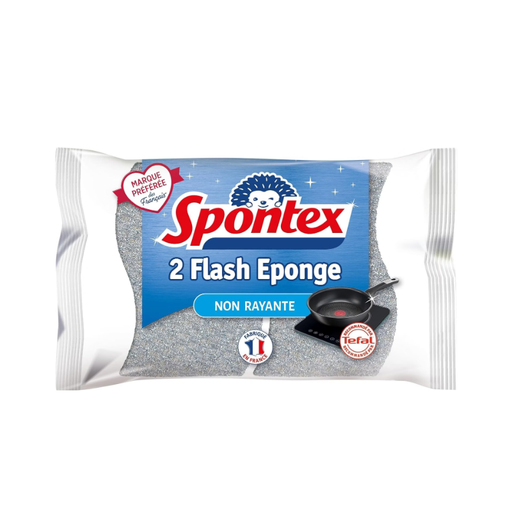
Why this choice suits this profile: This model is aimed at those who care about delicate finishes, but also want a versatile sponge for hobs, pans and dishes.
The scouring face is advertised as non-scratch and made from soft plastic fibres coated with aluminium. It is still essential to rinse the sponge and check its compatibility on an inconspicuous area.
Plant-based part made from cotton, wood pulp and flax, easy rinsing and machine washable at 40 °C.
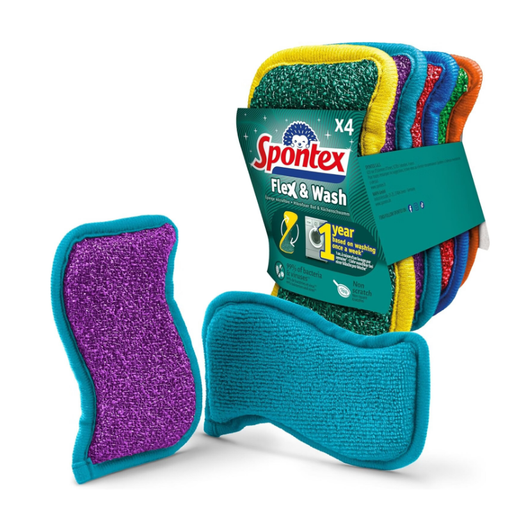
Why this choice suits this profile: Its reusable design is ideal for households that regularly clean several rooms and want to cut down on replacements.
Washing is claimed for up to 52 cycles, which provides a concrete benchmark rather than a simple promise of longevity. The scouring face must still be cleared of debris after each use.
Four pieces, flexible shape for hard-to-reach areas, microfibre face and non-scratch face. Machine washable or dishwasher safe according to the instructions provided.
We have put together a comprehensive list, updated in real time, of products that meet these demanding selection criteria and European safety regulations.
Some models are indicated for non-stick coatings, but this is not always the case. Check the instructions, use the recommended face and avoid pressing too hard. A test on a small area remains the best precaution.
The lifespan depends on use, rinsing and drying. Some products claim up to 52 washes, while others recommend replacement roughly every two months. The condition of the fibre and any odour are good indicators in everyday use.
An anti-limescale sponge for the bathroom with a non-scratch scouring face can be suitable for taps, shower screens, baths and basins. On glass or shiny surfaces, apply light pressure, rinse off any residue and dry with the appropriate face.