
Livraison le jour même ou le lendemain

Qualité garantie

Débloquez vos offres de bienvenue: Livraison GRATUITE | Jusqu'à -80 % | 30 jours d'essai gratuits à JoyPlus
Téléchargez l'application
A well-organised garage, cellar, or workshop is the key to a functional and safe workspace. Yet, choosing the right heavy-duty garage shelving can quickly become a headache. Between load capacities that seem too good to be true and materials that don't live up to their promises, a bad investment is just around the corner.
As a product expert at Joybuy, my mission is to help you see things more clearly. Let's cut through the marketing jargon and focus on the facts. Here are the 3 most common mistakes to avoid and the essential criteria for choosing a truly reliable and durable shelving unit.
To make an informed choice, closely examine the structural features of your future metal shelving unit. These are what will guarantee its longevity and your safety.
The frame is the skeleton of your garage shelving. Its sturdiness depends not only on the material (usually steel) but, more importantly, on its thickness and design.
Your storage needs change over time. A good modular shelving unit should be able to keep up.
This isn't an option; it's a must. For any heavy-duty shelf, securing it to the wall is a non-negotiable safety measure. Make sure the product comes with an anti-tip kit. It prevents any risk of the unit falling over if it's accidentally bumped or if a child tries to climb it.
Rather than a random list, we've matched user profiles with concrete solutions that meet specific needs.
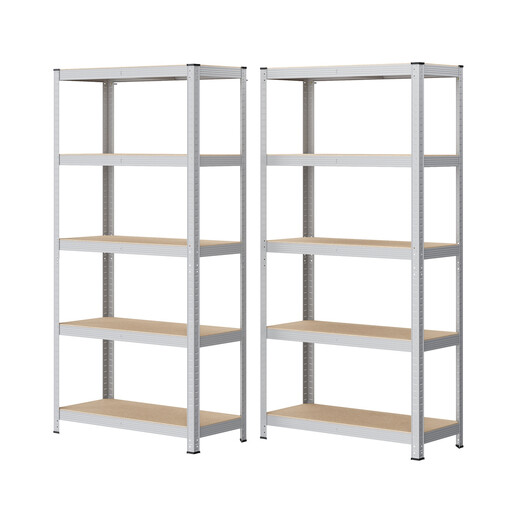
Why we chose it: This set of two offers excellent storage volume for a great price. Perfect for decluttering a garage or cellar by storing boxes, gardening equipment, or archives. Their modularity allows them to be used separately or side-by-side.
The steel structure and 175 kg capacity per shelf (making it a heavy-duty 875 kg shelf in total) are supported by a reinforced design. The anti-tip kit is included for a completely safe installation.
An unbeatable volume-to-price ratio. The ability to split each unit into two separate workbenches provides maximum flexibility for your layout.
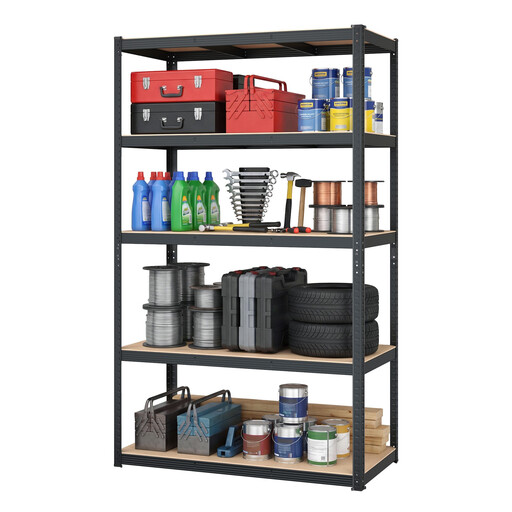
Why we chose it: For those who handle heavy tools, mechanical parts, or stocks of materials. Its generous dimensions (120 cm wide, 60 cm deep) and reinforced structure are built for significant loads and bulky items.
Here, the load capacity is ensured by support crossbars under each shelf, which prevents any sagging. The click-in system is designed for maximum rigidity, which is essential in a workshop.
Its large 60 cm depth offers a much greater storage area than average, ideal for tool chests, compressors, or even tyres.
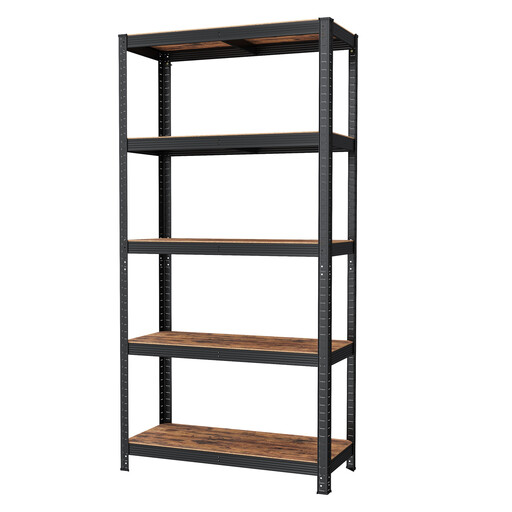
Why we chose it: For those who want to combine sturdiness with style. Perfect for a visible workshop, a pantry, or an immaculate garage, it offers the same load capacity in a more refined finish that blends harmoniously into a well-kept environment.
This model doesn't sacrifice sturdiness for style. The black powder-coated steel frame and 875 kg capacity are identical to purely utilitarian models. Be aware, however: the MDF boards, even with their stylish finish, must be used in a dry environment.
The two-tone rustic brown and black finish adds a touch of industrial style that transforms a simple storage unit into a true piece of functional decor.
We have selected a full range of products that meet our criteria for sturdiness and safety.
Is it absolutely necessary to fix a heavy-duty shelf to the wall? Yes, and it's non-negotiable. Even if the shelf seems stable when empty, its centre of gravity shifts once it's loaded. Securing it to the wall with the provided anti-tip kit is your best insurance against any risk of it tipping over. It's a guarantee of safety for your family and your equipment.
How can I protect MDF shelves from moisture in a cellar? If your cellar or garage is damp, a few precautions are necessary. Applying a water-repellent varnish or a paint designed for damp rooms to the MDF shelves before assembly will create an effective protective barrier. Also, consider properly ventilating the room: it's a worthwhile long-term solution.
What is the difference between static load and dynamic load? The static load is the maximum weight a shelf can support when the load is stationary and perfectly distributed (this is the official figure). The dynamic load, on the other hand, refers to the ability to support a weight in motion (for example, when you slide a heavy box). It is always lower than the static load. For everyday use, assume that the real-world load capacity is around 70-80% of the advertised maximum static load.