
Livraison le jour même ou le lendemain

Qualité garantie

Débloquez vos offres de bienvenue: Livraison GRATUITE | Jusqu'à -80 % | 30 jours d'essai gratuits à JoyPlus
Téléchargez l'application
A cluttered garage does not necessarily lack space: it often lacks storage suited to the weight, size and frequency of use of your belongings. Metal storage shelving can hold tools, boxes, paint tins or seasonal equipment, but not every model is designed for the same demands.
Before you buy, three common pitfalls are worth avoiding.
When looking for garage shelving capable of supporting heavy loads, check that a separate capacity is stated for each shelf. The term ‘static load’ refers to a stationary weight placed under normal conditions of use. It should not be confused with a dynamic load, such as a heavy object being placed down abruptly or shelving being moved while fully loaded.
Place the heaviest items on the lower levels: toolboxes, sealed containers or bags of building materials. Lighter items can be stored higher up. Also make sure that the floor can support the combined weight of the shelving unit and its contents.
Measure the available area carefully, taking skirting boards, pipes, sockets and the space needed to move around into account. A depth of 40 to 50 cm will generally suit storage boxes and bulky equipment, but a narrow cellar may require a shallower model.
Adjustable storage shelving allows you to adapt the shelf height to the items being stored. Some models offer adjustment in 5 cm increments, while others use a slot-together design. Five-tier shelving is versatile, provided that the spacing between the shelves genuinely suits your requirements.
Painted or galvanised steel is particularly suitable for garages, cellars and workshops. Reinforcing bars, adjustable feet and anti-tip bars all help to stabilise the unit. However, they do not replace wall fixing where this is recommended.
Boltless or tool-free shelving can speed up assembly thanks to its slot-together design. You should still follow the instructions, wear gloves during assembly and check that every level is properly aligned. Modular shelving that can be split into two units also offers greater flexibility in a workshop or shared space.
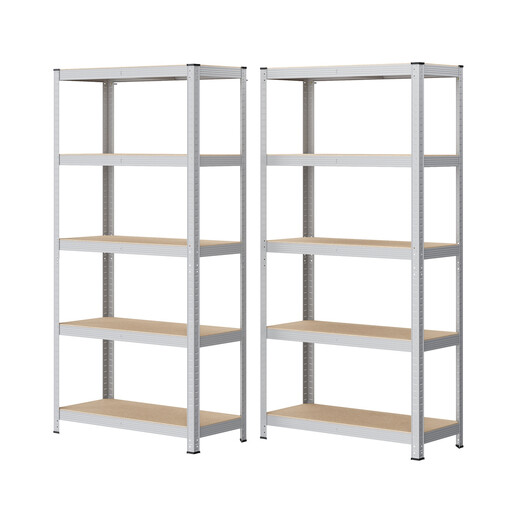
Why this choice suits this profile : This two-unit set lets you organise a garage, cellar or utility room separately, without having to buy two different shelving systems.
The product details state a static capacity of 175 kg per level and 875 kg in total for the set, with two anti-tip kits included. Loads must still be distributed evenly.
Dimensions of each unit : 40 × 90 × 180 cm. Adjustable shelves, slot-together assembly and the option to separate the set into two modules.
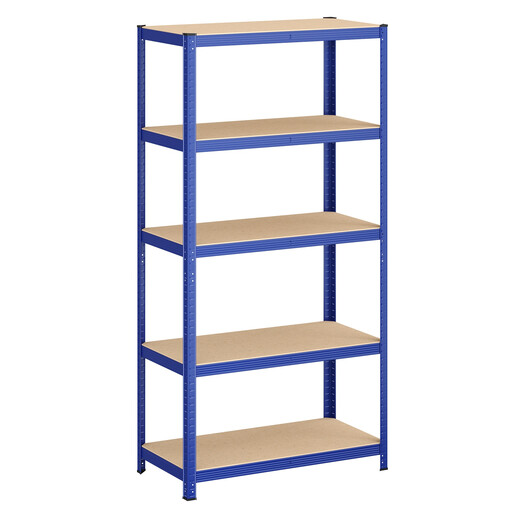
Why this choice suits this profile : At 200 cm high and 100 cm wide, it is ideal for anyone looking to make maximum use of the height of a garage, workshop or storage room.
The manufacturer states a maximum capacity of 120 kg per shelf and 600 kg in total. Adjustment in 5 cm increments minimises wasted space between items.
Galvanised steel, advertised tool-free assembly, option to split into two units and anti-tip kit included.
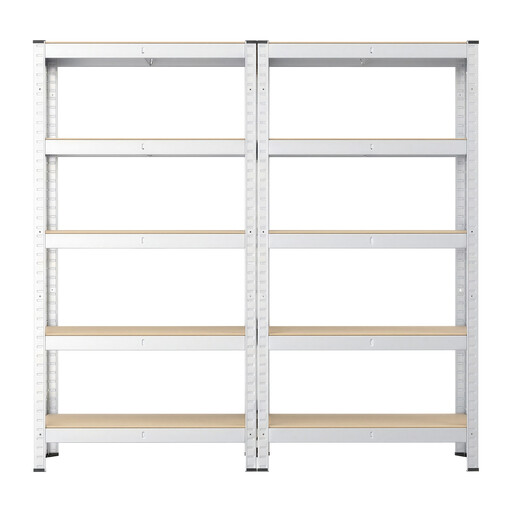
Why this choice suits this profile : With a depth of 30 cm and a height of 150 cm per unit, this metal shelving is easier to fit into a cellar or narrow utility room.
The stated capacity reaches 130 kg per level and 650 kg in total for both units. This limit must be respected, with the load evenly distributed and the shelving anchored to the wall.
Two units measuring 30 × 75 × 150 cm, five adjustable shelves and a powder-coated painted steel frame.
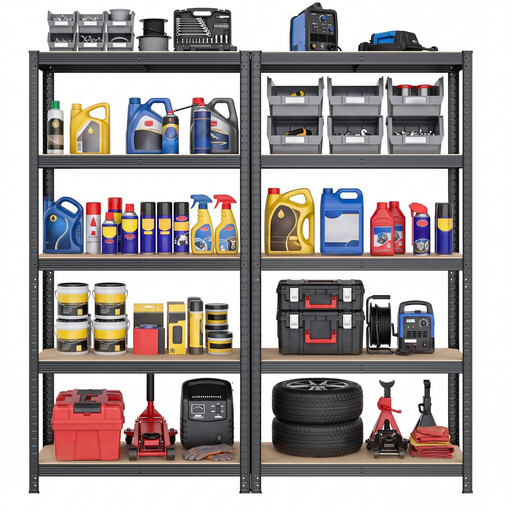
Why this choice suits this profile : This solution is suitable for a workshop, a heavily loaded garage or a small stockroom that requires several storage areas.
The stated specifications distinguish between 175 kg per level and 875 kg for the set. The reinforced bars and anti-tip kits are suited to the demands of heavily loaded storage.
Two units measuring 40 × 90 × 180 cm, five adjustable levels, steel frame and slot-together assembly.
We have put together a comprehensive, real-time updated list of products that meet these demanding selection criteria and European safety standards.
Before assembly, check that the floor is level and make sure there is enough space to walk around the unit. For tall shelving, always use the supplied anti-tip kit when recommended in the instructions. Also check that the wall is suitable for the type of fixing being used.
Avoid damp environments if the product information does not specify suitable protection. In an uninsulated garage, wipe away any condensation promptly and check the connection points regularly. For painted or galvanised surfaces, cleaning with a slightly damp cloth will generally be sufficient.
It depends on the model, the type of shelf and how the weight is distributed. The figures stated in product details generally refer to a maximum static load. Always check the limit per level: it may differ considerably from the total capacity.
Boltless or tool-free assembly can provide a stable unit when the components are properly slotted together, the structure is standing on a level floor and the load is evenly distributed. For tall or heavily loaded shelving, wall fixing remains an important precaution when specified by the manufacturer.
Observe the stated load limit, place heavy items at the bottom, avoid impacts and inspect the shelves, uprights and fittings regularly. In a cellar or garden shed, minimise exposure to moisture and do not allow water to collect on the panels.