
Livraison le jour même ou le lendemain

Qualité garantie

Débloquez vos offres de bienvenue: Livraison GRATUITE | Jusqu'à -80 % | 30 jours d'essai gratuits à JoyPlus
Téléchargez l'application
The key to a well-organised garage, cellar, or workshop? A reliable storage solution. However, the market for heavy-duty shelving is a minefield where marketing promises don't always hold up. As a product specialist at Joybuy, my mission is to guide you toward a safe and durable purchase by helping you avoid the most common pitfalls.
Before you make a decision, learn to decode the marketing claims that often hide design flaws. Here are the three essential pitfalls to be aware of.
Many manufacturers advertise an impressive total load capacity (e.g., 800?kg). The catch? This overall figure is meaningless if each individual shelf can only support 80?kg. For storing dense, heavy items like tool chests, engine parts, or stacks of archives, the load capacity per shelf is the only metric that matters. A low-quality shelf unit will quickly buckle under an unevenly distributed load.
A tall, heavily loaded metal shelving unit becomes a real hazard if its structure lacks stability. Entry-level models often skimp on crucial reinforcements, such as crossbars under the shelves or sufficient steel thickness. The absence of an anti-tip kit (to secure the unit to the wall) is a major red flag: never overlook it, especially if children are nearby or in a professional setting.
Cellar or garage shelving is, by definition, exposed to moisture. Poor-quality steel or a simple coat of cheap paint means rust is guaranteed within a few months. The same goes for medium-density fibreboard (MDF) shelves, which are prone to warping at the first sign of moisture. A quality surface treatment (galvanized steel or epoxy powder coating) isn't an option—it's a prerequisite for the longevity of your garage shelving.
To make the right choice, focus on these three key indicators. They are what distinguish a simple shelf from a truly robust storage solution.
This is the non-negotiable criterion. For standard use in a garage or workshop, aim for a minimum of 100 to 120?kg per shelf. For more intensive needs (storing mechanical parts, heavy equipment), a capacity of 150 to 175?kg or more per level is a prerequisite. This information must be clearly stated by the manufacturer: if it isn't, be wary.
The frame must be made of steel. Pay close attention to its surface treatment:
The shelves are most often made of MDF (medium-density fibreboard). Check their thickness: a minimum of 8?mm is required to prevent them from sagging under the load.
A good shelving unit should adapt to your needs, not the other way around. Opt for a modular shelving unit with height-adjustable shelves. Tool-free assembly is another major advantage. Clip-in or interlocking systems allow for quick and surprisingly sturdy assembly without any screws or bolts. Installation becomes a breeze. The icing on the cake: some models can be split into two lower workbenches, offering highly valuable versatility.
Here is a selection of models that check all the boxes, suited for different needs.
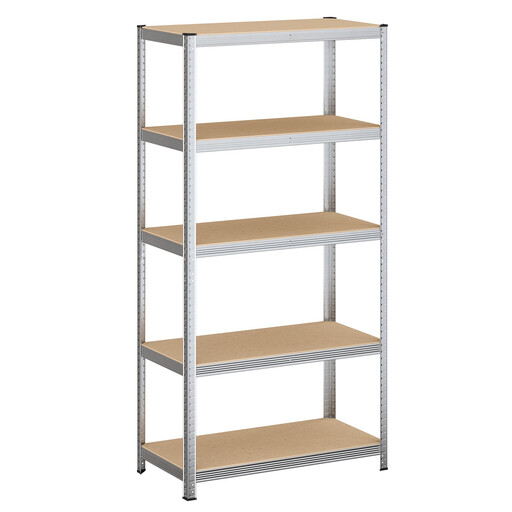
Why we recommend it: Perfect for those who want a reliable and versatile solution to organise a garage or laundry room without the hassle. It's the ideal starting point for finally getting things in order.
With its 120 kg capacity per shelf, it provides clear, suitable strength for storing tools, archive boxes, or supplies. Goodbye to sagging shelves.
Its tool-free assembly system and its ability to be converted into two separate workbenches make it an ultra-practical model that's adaptable to any space.
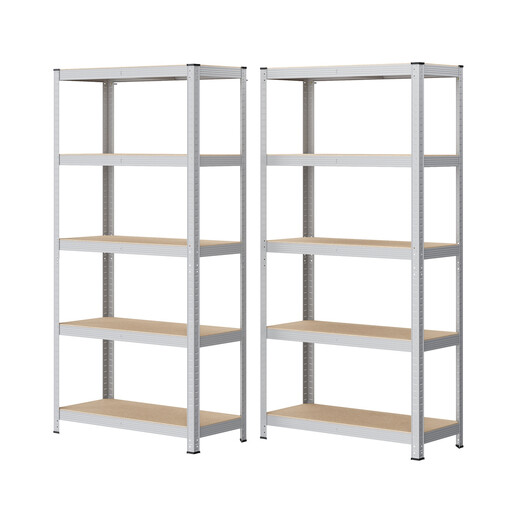
Why we recommend it: Designed for artisans, demanding DIYers, or for storing truly heavy equipment. Its exceptional load capacity per shelf makes it a first-rate solution for a workshop or small warehouse.
At 175 kg per shelf, it's in a different league than standard models. It's built to handle heavy, concentrated loads without buckling.
Offered as a set of two, it delivers unbeatable value for money for outfitting an entire space. The included anti-tip kit is an added guarantee of safety.
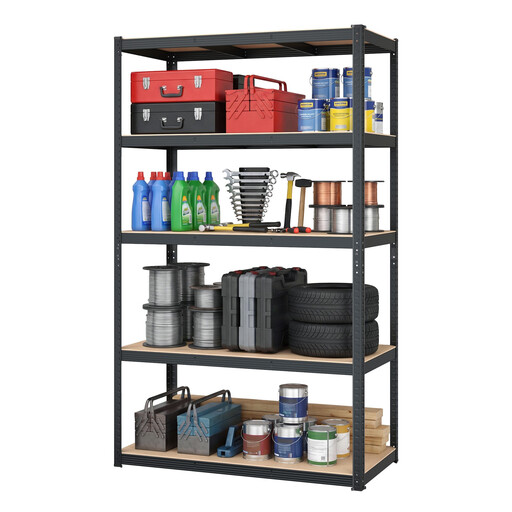
Why we recommend it: Its XXL dimensions (120 cm wide and 60 cm deep) offer substantial storage volume, ideal for bulky items like tyres, travel trunks, or large gardening equipment.
It combines a large format with foolproof robustness: 150 kg per shelf and central reinforcements that prevent any sagging, even over a 120 cm span.
Its 60 cm depth is a game-changer for storing large boxes or equipment that never fit on standard 30 or 40 cm shelves.
Discover our complete selection of products that meet our strictest quality and safety criteria.
Yes, it's more than recommended—it's essential. Most quality models include an anti-tip kit. Even if the unit seems stable when empty, its centre of gravity shifts dangerously once it's loaded up high. Wall mounting is a simple and indispensable safety measure to prevent any risk of tipping over.
For cellar shelving or any other damp location, choose galvanized steel or an epoxy coating. Avoid placing wet items directly on the MDF shelves and wipe up any spills immediately. A simple wipe with a dry cloth from time to time will be enough to keep it in perfect condition.
Absolutely. Modern interlocking systems are designed to be both intuitive and extremely robust. The different components (uprights, crossbars) clip into one another. A rubber mallet (often included) is the ideal tool to properly fit the parts together and ensure perfect rigidity. In the end, the structure is just as sturdy, if not more so, than a traditional screw-in model.