
Livraison le jour même ou le lendemain

Qualité garantie

Débloquez vos offres de bienvenue: Livraison GRATUITE | Jusqu'à -80 % | 30 jours d'essai gratuits à JoyPlus
Téléchargez l'application
An overflowing garage, a poorly organised basement, a workshop with tools piling up… It's an all-too-familiar scenario. The solution? A heavy-duty storage shelf, of course. But finding the right model can often feel like an uphill battle. Between unkept promises of sturdiness and misleading technical specs, a purchase can quickly lead to disappointment, or even danger. To avoid ending up with a wobbly shelf, here’s how to navigate the most common traps.
Here are the three classic mistakes you must not make:
To make the right choice, cut through the marketing jargon and focus on the facts. Here are the three points to inspect closely.
Forget total capacity; it's a misleading gimmick. The number that counts is the maximum load each individual shelf can support. This tells you whether you can place your toolboxes, paint cans, or archive boxes on it without watching everything come crashing down. For basement or garage storage, aim for a capacity of 100 kg to 175 kg per level: it's a solid and safe foundation.
The frame also plays a key role. A metal shelf made of galvanised or powder-coated steel will resist rust much better—a crucial detail in a damp basement or garage. As for the decks, they are often made of MDF (fibreboard), a good, budget-friendly, and sturdy compromise, but be warned: it does not handle long-term exposure to moisture well.
On this point, no compromises are acceptable. A shelf worthy of the name must include:
Your storage needs evolve, and your shelving should too. A modular shelf is a real asset. Check that the shelf height is adjustable, often in increments of a few centimetres. The best of the best? Models that can be split in two to form two low workbenches instead of a single tall column. This versatility will allow you to optimise your space and adapt your storage unit as your projects evolve.
To put theory into practice, here are three models that check all the right boxes, each suited to a different type of user.
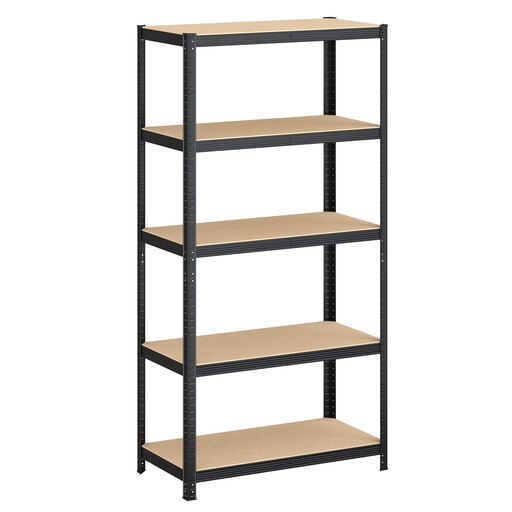
Why we love it: Perfect for those who want a simple and versatile solution for their garage or utility room. It strikes the right balance between load capacity, dimensions, and ease of assembly for standard home use.
The capacity is clearly stated as 120 kg per shelf: an honest figure that's more than enough for everyday use. The screwless assembly and included anti-tip kit save you from any nasty surprises.
Its modularity. You can assemble it as a tall column or split it into two low workbenches. It's ultra-practical for setting up a workshop corner or adapting to low ceilings.
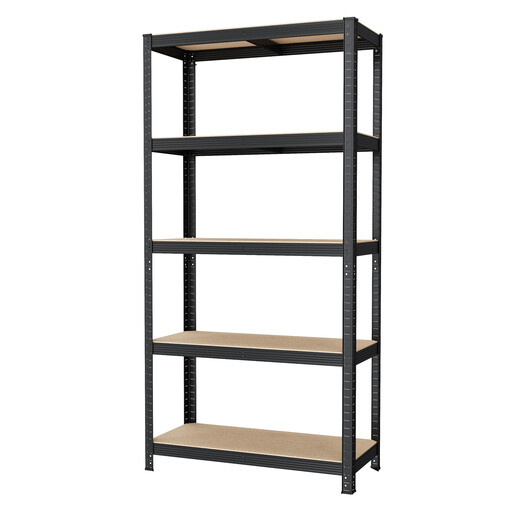
Why we love it: Designed for pros and seasoned DIYers who store heavy equipment. This is the model of choice for a workshop, warehouse, or garage that demands maximum load capacity and unwavering robustness.
Here, we step up to 175 kg per shelf. You can store heavy items without the slightest fear of the decks sagging. The reinforced steel frame and safety kit live up to the promise.
Its XXL load capacity makes it a long-lasting investment for intensive use. Despite its robustness, the interlocking assembly system remains child's play.
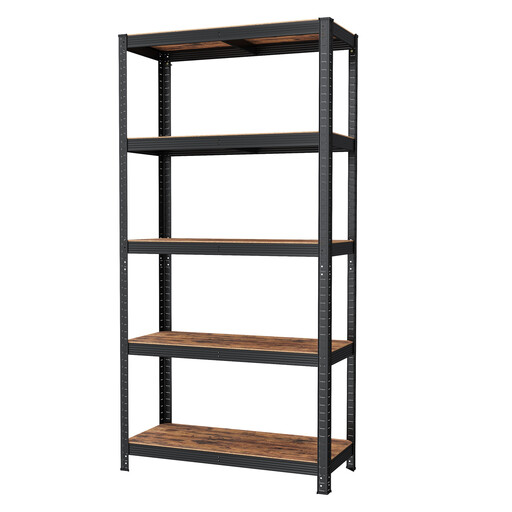
Why we love it: For those who want strength without sacrificing style. Perfect for integrating a heavy-duty storage solution into a living room or office, this industrial bookcase blends the raw aesthetic of metal with the warmth of wood.
The stylish look doesn't come at the expense of strength. It boasts the same 175 kg per shelf capacity and a steel frame, but with a "rustic wood" finish that allows it to fit in anywhere in the house.
It's a true chameleon: it combines near-professional strength with a polished design. It's just as relevant in a garage as it is in a living room for displaying books and decorative objects.
Take a look at our full selection of products that meet our quality and safety criteria.
Three golden rules for unwavering stability. First, always use the provided wall-mounting kit. Second, check that your floor is level (if not, a model with adjustable feet is essential). Finally, distribute the load intelligently: always place the heaviest items on the bottom.
It's primarily a matter of looks and trade-offs. The garage shelf is straight to the point: maximum load and rust resistance, with raw materials like steel and MDF. The industrial bookcase, on the other hand, is designed to be seen. It retains a very strong metal frame but dresses it up with more decorative finishes (wood-effect decks, trendy colours) to blend into a living room or office.
Yes, and it's surprisingly sturdy. Modern interlocking systems are precisely engineered so that the parts fit together perfectly. Once the shelf is loaded, the weight itself helps to consolidate the structure. It's often faster and far less frustrating than assembly with screws, for equivalent sturdiness. One piece of advice: wear protective gloves during assembly to avoid small cuts.